


Factors Associated With the Acceleration of Patient Enrollment in Clinical Studies: A Cross-Sectional Study
- PMID: 34776970
- PMCID: PMC8580154
- DOI: 10.3389/fphar.2021.753067
Factors Associated With the Acceleration of Patient Enrollment in Clinical Studies: A Cross-Sectional Study
Abstract
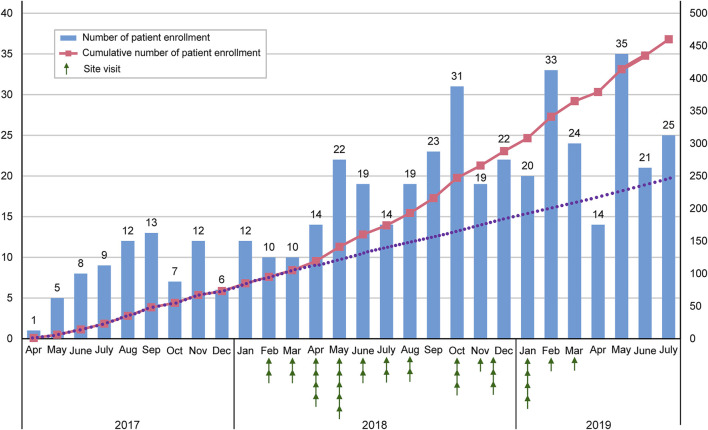
Under-recruitment in clinical trials is an issue worldwide. If the number of patients enrolled is lower than expected, based on the required sample size, then the reliability of the study results and their validation tend to be impaired. The current study therefore evaluated factors associated with accelerating patient enrollment using data from an ongoing multicenter prospective cohort study. The researchers encouraged research institutions to accelerate patient enrollment via e-mail, newsletters, telephone calls, and site visits. We analyzed the relationship between several potential factors associated with acceleration of patient enrollment including site visits and patient enrollment in a real clinical study. Data were collected from 106 research institutions that participated in a multicenter prospective cohort study. Results showed that the following parameters differed in terms of patient enrollment and non-enrollment: urban area (47.2 vs. 67.6%, p = 0.04), clinical research coordinator (CRC) participation in data input to electronic data capture (EDC) (41.7 vs. 11.8%, p < 0.01), and site visit (38.9 vs. 11.8%, p < 0.01). A multivariate analysis revealed that patient enrollment was significantly associated with urban area (odds ratio [OR] 0.33, 95% confidence interval [CI] 0.12-0.86, p = 0.02), CRC participation in data input to EDC (OR 5.02; 95% CI 1.49-16.8; p < 0.01), and site visit (OR 4.54, 95% CI 1.31-15.7, p = 0.01). In conclusion, site visits and CRC participation in data input to EDC had a significant effect on patient enrollment promotion. Moreover, hospitals in rural areas were more effective in promoting patient enrollment than those in urban areas.
Keywords: Japan; clinical research; clinical research coordinator; clinical research support; patient enrollment; site visit.
Copyright © 2021 Ueda, Nishizaki, Nojiri, Iwata, Miyauchi, Matsuyama, Sanada, Minamino and Daida.
Conflict of interest statement
RU, YN, SN, KM, TM and SS report no conflicts of interest. HI received research grants from Mitsubishi Tanabe Pharma Corp., Kowa Pharmaceuticals Co., Ltd., and Novo Nordisc and honoraria from Bayer Yakuhin, Ltd., Daiichi Sankyo Co., Ltd., Takeda Pharmaceutical Co. Ltd., MSD KK, Kowa Pharmaceuticals Co., Ltd., and Mitsubishi Tanabe Pharma Corp. KM received honoraria from Sanofi, Daiichi-Sankyo, Bayer Health Care, Bristol Myers Squibb, and MSD. HD received grants from Canon Medical Systems Corporation, Philips Japan, Ltd., Toho Holdings Co., Ltd., Asahi Kasei Corporation, and Inter Reha Co., Ltd.; scholarship grants from Nippon Boehringer Ingelheim Co., Ltd., Otsuka Pharmaceutical Co., Ltd., Sanofi K.K., MSD K.K., Daiichi-Sankyo Company, Limited, Pfizer Co., Ltd., Mitsubishi Tanabe Pharma Corp., Astellas Pharma Inc., Takeda Pharmaceutical Co., Ltd., Teijin Pharma Ltd., Shionogi and Co., Ltd., Actelion Pharmaceuticals Ltd., Actelion Ltd., Kowa Pharmaceutical Company Ltd., and Bayer Yakuhin, Ltd.; and lecture fees from Amgen Inc., Daiichi-Sankyo Company, Limited, Kowa Pharmaceutical Company Ltd., and MSD K.K.
Figures
References
LinkOut - more resources
Full Text Sources
