Review
. 2021 Oct 28:12:720867.
doi: 10.3389/fpls.2021.720867. eCollection 2021.

Lipid Peroxide-Derived Reactive Carbonyl Species as Mediators of Oxidative Stress and Signaling

Affiliations
Review

Lipid Peroxide-Derived Reactive Carbonyl Species as Mediators of Oxidative Stress and Signaling

Md Sanaullah Biswas et al. Front Plant Sci. .

Abstract

Oxidation of membrane lipids by reactive oxygen species (ROS) or O2/lipoxygenase leads to the formation of various bioactive compounds collectively called oxylipins. Reactive carbonyl species (RCS) are a group of oxylipins that have the α,β-unsaturated carbonyl structure, including acrolein and 4-hydroxy-(E)-2-nonenal. RCS provides a missing link between ROS stimuli and cellular responses in plants via their electrophilic modification of proteins. The physiological significance of RCS in plants has been established based on the observations that the RCS-scavenging enzymes that are overexpressed in plants or the RCS-scavenging chemicals added to plants suppress the plants' responses to ROS, i.e., photoinhibition, aluminum-induced root damage, programmed cell death (PCD), senescence, abscisic acid-induced stomata closure, and auxin-induced lateral root formation. The functions of RCS are thus a key to ROS- and redox-signaling in plants. The chemical species involved in distinct RCS signaling/damaging phenomena were recently revealed, based on comprehensive carbonyl determinations. This review presents an overview of the current status of research regarding RCS signaling functions in plants and discusses present challenges for gaining a more complete understanding of the signaling mechanisms.

Keywords: environmental stress responses; plant hormone signaling; reactive electrophile species; reactive oxygen species; redox signaling.


Conflict of interest statement

The authors declare that the research was conducted in the absence of any commercial or financial relationships that could be construed as a potential conflict of interest.

Figures
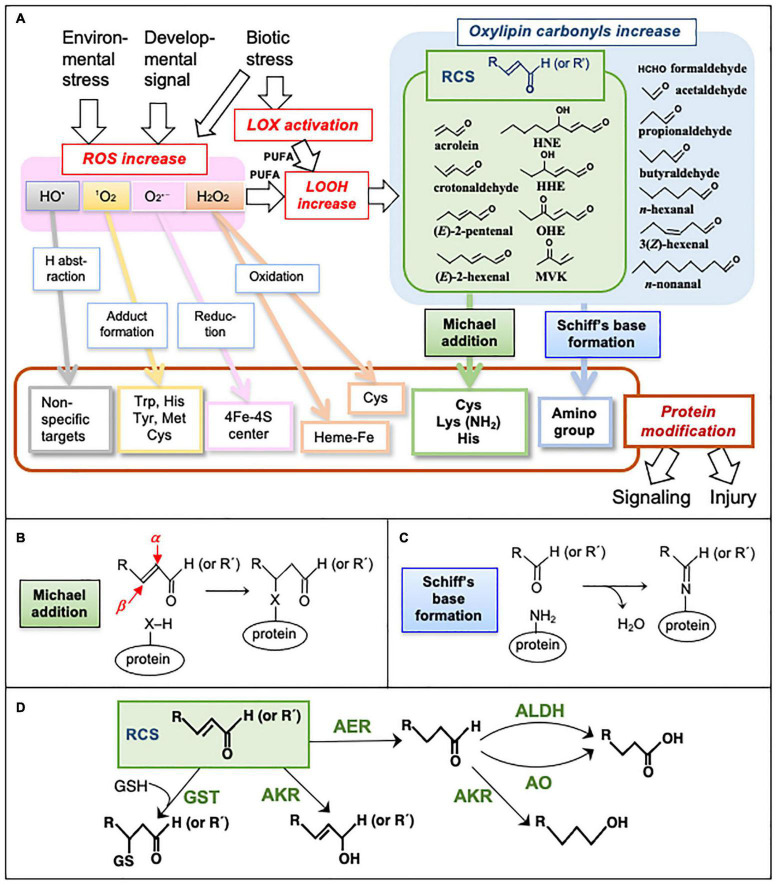
FIGURE 1
FIGURE 1
Metabolism and reactions of oxylipin carbonyls. (A) Formation of ROS and oxylipin carbonyls and their actions causing signaling and injury via protein modification. HO is highly reactive and non-specifically oxidizes almost all biomolecules. 1O2 is also highly reactive, and it prefers adduct formation on a double bond and a sulfur atom. O2•–, a relatively less reactive ROS, can reductively destroy the 4Fe-4S center in some enzymes such as aconitase (Halliwell and Gutteridge, 2015). H2O2 is also less reactive and may oxidize the Fe atom in the heme proteins such as ascorbate peroxidase or guaiacol peroxidase to inactivate them (Miyake and Asada, 1996). Oxylipin carbonyls and RCS, produced via the oxidation of PUFA by ROS, react with proteins in different manners from ROS. (B) Formation of the Michael adduct on a protein. The α- and β-carbons in an RCS molecule are indicated by red arrows. X, a nucleophilic atom. (C) Schiff’s base formation on a protein. (D) Enzymes to scavenge carbonyls and RCS in plants. AER, 2-alkenal reductase; AKR, aldo-keto reductase; ALDH, aldehyde dehydrogenase; AO, aldehyde oxidase; GST, glutathione transferase.

References

    1. Aldini G., Delle-Done I., Facino R. M., Mizani A., Carini M. (2007). Intervention strategies to inhibit protein carbonylation by lipoxydation-derived reactive carbonyls. Med. Res. Rev. 27 817–868. 10.1002/med.20073 - DOI - PubMed
    1. Alméras E., Stolz S., Vollenweider S., Reymond P., Mène-Saffrané L., Farmer E. E. (2003). Reactive electrophile species activate defense gene expression in Arabidopsis. Plant J. 34 205–216. 10.1046/j.1365-313x.2003.01718.x - DOI - PubMed
    1. Armed N., Dobler D., Dean M., Thronalley P. J. (2005). Peptide mapping identifies hotspot site of modification in human serum albumin by methylglyoxal involved in ligand binding and esterase activity. J. Biol. Chem. 280 5724–5732. 10.1074/jbc.M410973200 - DOI - PubMed
    1. Aroca A., Gotor C., Romero L. C. (2018). Hydrogen sulfide signaling in plants: emerging roles of protein persulfidation. Front. Plant Sci. 9:1369. 10.3389/fpls.2018.01369 - DOI - PMC - PubMed
    1. Asada K. (2006). Production and scavenging of reactive oxygen species in chloroplasts and their functions. Plant Physiol. 141 391–396. 10.1104/pp.106.082040 - DOI - PMC - PubMed

LinkOut - more resources
