Review
. 2021 Oct 28:11:758512.
doi: 10.3389/fonc.2021.758512. eCollection 2021.

Haploidentical Stem Cell Transplantation for Acute Myeloid Leukemia: Current Therapies, Challenges and Future Prospective

Affiliations
Review

Haploidentical Stem Cell Transplantation for Acute Myeloid Leukemia: Current Therapies, Challenges and Future Prospective

Ying-Jun Chang et al. Front Oncol. .

Abstract

Haploidentical stem cell transplantation (haplo-SCT), an alternative donor source, offers a curative therapy for patients with acute myeloid leukemia (AML) who are transplant candidates. Advances in transplantation techniques, such as donor selection, conditioning regimen modification, and graft-versus-host disease prophylaxis, have successfully improved the outcomes of AML patients receiving haplo-SCT and extended the haploidentical transplant indictions for AML. Presently, treating de novo AML, secondary AML, therapy-related AML and refractory and relapsed AML with haplo-SCT can achieve comparable outcomes to those of human leukocyte antigen (HLA)-matched sibling donor transplantation (MSDT), unrelated donor transplantation or umbilical cord blood transplantation. For some subgroups of AML subjects, such as patients with positive pretransplantation minimal/measurable residual disease, recent studies suggest that haplo-SCT might be superior to MSDT in decreasing relapse and improving survival. Unfortunately, for patients with AML after haplo-SCT, relapse and infections remain the causes of death that restrict further improvement in clinical outcomes. In this review, we discuss the recent advances and challenges in haplo-SCT for AML treatment, mainly focusing on unmanipulated haplo-SCT protocols. We provide an outlook on future prospects and suggest that relapse prophylaxis, intervention, and treatment, as well as infection prevention and therapy, are areas of active research in AML patients who receive haploidentical allografts.

Keywords: acute myeloid leukemia; graft-versus-leukemia-effect; haploidentical stem cell transplantation; infection; relapse.


Conflict of interest statement

The authors declare that the research was conducted in the absence of any commercial or financial relationships that could be construed as a potential conflict of interest.

Figures
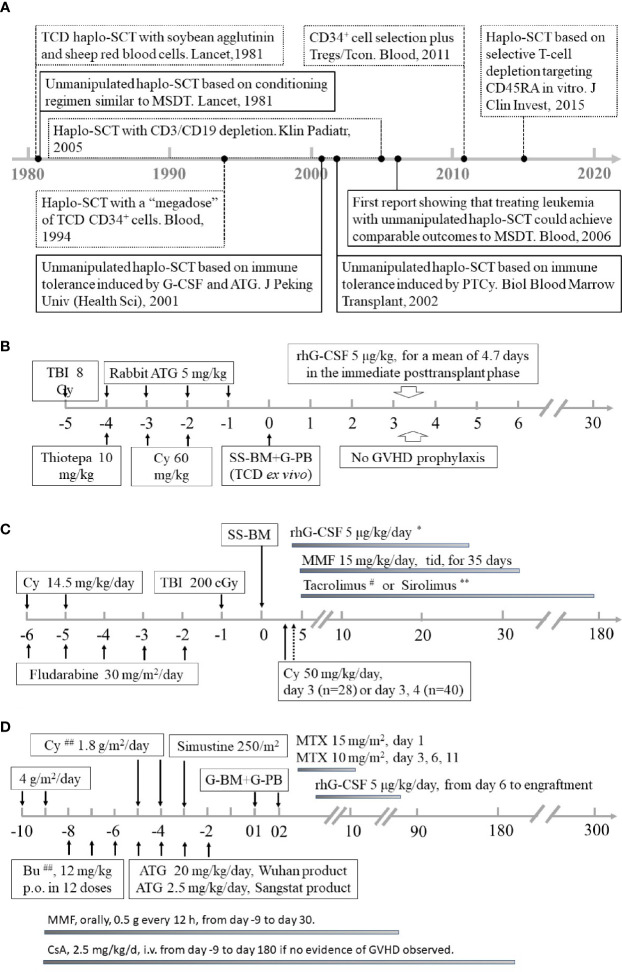
Figure 1
Figure 1
Summary of historical perspective and conditioning regimens of different haploidentical stem cell transplantation modalities for AML. (A) The historical perspective of haplo-SCT for AML. (B) University of Perugia: myeloablative conditioning and ex vivo TCD with “megadose” CD34+ cell allografts. (C) Peking University: myeloablative conditioning based on immune tolerance induced by G-CSF and ATG. (D) Johns Hopkins University: nonmyeloablative conditioning with high-dose PT/Cy. Panels (B–D) were adapted from Aversa et al. (Blood, 1994), Luznik et al. and Cieri et al. (Biol Blood Marrow Transplant,2008; Biol Blood Marrow Transplant,2015), and Huang et al. (Bone Marrow Transplant,2006), respectively. AML, acute myeloid leukemia; Haplo-SCT, haploidentical stem cell transplantation; Tregs, regulatory T cells; Tcon, conventional T cells; MSDT, human leukocyte antigen (HLA)-matched sibling donor transplantation; G-CSF, granulocyte colony-stimulating factor; ATG, anti-thymocyte globulin; PTCy, posttransplantation cyclophosphamide; TBI, Total body irradiation; SS-BM, steady-state bone marrow; G-PB, G-CSF mobilized peripheral stem cells; GVHD, graft-versus-host disease; MMF, mycophenolate mofetil; G-BM, G-CSF-stimulated bone marrow harvests; MTX, Methotrexate; Bu, Busulfan; CSA, Cyclosporin A *Subcutaneous injection starting on Day 4 and continuing until recovery of neutrophils to >1000/μl for 3 days. #Tacrolimus was initiated at a dose of 1 mg i.v. daily, adjusted to achieve a therapeutic level of 5–15 ng/mL, and then converted to oral form until discontinuation. If there was no active GVHD, tacrolimus was tapered off by Day 180. **Sirolimus (orally, monitored 2 times each week to maintain a target therapeutic plasma level of 8 to 14 ng/mL during the first 2 months after transplantation, thereafter of 5 to 8 ng/mL until discontinuation). ##Patients 50 years old or older were conditioned with the same regimen as in (D), except for lower dosages of Bu (6–8 mg/kg) and Cy (1.0 g/m2/d).
Figure 2
Figure 2
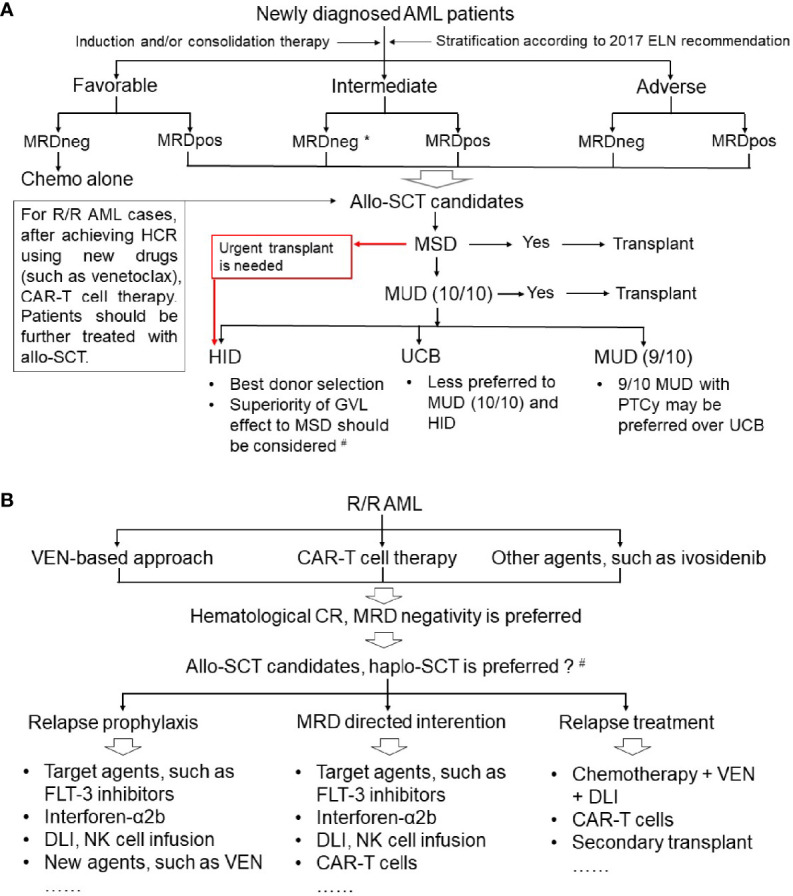
Position of haploidentical stem cell transplantation in the treatment of acute myeloid leukemia. (A) Newly diagnosed AML; (B) refractory or relapsed AML. AML, acute myeloid leukemia; ELN, European LeukemiaNet; MRD, minimal residual disease; MRDneg, negative MRD; MRDpos, positive MRD; Allo-SCT, allogeneic stem cell transplantation; R/R, refractory or relapsed; HCR, hematological complete remission; CAR-T, chimeric antigen receptor (CAR) T cell; MSD, human leukocyte antigen (HLA)-matched sibling donor; MUD, HLA-matched unrelated donor; HID, haploidentical donor; UCB, umbilical cord blood; PTCy, post-transplant cyclophosphamide; GVL, graft-versus-leukemia; VEN, venetoclax; Haplo-SCT, haploidentical SCT; DLI, donor lymphocyte infusion; NK cell, natural killer cell. *For intermediate-risk AML patients with MRD negative CR1, controversy remains regarding the selection of chemotherapy alone, autologous SCT or allo-SCT in patients. #For pre-MRD positive AML cases, haplo-SCT had a stronger GVL effect compared with that of MSDT.

Similar articles

Cited by

References

    1. Dohner H, Estey E, Grimwade D, Amadori S, Appelbaum FR, Büchner T, et al. . Diagnosis and Management of AML in Adults: 2017 ELN Recommendations From an International Expert Panel. Blood (2017) 129:424–47. doi: 10.1182/blood-2016-08-733196 - DOI - PMC - PubMed
    1. Short NJ, Rytting ME, Cortes JE. Acute Myeloid Leukaemia. Lancet (2018) 392:593–606. doi: 10.1016/S0140-6736(18)31041-9 - DOI - PMC - PubMed
    1. Huang XJ, Liu DH, Liu KY, Xu LP, Chen H, Han W, et al. . Treatment of Acute Leukemia With Unmanipulated HLA-Mismatched/Haploidentical Blood and Bone Marrow Transplantation. Biol Blood Marrow Transplant (2009) 15:257–65. doi: 10.1016/j.bbmt.2008.11.025 - DOI - PubMed
    1. Ciurea SO, Zhang MJ, Bacigalupo AA, Bashey A, Appelbaum FR, Aljitawi OS, et al. . Haploidentical Transplant With Posttransplant Cyclophosphamide vs Matched Unrelated Donor Transplant for Acute Myeloid Leukemia. Blood (2015) 126:1033–40. doi: 10.1182/blood-2015-04-639831 - DOI - PMC - PubMed
    1. Huang XJ, Zhu HH, Chang YJ, Xu LP, Liu DH, Zhang XH, et al. . The Superiority of Haploidentical Related Stem Cell Transplantation Over Chemotherapy Alone as Postremission Treatment for Patients With Intermediate- or High-Risk Acute Myeloid Leukemia in First Complete Remission. Blood (2012) 119:5584–90. doi: 10.1182/blood-2011-11-389809 - DOI - PubMed