. 2021 Sep 9;2(6):586-599.
doi: 10.1158/2643-3230.BCD-21-0049. eCollection 2021 Nov.

Integrative Genomic Analysis of Pediatric Myeloid-Related Acute Leukemias Identifies Novel Subtypes and Prognostic Indicators

Affiliations

Integrative Genomic Analysis of Pediatric Myeloid-Related Acute Leukemias Identifies Novel Subtypes and Prognostic Indicators

Maarten Fornerod et al. Blood Cancer Discov. .

Abstract

Genomic characterization of pediatric patients with acute myeloid leukemia (AML) has led to the discovery of somatic mutations with prognostic implications. Although gene-expression profiling can differentiate subsets of pediatric AML, its clinical utility in risk stratification remains limited. Here, we evaluate gene expression, pathogenic somatic mutations, and outcome in a cohort of 435 pediatric patients with a spectrum of pediatric myeloid-related acute leukemias for biological subtype discovery. This analysis revealed 63 patients with varying immunophenotypes that span a T-lineage and myeloid continuum designated as acute myeloid/T-lymphoblastic leukemia (AMTL). Within AMTL, two patient subgroups distinguished by FLT3-ITD and PRC2 mutations have different outcomes, demonstrating the impact of mutational composition on survival. Across the cohort, variability in outcomes of patients within isomutational subsets is influenced by transcriptional identity and the presence of a stem cell-like gene-expression signature. Integration of gene expression and somatic mutations leads to improved risk stratification.

Significance: Immunophenotype and somatic mutations play a significant role in treatment approach and risk stratification of acute leukemia. We conducted an integrated genomic analysis of pediatric myeloid malignancies and found that a combination of genetic and transcriptional readouts was superior to immunophenotype and genomic mutations in identifying biological subtypes and predicting outcomes. This article is highlighted in the In This Issue feature, p. 549.


Figures

Figure 1.
Figure 1.
Transcriptional identities correlate with key oncogenic driver events and are agnostic of immunophenotype. A, Study design. 122 normal, noncomplex, and complex karyotype pediatric specimens were selected. Exclusion criteria for sequencing include FAB M3 (acute promyelocytic leukemia, APML), FAB M7 (AMKL), core binding factor (CBF) leukemia (RUNX1–RUNX1T1, CBFB–MYH11), and KMT2Ar cases. Cases underwent WGS, WES, and RNA-seq. Data were combined with four other pediatric data sets, including FAB M7, early T-cell precursor acute lymphoblastic leukemia, the TARGET AML data set, and pediatric mixed phenotype acute leukemia for a total of 435 cases (45789). Ten additional KMT2Ar AML cases were sequenced to increase the cohort size. Transcriptional clusters as identified by t-SNE, somatic calls, and outcome correlates were utilized to identify biological subtypes as previously described (4). NGS, next-generation sequencing. B, RNA-seq of 435 cases of pediatric AML, AMKL, MPAL, and ETP were combined and batch corrected. t-SNE visualization utilizing the top 100 differentially expressed genes within each data set. Immunophenotype of cases as determined by flow cytometry at diagnosis is shown. AMTL, acute myeloid/T-lymphoblastic leukemia; AUL, acute undifferentiated leukemia; B/M, B-lymphoid and myeloid coexpression; MK, mixed karyotype; T/B, T-lymphoid and B-lymphoid coexpression; T/B/M, T-lymphoid, B-lymphoid, and myeloid coexpression; T/M, T-lymphoid and myeloid coexpression. C, Key oncogenic driver mutations as determined by next-generation sequencing. Ph-like, Philadelphia chromosome–like acute lymphoblastic leukemia; PTD, partial tandem duplication; Txn, transcription.
Figure 2.
Figure 2.
Mutational composition of pediatric myeloid malignancies. Waterfall plot of major mutational events across the entire cohort. See Supplementary Table S12 for genomic details and Supplementary Table S13 for genes and fusion events included in each of the groupings on the y-axis. AMP, amplification; AUL, acute undifferentiated leukemia; DEL, deletion; IP, immunophenotype; LOH, loss of heterozygosity; Ph-like, Philadelphia chromosome–like acute lymphoblastic leukemia; PTD, partial tandem duplication; Txn, transcription.
Figure 3.
Figure 3.
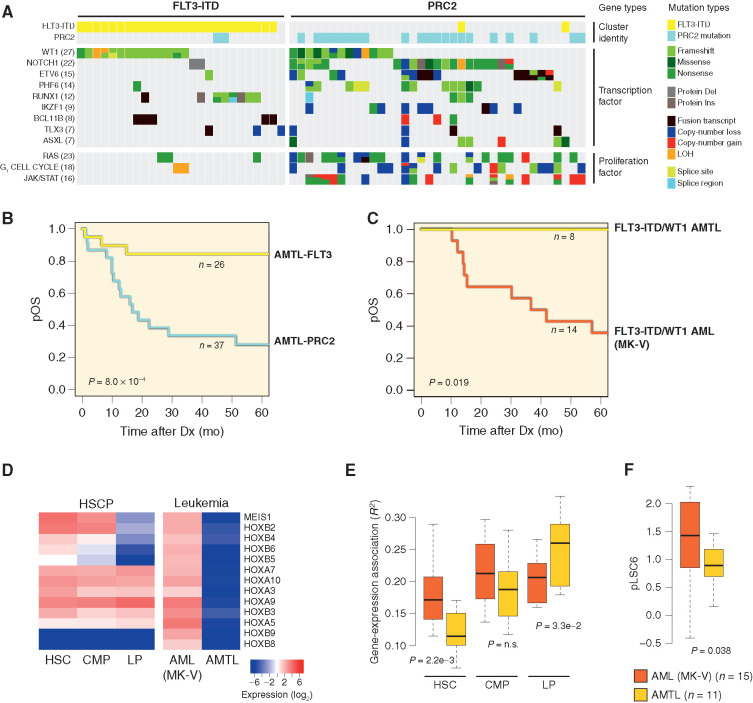
Genomic and transcriptional features of AMTL. Sixty-three cases spanning AML, AUL, MPAL, and ETP immunophenotypes shared a common transcriptional identity (see Fig. 1B). A, Mutational spectrum of AMTL cases. Del, deletion; Ins, insertion; LOH, loss of heterozygosity. B, Outcomes of patients with AMTL according to FLT3-ITD and PRC2 transcriptional identity. Dx, diagnosis; pOS, probability overall survival. C, Outcomes of FLT3-ITD/WT1 double-mutant cases based on AMTL and MK-V transcriptional identity (see Fig. 1). D, Expression of HOX locus genes in normal hematopoietic progenitor subsets and FLT3-ITD/WT1 cases from AMTL and MK-V transcriptional clusters. CMP, common myeloid progenitor; HSCP, HSC progenitor; LP, lymphoid-restricted progenitor. E, Enrichment of gene-expression signatures from HSC, CMP, and LP in FLT3-ITD/WT1 cases from AMTL and MK-V transcriptional clusters. n.s., not significant. F, pLSC6 score of FLT3-ITD/WT1 cases from AMTL and MK-V transcriptional clusters.
Figure 4.
Figure 4.
Leukemia stemness is associated with overall survival. A, pLSC6 score was determined in normal hematopoietic progenitor subsets as previously described (17, 19). DC, dendritic cell; E, erythrocyte; G, granulocyte; GMP, granulocyte/macrophage progenitor; MEG, megakaryocyte; MEP, megakaryocyte/erythrocyte progenitor; NK, natural killer cell. B, pLSC6 scores from normal hematopoietic progenitors were used to define thresholds of low (lineage-committed cells), intermediate (multipotent progenitors), and high (pluripotent progenitors) values in our cohort. C, Imposing pLSC6 thresholds on our cohort found a subset of patients with intermediate and high scores that were significantly associated with overall survival (P = 9.3 × 10⁻⁷). Dx, diagnosis; pOS, probability overall survival. D, t-SNE visualization of the cohort with pLSC6 levels indicated. Thresholds of low, medium, and high as determined in A. B/M, B-lymphoid and myeloid coexpression; Ph-like, Philadelphia chromosome–like acute lymphoblastic leukemia; PTD, partial tandem duplication; Txn, transcription.
Figure 5.
Figure 5.
Oncogenic driver events, transcriptional identity, and leukemia stemness all contribute to outcome in pediatric myeloid-related acute leukemias. A, Integrative Cox proportional hazards model to look at associations with overall survival in the discovery cohort (38). Each bar represents the −log10 P value of covariates and their association with survival. The covariates used in the model to calculate the P value are indicated below the graph with a check mark. Immunophenotype as a single covariate failed to reach statistical significance. B, Probability of EFS (pEFS) of an ongoing multi-institutional prospective pediatric AML trial (AML16) and the proposed classification scheme based on this article for the validation cohort. See Supplementary Figs. S22 and S23 for results of each independent cohort. C, Performance of the proposed genomic classification relative to that utilized in an ongoing prospective upfront pediatric AML study (NCT03164057) in terms of discrimination capability (left) and percentage of high-risk or low-risk classified patients (right) culminating in a risk classification utility score (top, right) for the validation cohort. See Supplementary Figs. S24 and S25 for results of each independent cohort. D, Working model. Mutational events in distinct hematopoietic progenitor subsets lead to transformation, and both components contribute to the transcriptional identity and leukemia stemness. Chemotherapy sensitivity and therefore outcomes are a composite of these factors.
Figure 6.
Figure 6.
Hierarchical decision-making tree for proposed risk stratification. *, T-MPAL, MPAL with T-lineage markers. MPAL cases coexpressing B-lineage markers contained ZNF384, Ph+, Ph-like, and KMT2Ar oncogenes and should be treated with ALL-directed therapy unless they prove nonresponsive to this approach. **, FLT3-ITD cases that are not AMTL and lack high-risk and low-risk features such as NUP98r, monosomy 7, NPM1, and CEBPA. HR, high risk; IR, intermediate risk; LR, low risk.

References

    1. Bennett JM, Catovsky D, Daniel MT, Flandrin G, Galton DA, Gralnick HR, et al. Proposed revised criteria for the classification of acute myeloid leukemia. A report of the French-American-British Cooperative Group. Ann Intern Med 1985;103:620–5. - PubMed
    1. Arber DA, Orazi A, Hasserjian R, Thiele J, Borowitz MJ, Le Beau MM, et al. The 2016 revision to the World Health Organization classification of myeloid neoplasms and acute leukemia. Blood 2016;127:2391–405. - PubMed
    1. Zwaan CM, Kolb EA, Reinhardt D, Abrahamsson J, Adachi S, Aplenc R, et al. Collaborative efforts driving progress in pediatric acute myeloid leukemia. J Clin Oncol 2015;33:2949–62. - PMC - PubMed
    1. de Rooij JD, Branstetter C, Ma J, Li Y, Walsh MP, Cheng J, et al. Pediatric non-Down syndrome acute megakaryoblastic leukemia is characterized by distinct genomic subsets with varying outcomes. Nat Genet 2017;49:451–6. - PMC - PubMed
    1. Bolouri H, Farrar JE, Triche T, Jr, Ries RE, Lim EL, Alonzo TA, et al. The molecular landscape of pediatric acute myeloid leukemia reveals recurrent structural alterations and age-specific mutational interactions. Nat Med 2018;24:103–12. - PMC - PubMed

Publication types