


Glycated haemoglobin levels among 3295 hospitalized COVID-19 patients, with and without diabetes, and risk of severe infection, admission to an intensive care unit and all-cause mortality
- PMID: 34779086
- PMCID: PMC8653248
- DOI: 10.1111/dom.14604
Glycated haemoglobin levels among 3295 hospitalized COVID-19 patients, with and without diabetes, and risk of severe infection, admission to an intensive care unit and all-cause mortality
Abstract
Aim: To determine the risk of adverse outcomes across the spectrum of glycated haemoglobin (HbA1c) levels among hospitalized COVID-19 patients with and without diabetes.
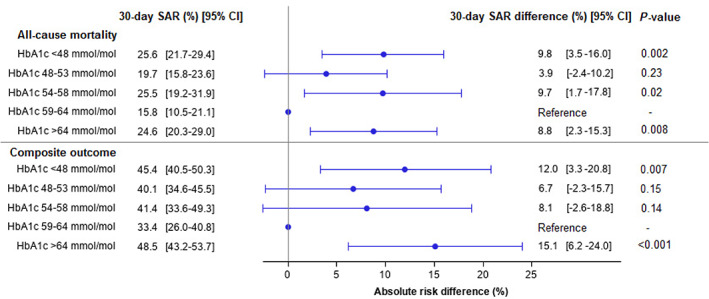
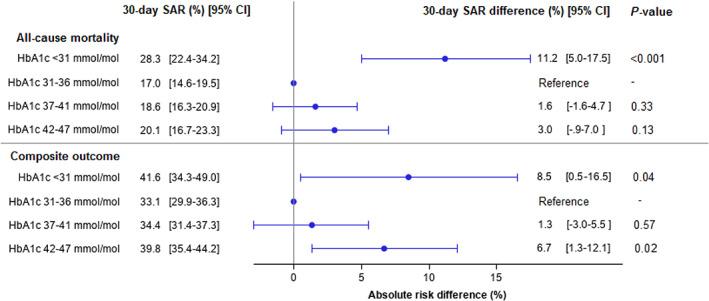
Materials and methods: Danish nationwide registries were used to study the association between HbA1c levels and 30-day risk of all-cause mortality and the composite of severe COVID-19 infection, intensive care unit (ICU) admission and all-cause mortality. The study population comprised patients hospitalized with COVID-19 (3 March 2020 to 31 December 2020) with a positive polymerase chain reaction (PCR) test and an available HbA1c ≤ 6 months before the first positive PCR test. All patients had at least 30 days of follow-up. Among patients with diabetes, HbA1c was categorized as <48 mmol/mol, 48 to 53 mmol/mol, 54 to 58 mmol/mol, 59 to 64 mmol/mol (reference) and >64 mmol/mol. Among patients without diabetes, HbA1c was stratified into <31 mmol/mol, 31 to 36 mmol/mol (reference), 37 to 41 mmol/mol and 42 to 47 mmol/mol. Thirty-day standardized absolute risks and standardized absolute risk differences are reported.
Results: We identified 3295 hospitalized COVID-19 patients with an available HbA1c (56.2% male, median age 73.9 years), of whom 35.8% had diabetes. The median HbA1c was 54 and 37 mmol/mol among patients with and without diabetes, respectively. Among patients with diabetes, the standardized absolute risk difference of the composite outcome was higher with HbA1c < 48 mmol/mol (12.0% [95% confidence interval {CI} 3.3% to 20.8%]) and HbA1c > 64 mmol/mol (15.1% [95% CI 6.2% to 24.0%]), compared with HbA1c 59 to 64 mmol/mol (reference). Among patients without diabetes, the standardized absolute risk difference of the composite outcome was greater with HbA1c < 31 mmol/mol (8.5% [95% CI 0.5% to 16.5%]) and HbA1c 42 to 47 mmol/mol (6.7% [95% CI 1.3% to 12.1%]), compared with HbA1c 31 to 36 mmol/mol (reference).
Conclusions: Patients with COVID-19 and HbA1c < 48 mmol/mol or HbA1c > 64 mmol/mol had a higher associated risk of the composite outcome. Similarly, among patients without diabetes, varying HbA1c levels were associated with higher risk of the composite outcome.
Keywords: antidiabetic drug; cardiovascular disease; database research; glycaemic control; hypoglycaemia; population study.
© 2021 John Wiley & Sons Ltd.
Conflict of interest statement
None declared.
Figures
References
-
- World Health Organization 2020. https://www.who.int/director-general/speeches/detail/who-director-genera.... Accessed November 2, 2021
-
- Currie CJ, Peters JR, Tynan A, et al. Survival as a function of HbA(1c) in people with type 2 diabetes: a retrospective cohort study. Lancet. 2010;375(9713):481‐489. - PubMed
Publication types
MeSH terms
Substances
Grants and funding
LinkOut - more resources
Full Text Sources
Medical
