. 2022 Feb 17;90(2):e0054821.
doi: 10.1128/IAI.00548-21. Epub 2021 Nov 15.

CC16 Deficiency in the Context of Early-Life Mycoplasma pneumoniae Infection Results in Augmented Airway Responses in Adult Mice

Affiliations

CC16 Deficiency in the Context of Early-Life Mycoplasma pneumoniae Infection Results in Augmented Airway Responses in Adult Mice

Natalie Iannuzo et al. Infect Immun. .

Abstract

Studies have shown that club cell secretory protein (CC16) plays important protective roles in the lungs, yet its complete biological functions are unclear. We devised a translational mouse model in order to investigate the impact of early life infections, in the context of CC16 deficiency, on lung function in adult mice. CC16 sufficient (WT) and deficient (CC16-/-) mice were infected with Mycoplasma pneumoniae (Mp) as weanlings and assessed as adults (early life infection model; ELIM) and compared to adult mice infected for only 3 days (adult infection model; AIM). CC16-/- Mp-infected mice had significantly increased airway hyperresponsiveness (AHR) in both models compared to WT mice. However, CC16-/- mice infected in early life (ELIM) displayed significantly increased AHR compared to CC16-/- mice infected in adulthood (AIM). In stark contrast, lung function in ELIM WT mice returned to levels similar to saline-treated controls. While WT mice cleared Mp infection in the ELIM, CC16-/- mice remained colonized with Mp throughout the model, which likely contributed to increased airway remodeling and persistence of Muc5ac expression. When CC16-/- mouse tracheal epithelial cells (MTECs) were infected with Mp, increased Mp colonization and collagen gene expression were also detected compared to WT cells, suggesting that CC16 plays a protective role during Mp infection, in part through epithelial-driven host defense mechanisms.

Keywords: CC16; Mycoplasma pneumoniae; airway remodeling; epithelial cells; inflammation; lung infection.


Conflict of interest statement

The authors declare no conflict of interest.

Figures
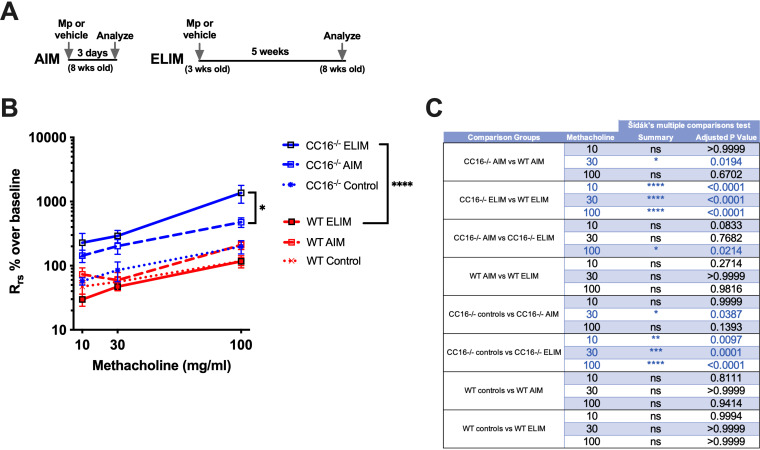
FIG 1
FIG 1
Airway resistance is increased in CC16−/− mice infected with Mp for the AIM and ELIM. Airway resistance during a methacholine challenge of WT (n = 9) and CC16−/− (n = 16) male mice infected with Mp for the AIM and WT (n = 11) and CC16−/− (n = 13) mice infected with Mp for the ELIM protocols. Non-infected saline controls are shown on each graph (dotted lines). Total airways respiratory resistance (Rrs) was calculated as a percentage over baseline in order to compare between separate experimental runs on the Flexivent machine. All mice were assessed for pulmonary function at 8 weeks of age. *, P < 0.05; **, P < 0.01; ***, P < 0.001; ****, P < 0.0001 by one-way ANOVA Sidak’s multiple comparison test.
FIG 2
FIG 2
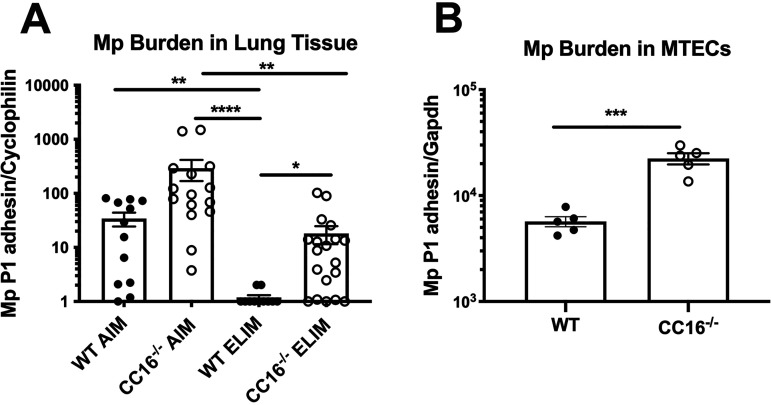
CC16−/− mice and MTECs have increased Mp burden. Mp burden was assessed in the lung tissue of mice from the AIM and ELIM. (A) WT AIM (n = 12), CC16−/− AIM (n = 15), WT ELIM (n = 11), CC16−/− ELIM (n = 19) were assessed for Mp burden by RT-PCR for Mp-specific P1-adhesin gene. *, P < 0.05; **, P < 0.01; ***, P < 0.01 Kruskal-Wallis multiple-comparison test. Cyclophilin was used as a housekeeping control for RT-PCR. (B) WT control (n = 5) and CC16−/− control (n = 5) mouse tracheal epithelial cells (MTECs) grown simultaneously at an air-liquid interface were infected with Mp and assessed for Mp burden after 48 h by RT-PCR. ***, P < 0.001 unpaired t test. Gapdh was used as a housekeeping control for RT-PCR. Data shown are mean ± SEM.
FIG 3
FIG 3
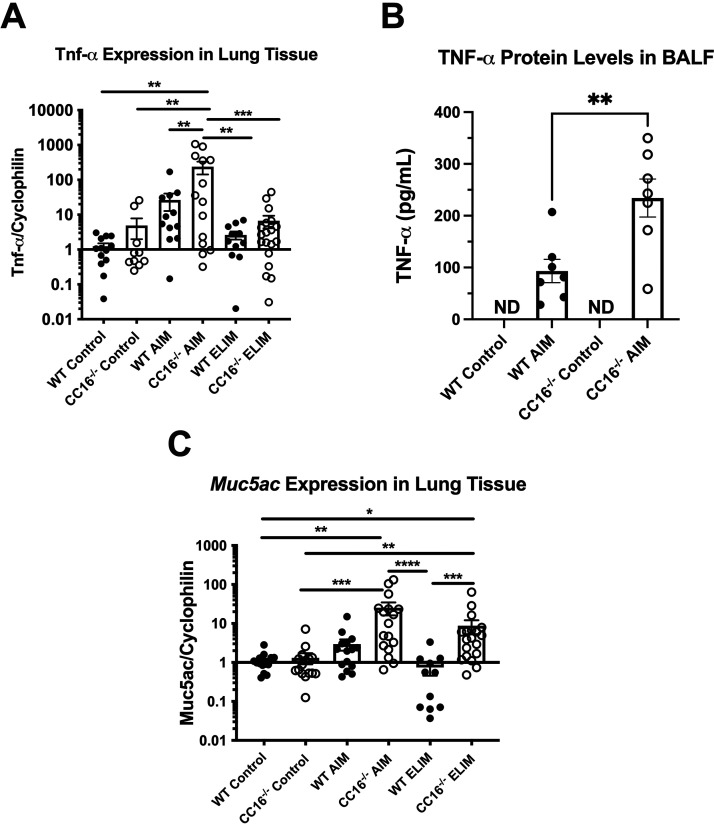
Tnf-α and Muc5ac are increased in CC16−/− mice infected with Mp during the AIM and ELIM. Tnf-α gene expression (A) was measured in the lung tissue of WT control (n = 11), CC16−/− control (n = 10), WT AIM (n = 12), CC16−/− AIM (n = 14), WT ELIM (n = 11), and CC16−/− ELIM (n = 19) mice by RT-PCR. TNF-α protein levels (B) were measured in the BALF of WT control (n = 7), CC16−/− control (n = 7), WT AIM (n = 7), and CC16−/− AIM (n = 7) mice by ELISA. Muc5ac (C) gene expression was measured in the lung tissue of WT control (n = 17), CC16−/− control (n = 16), WT AIM (n = 15), CC16−/− AIM (n = 17), WT ELIM (n = 11), and CC16−/− ELIM (n = 19) mice by RT-PCR. For RT-PCR data, *, P < 0.05; **, P < 0.01; ***, P < 0.001; ****, P < 0.0001 one-way ANOVA Tukey’s multiple-comparison test. Data shown are mean ± SEM. Cyclophilin was used as the housekeeping control for RT-PCR. For ELISA data, **, P < 0.01 unpaired t test. ND, not detected.
FIG 4
FIG 4
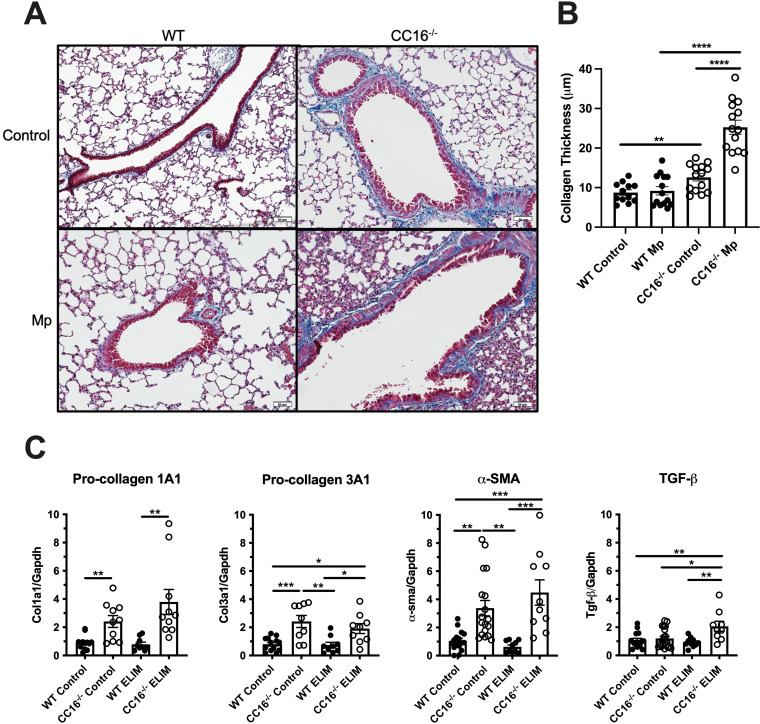
Collagen production is increased in the lungs of CC16−/− mice and further exacerbated by Mp infection in the ELIM. (A) Representative trichrome-stained lung sections from WT control (n = 12), WT Mp (n = 12), CC16−/− control (n = 14), and CC16−/− Mp (n = 14) mice from the ELIM. Scale bars: 50μm. (B) Quantitative analysis of collagen thickness was measured on pictures taken at ×20 magnification using Metamorph software as described in the Methods section. (C) Airway remodeling measurements in WT and CC16−/− mice infected Mp for the ELIM. Pro-collagen 1A1 (Col1a1) was measured in WT control (n = 12), CC16−/− control (n = 10), WT ELIM (n = 9), and CC16−/− ELIM (n = 10). Pro-collagen 3A1 (Col3a1) was measured in WT control (n = 13), CC16−/− control (n = 9), WT ELIM (n = 9), and CC16−/− ELIM (n = 9). α-sma was measured in WT control (n = 16), CC16−/− control (n = 18), WT ELIM (n = 10), and CC16−/− ELIM (n = 10). Tgf-β was measured in WT control (n = 15), CC16−/− control (n = 21), WT ELIM (n = 10), and CC16−/− ELIM (n = 9). Airway remodeling factors were measured using RT-PCR with Gapdh as a housekeeping control. *, P < 0.05; **, P < 0.01; ***, P < 0.001 by one-way ANOVA Tukey’s multiple comparison test. Data shown are mean ± SEM.
FIG 5
FIG 5
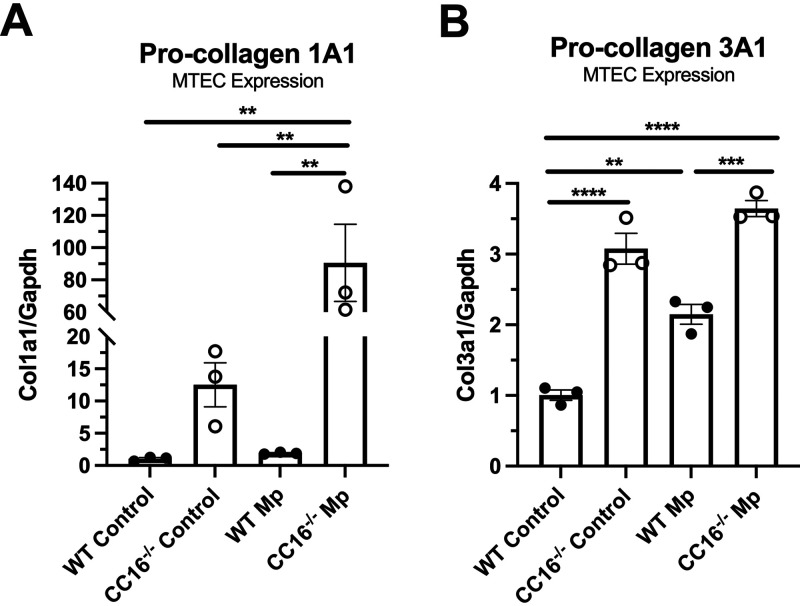
Loss of CC16 results in increased expression of collagen genes in MTECs at baseline and during Mp challenge. WT (n = 3) and CC16−/− (n = 3) were treated with media (control) or Mp for 48 h, after which pro-collagen 1A1 (Col1a1) and pro-collagen 3A1 (Col3a1) expression was measured by RT-PCR with Gapdh as a housekeeping control. *, P < 0.05; **, P < 0.01; ***, P < 0.001; and ****, P < 0.0001 by one-way ANOVA Tukey’s multiple comparison test. Data shown are mean ± SEM.

References

    1. Broeckaert F, Bernard A. 2000. Clara cell secretory protein (CC16): characteristics and perspectives as lung peripheral biomarker. Clin Exp Allergy 30:469–475. 10.1046/j.1365-2222.2000.00760.x. - DOI - PubMed
    1. Guerra S, Vasquez MM, Spangenberg A, Halonen M, Martin RJ. 2016. Club cell secretory protein in serum and bronchoalveolar lavage of patients with asthma. J Allergy Clin Immunol 138:932–934.e1. 10.1016/j.jaci.2016.03.047. - DOI - PMC - PubMed
    1. Rava M, Tares L, Lavi I, Barreiro E, Zock JP, Ferrer A, Muniozguren N, Nadif R, Cazzoletti L, Kauffmann F, Anto JM, Guerra S. 2013. Serum levels of Clara cell secretory protein, asthma, and lung function in the adult general population. J Allergy Clin Immunol 132:230–232. 10.1016/j.jaci.2013.01.023. - DOI - PubMed
    1. Zhai J, Stern DA, Sherrill DL, Spangenberg AL, Wright AL, Morgan WJ, Halonen M, Martinez FD, Guerra S. 2018. Trajectories and early determinants of circulating CC16 from birth to age 32 years. Am J Respir Crit Care Med 198:267–270. 10.1164/rccm.201712-2398LE. - DOI - PMC - PubMed
    1. Guerra S, Halonen M, Vasquez MM, Spangenberg A, Stern DA, Morgan WJ, Wright AL, Lavi I, Tares L, Carsin AE, Dobano C, Barreiro E, Zock JP, Martinez-Moratalla J, Urrutia I, Sunyer J, Keidel D, Imboden M, Probst-Hensch N, Hallberg J, Melen E, Wickman M, Bousquet J, Belgrave DCM, Simpson A, Custovic A, Anto JM, Martinez FD. 2015. Relation between circulating CC16 concentrations, lung function, and development of chronic obstructive pulmonary disease across the lifespan: a prospective study. Lancet Respiratory Medicine 3:613–620. 10.1016/S2213-2600(15)00196-4. - DOI - PMC - PubMed

Publication types

LinkOut - more resources