. 2021 Jun;6(2):XLVIII-LXXXIX.
doi: 10.1177/23969873211012133. Epub 2021 May 11.

European Stroke Organisation (ESO) guidelines on blood pressure management in acute ischaemic stroke and intracerebral haemorrhage

Affiliations

European Stroke Organisation (ESO) guidelines on blood pressure management in acute ischaemic stroke and intracerebral haemorrhage

Else Charlotte Sandset et al. Eur Stroke J. 2021 Jun.

Abstract

The optimal blood pressure (BP) management in acute ischaemic stroke (AIS) and acute intracerebral haemorrhage (ICH) remains controversial. These European Stroke Organisation (ESO) guidelines provide evidence-based recommendations to assist physicians in their clinical decisions regarding BP management in acute stroke.The guidelines were developed according to the ESO standard operating procedure and Grading of Recommendations, Assessment, Development, and Evaluation (GRADE) methodology. The working group identified relevant clinical questions, performed systematic reviews and meta-analyses of the literature, assessed the quality of the available evidence, and made specific recommendations. Expert consensus statements were provided where insufficient evidence was available to provide recommendations based on the GRADE approach. Despite several large randomised-controlled clinical trials, quality of evidence is generally low due to inconsistent results of the effect of blood pressure lowering in AIS. We recommend early and modest blood pressure control (avoiding blood pressure levels >180/105 mm Hg) in AIS patients undergoing reperfusion therapies. There is more high-quality randomised evidence for BP lowering in acute ICH, where intensive blood pressure lowering is recommended rapidly after hospital presentation with the intent to improve recovery by reducing haematoma expansion. These guidelines provide further recommendations on blood pressure thresholds and for specific patient subgroups. There is ongoing uncertainty regarding the most appropriate blood pressure management in AIS and ICH. Future randomised-controlled clinical trials are needed to inform decision making on thresholds, timing and strategy of blood pressure lowering in different acute stroke patient subgroups.

Keywords: antihypertensive; blood pressure; blood pressure lowering; guidelines; hypertension; intracerebral haemorrhage; ischaemic stroke; recommendations.


Conflict of interest statement

Declaration of conflicting interests: Declarations of conflicts of interests are outlined in table 1.

Figures

Figure 1.
Figure 1.
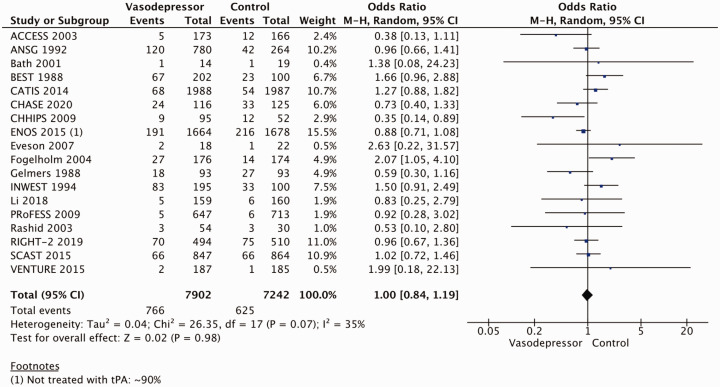
Effect of pre-hospital blood pressure lowering by any vasopressor drug compared to no drug on mortality at three months following symptom onset.
Figure 2.
Figure 2.
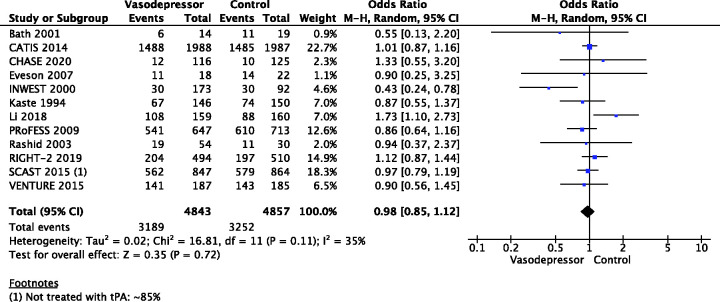
Effect of pre-hospital blood pressure lowering by any vasopressor drug compared to no drug on good functional outcome (mRS scores 0–2) at three months following symptom onset.
Figure 3.
Figure 3.
The effect of blood pressure lowering with any vasodepressor drug compared with no drug on mortality at three to six months following symptom onset in patients with acute ischaemic stroke not treated with reperfusion therapies.
Figure 4.
Figure 4.
The effect of blood pressure lowering with any vasodepressor drug compared with no drug on good functional outcome (mRS scores 0–2) at three to six months following symptom onset in patients with acute ischaemic stroke not treated with reperfusion therapies.
Figure 5.
Figure 5.
The effect of continuing versus temporarily stopping previous blood pressure lowering therapy on mortality at three to six months following symptom onset in patients with acute ischaemic stroke.
Figure 6.
Figure 6.
The effect of continuing versus temporarily stopping previous blood pressure lowering therapy on good functional outcome (defined as mRS scores 0–2) at three to six months following symptom onset in patients with acute ischaemic stroke.
Figure 7.
Figure 7.
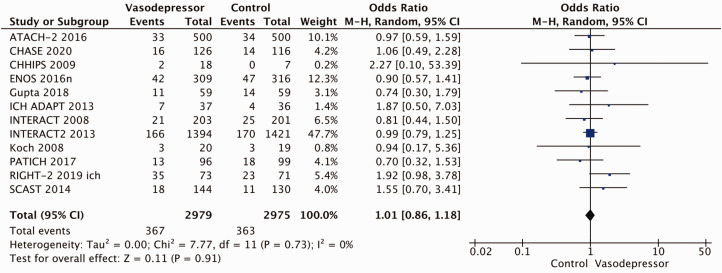
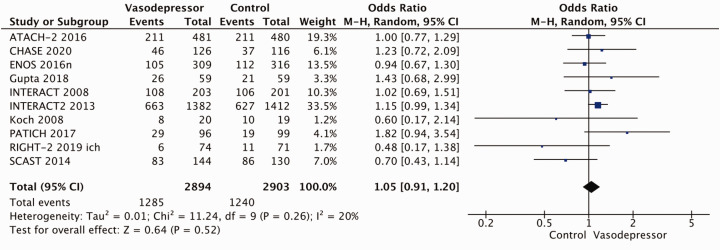
The effect of intensive blood pressure lowering with any vasodepressor drug compared to control on mortality at three to six months following symptom onset in patients with acute intracerebral haemorrhage.
Figure 8.
Figure 8.
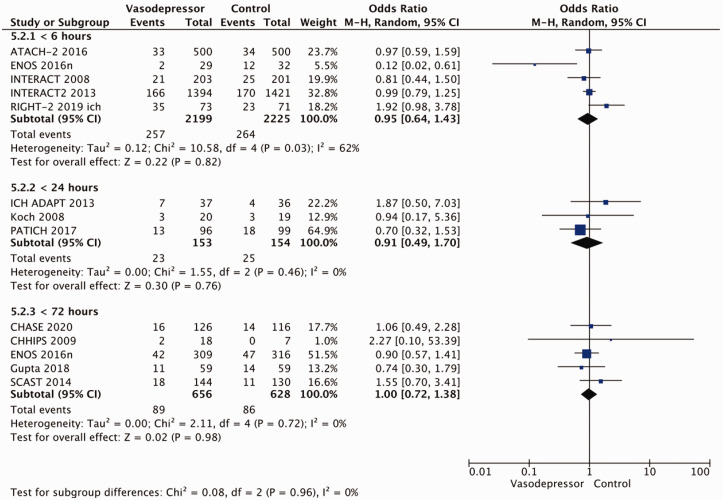
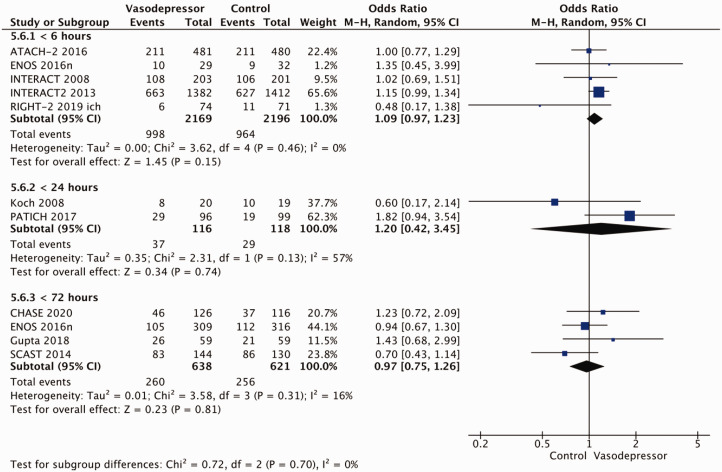
The effect of intensive blood pressure lowering with any vasodepressor drug compared to control on mortality at three to six months following symptom onset in in subgroups stratified by time to treatment (trials enrolling patients within 6 hours, trials enrolling patients within 24 hours after exclusion of trials enrolling patients within 6 hours, and trials enrolling patients within 72 hours after excluding trials enrolling within 24 hours).
Figure 9.
Figure 9.
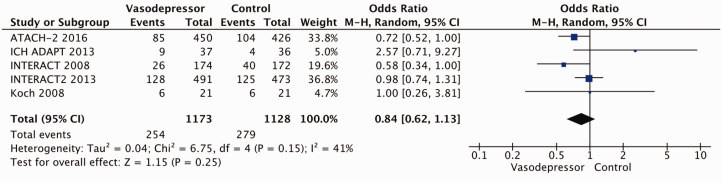
The effect of intensive blood pressure lowering with any vasodepressor drug compared to control on good functional outcome (defined as mRS scores 0–2 at three to six months following symptom onset) in patients with acute intracerebral haemorrhage.
Figure 10.
Figure 10.
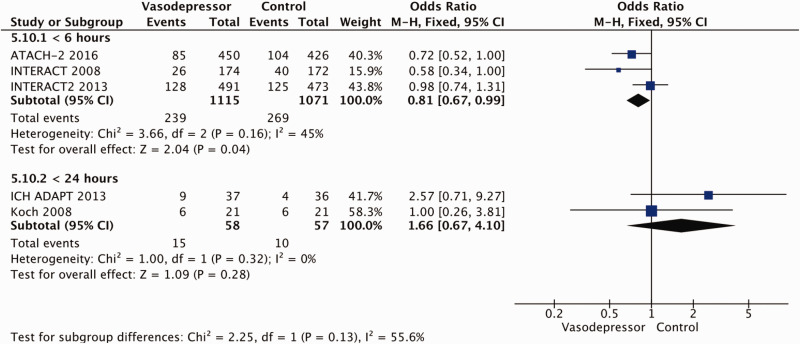
The effect of intensive blood pressure lowering with any vasodepressor drug compared to control on good functional outcome (defined as mRS scores 0–2 at three to six months following symptom onset) in subgroups stratified by time to treatment (trials enrolling patients within 6 hours, trials enrolling patients within 24 hours after exclusion of trials enrolling patients within 6 hours, and trials enrolling patients within 72 hours after excluding trials enrolling within 24 hours).
Figure 11.
Figure 11.
The effect of intensive blood pressure lowering with any vasodepressor drug compared to control on haematoma expansion.
Figure 12.
Figure 12.
The effect of intensive blood pressure lowering with any vasodepressor drug compared to control on haematoma expansion in subgroups stratified by time to treatment (trials enrolling patients within 6 hours, trials enrolling patients within 24 hours after exclusion of trials enrolling patients within 6 hours).
Figure 13.
Figure 13.
The effect of continuing versus temporarily stopping previous blood pressure lowering therapy on mortality at three to six months following symptom onset in patients with acute intracerebral haemorrhage.
Figure 14.
Figure 14.
The effect of continuing versus temporarily stopping previous blood pressure lowering therapy on good functional outcome (defined as mRS scores 0–2) at three to six months following symptom onset in patients with acute intracerebral haemorrhage.

References

    1. Fischer U, Cooney MT, Bull LM, et al.. Acute post-stroke blood pressure relative to premorbid levels in intracerebral haemorrhage versus major ischaemic stroke: a population-based study. Lancet Neurol 2014; 13: 374–384. - PMC - PubMed
    1. Bath PM, Appleton JP, Krishnan K, et al.. Blood pressure in acute stroke: to treat or not to treat: that is still the question. Stroke 2018; 49: 1784–1790. - PubMed
    1. Carcel C, Anderson CS.Timing of blood pressure lowering in acute ischemic stroke. Curr Atheroscler Rep 2015; 17: 42. - PubMed
    1. Jusufovic M, Mishra NK, Lansberg MG, et al.. Blood pressure management in acute stroke. Curr Hypertens Rev 2016; 12: 121–126. - PubMed
    1. Qureshi AI.Acute hypertensive response in patients with stroke: pathophysiology and management. Circulation 2008; 118: 176–187. - PubMed

LinkOut - more resources