Review
. 2021 Dec 17;16(12):2707-2718.
doi: 10.1021/acschembio.1c00549. Epub 2021 Nov 15.

Brightening up Biology: Advances in Luciferase Systems for in Vivo Imaging

Affiliations
Review

Brightening up Biology: Advances in Luciferase Systems for in Vivo Imaging

Shirley Liu et al. ACS Chem Biol. .

Abstract

Bioluminescence imaging (BLI) using luciferase reporters is an indispensable method for the noninvasive visualization of cell populations and biochemical events in living animals. BLI is widely performed with preclinical rodent models to understand disease processes and evaluate potential cell- or gene-based therapies. However, in vivo BLI remains constrained by low photon production and tissue attenuation, limiting the sensitivity of reporting from small numbers of cells in deep locations and hindering its application to larger animal models. This Review highlights recent advances in the development of luciferase systems that improve the sensitivity of in vivo BLI and discusses the expanding array of biological applications.


Conflict of interest statement

The authors declare no competing financial interest.

Figures
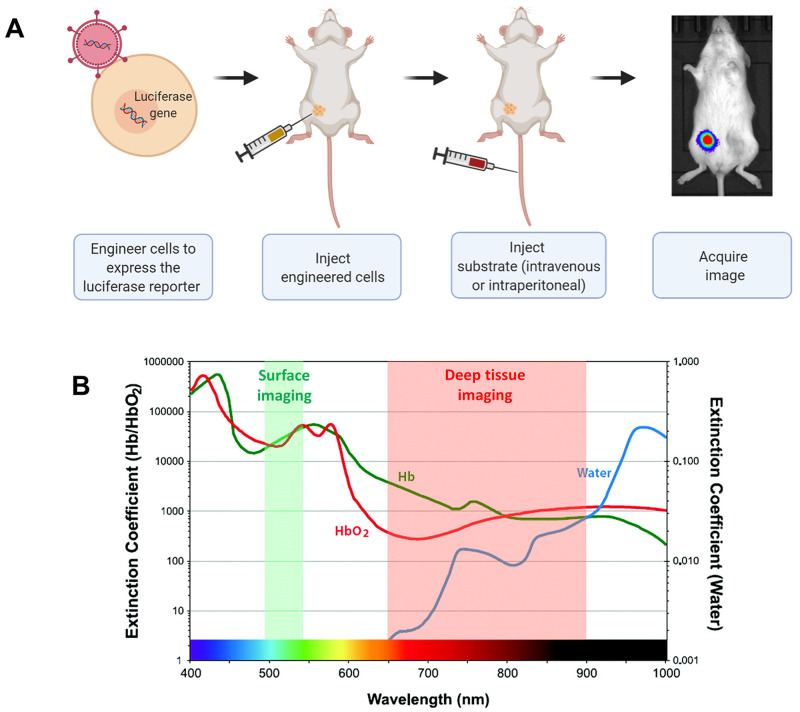
Figure 1
Figure 1
In vivo bioluminescence imaging (BLI) of engineered cells. (A) Cells are first genetically engineered to express the luciferase, then transplanted into the animal. The appropriate substrate is injected, and the emitted light is captured to generate an image. (B) Extinction coefficient value of water, oxyhemoglobin (HbO2), and deoxyhemoglobin (Hb) for wavelengths in the visible to near-infrared region. Adapted with permission from Kobayashi et al. Copyright 2010 American Chemical Society.
Figure 2
Figure 2
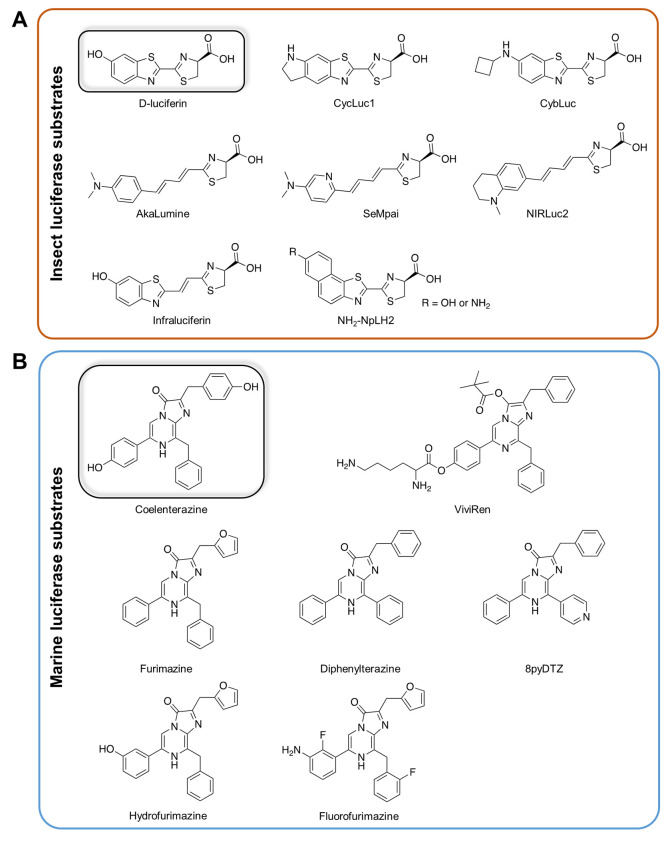
Chemical structures of native luciferins and their analogs: (A) Native insect luciferase substrate d-luciferin and its analogs. (B) Native marine luciferase substrate coelenterazine and its analogs.
Figure 3
Figure 3
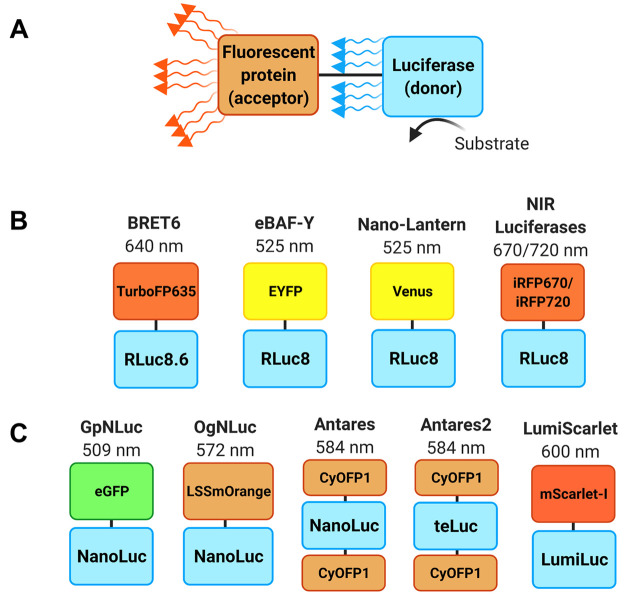
Bioluminescence resonance energy transfer (BRET)-based luciferase systems: (A) A luciferase donor reacts with its substrate to produce light which is then absorbed by a fused fluorescent protein and re-emitted at a longer wavelength. (B) RLuc-based BRET systems and (C) NanoLuc-based BRET systems and their respective peak emission wavelengths.
Figure 4
Figure 4
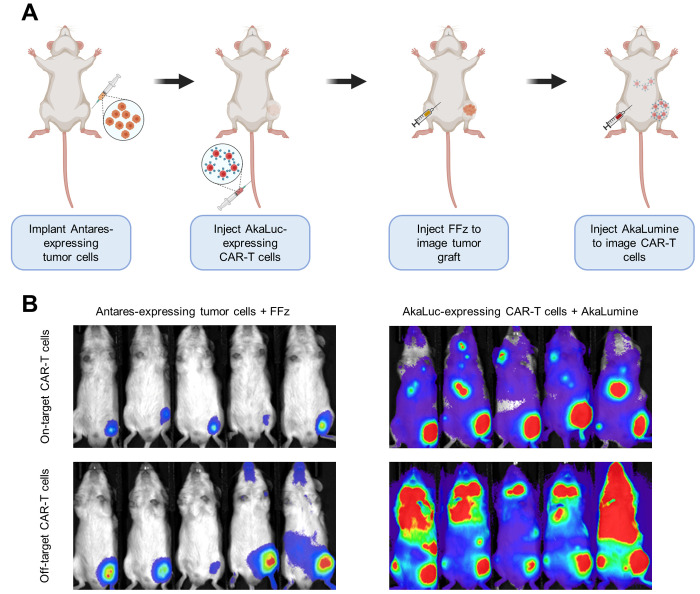
Example of sensitive multicomponent BLI enabled by state-of-the-art bioluminescent systems: (A) Scheme of experimental design for in vivo tracking of both Antares-expressing tumor cells and AkaLuc-expressing CAR-T cells. (B) Representative BLI images showing the change in tumor size and the localization of expanded CAR-T cells. Adapted with permission from Su et al. Copyright 2020 Springer Nature.

References

    1. Kang J. H.; Chung J. K. Molecular-genetic imaging based on reporter gene expression. J. Nucl. Med. 2008, 49 (Suppl 2), 164S–179S. 10.2967/jnumed.107.045955. - DOI - PubMed
    1. Badr C. E.; Tannous B. A. Bioluminescence imaging: progress and applications. Trends Biotechnol. 2011, 29, 624–633. 10.1016/j.tibtech.2011.06.010. - DOI - PMC - PubMed
    1. Edinger M.; Cao Y. A.; Hornig Y. S.; Jenkins D. E.; Verneris M. R.; Bachmann M. H.; Negrin R. S.; Contag C. H. Advancing animal models of neoplasia through in vivo bioluminescence imaging. Eur. J. Cancer 2002, 38, 2128–2136. 10.1016/S0959-8049(02)00410-0. - DOI - PubMed
    1. Mandl S.; Schimmelpfennig C.; Edinger M.; Negrin R. S.; Contag C. H. Understanding immune cell trafficking patterns via in vivo bioluminescence imaging. J. Cell. Biochem. 2002, 87, 239–248. 10.1002/jcb.10454. - DOI - PubMed
    1. Paroo Z.; Bollinger R. A.; Braasch D. A.; Richer E.; Corey D. R.; Antich P. P.; Mason R. P. Validating bioluminescence imaging as a high-throughput, quantitative modality for assessing tumor burden. Mol. Imaging 2004, 3, 117–124. 10.1162/1535350041464865. - DOI - PubMed

Publication types