


Left parietal involvement in motion sickness susceptibility revealed by multimodal magnetic resonance imaging
- PMID: 34783415
- PMCID: PMC8764490
- DOI: 10.1002/hbm.25710
Left parietal involvement in motion sickness susceptibility revealed by multimodal magnetic resonance imaging
Abstract
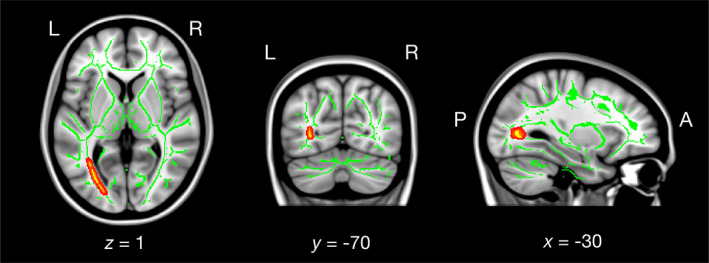
Susceptibility to motion sickness varies greatly across individuals. However, the neural mechanisms underlying this susceptibility remain largely unclear. To address this gap, the current study aimed to identify the neural correlates of motion sickness susceptibility using multimodal MRI. First, we compared resting-state functional connectivity between healthy individuals who were highly susceptible to motion sickness (N = 36) and age/sex-matched controls who showed low susceptibility (N = 36). Seed-based analysis revealed between-group differences in functional connectivity of core vestibular regions in the left posterior Sylvian fissure. A data-driven approach using intrinsic connectivity contrast found greater network centrality of the left intraparietal sulcus in high- rather than in low-susceptible individuals. Moreover, exploratory structural connectivity analysis uncovered an association between motion sickness susceptibility and white matter integrity in the left inferior fronto-occipital fasciculus. Taken together, our data indicate left parietal involvement in motion sickness susceptibility.
Keywords: MRI; conflict; motion sickness; resting state; vestibular; visual.
© 2021 Toyota Central R&D Labs., Inc. Human Brain Mapping published by Wiley Periodicals LLC.
Conflict of interest statement
H. S., T. H., and T. S. were employed by Toyota Central R&D Laboratories, Inc. The remaining authors declare that the research was conducted in the absence of any commercial or financial relationships that could be construed as a potential conflict of interest.
Figures


References
-
- Arshad, Q. , Nigmatullina, Y. , Roberts, R. E. , Goga, U. , Pikovsky, M. , Khan, S. , … Bronstein, A. M. (2016). Perceived state of self during motion can differentially modulate numerical magnitude allocation. European Journal of Neuroscience, 44, 2369–2374. - PubMed
-
- Ashburner, J. (2007). A fast diffeomorphic image registration algorithm. NeuroImage, 38, 95–113. - PubMed
MeSH terms
LinkOut - more resources
Full Text Sources
Medical
Miscellaneous
