Novel insights into the pathological development of dyslipidemia in patients with hypothyroidism
- PMID: 34784265
- PMCID: PMC9162743
- DOI: 10.17305/bjbms.2021.6606
Novel insights into the pathological development of dyslipidemia in patients with hypothyroidism
Abstract
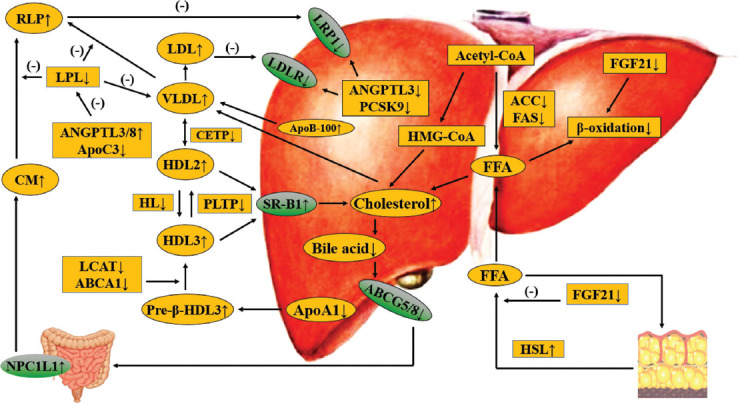
According to the previous reports, hypothyroidism has been shown to be strongly correlated with increased circulating concentrations of total cholesterol, low-density lipoprotein cholesterol (LDL-C), and triglycerides (TG). Notably, thyroid hormones are confirmed to modulate the production, clearance, and transformation process of cholesterol within circulation of mammals. Moreover, emerging evidence suggests that the thyroid-stimulating hormone could also participate in modulating serum lipid metabolism independently of thyroid hormones, which further induces the pathological development of dyslipidemia. However, the underlying mechanism is still not fully elucidated. Recently, several research studies have demonstrated that the pathogenic progression of hypothyroidism-related dyslipidemia might be correlated with the decreased serum concentrations of thyroid hormones and the increased serum concentrations of thyroid-stimulating hormones. Thus, this indicates that hypothyroidism could induce dyslipidemia and its related cardio-metabolic disorder diseases. In addition, several newly identified modulatory biomarkers, such as proprotein convertase subtilisin/kexin type 9 (PCSK9), angiopoietin-like protein (ANGPTLs), and fibroblast growth factors (FGFs), might play an important role in the regulation of dyslipidemia induced by hypothyroidism. Furthermore, under the status of hypothyroidism, significantly dysfunctional HDL particles could also be observed. In the current review, we summarized the recent knowledge of the relationship between the development of hypothyroidism with dyslipidemia. We also discussed the updated understanding of the mechanisms whereby hypothyroidism induces the risk and the development of dyslipidemia and cardio-metabolic diseases.
Conflict of interest statement
Conflicts of interest: The authors declare no conflict of interests.
Figures
References
-
- Lauffer P, Zwaveling-Soonawala N, Naafs JC, Boelen A, van Trotsenburg AS. Diagnosis and management of central congenital hypothyroidism. Front Endocrinol (Lausanne) 2021;12:6–7. http://doi.org/10.3389/fendo.2021.6↷7. - PMC - PubMed
-
- Ejaz M, Kumar P, Thakur M, Bachani P, Naz S, Lal K, et al. Comparison of lipid profile in patients with and without subclinical hypothyroidism. Cureus. 2021;13(8):e17301. http://doi.org/10.7759/cureus.17301. - PMC - PubMed
-
- Willard DL, Leung AM, Pearce EN. Thyroid function testing in patients with newly diagnosed hyperlipidemia. JAMA Intern Med. 2014;174(2):287–9. http://doi.org/10.1001/jamainternmed.2013.12188. - PMC - PubMed
-
- Bekkering GE, Agoritsas T, Lytvyn L, Heen AF, Feller M, Moutzouri E, et al. Thyroid hormones treatment for subclinical hypothyroidism:A clinical practice guideline. BMJ. 2019;365:l2006. http://doi.org/10.1136/bmj.l2006. - PubMed
-
- Giglio RV, Pantea Stoian A, Al-Rasadi K, Banach M, Patti AM, Ciaccio M, et al. Novel therapeutical approaches to managing atherosclerotic risk. Int J Mol Sci. 2021;22(9):94633. http://doi.org/10.3390/ijms22094633. - PMC - PubMed
Publication types
MeSH terms
Substances
LinkOut - more resources
Full Text Sources
Medical
Miscellaneous