. 2021 Oct 15;13(10):11413-11426.
eCollection 2021.

Overexpressed GNA13 induces temozolomide sensitization via down-regulating MGMT and p-RELA in glioma

Affiliations

Overexpressed GNA13 induces temozolomide sensitization via down-regulating MGMT and p-RELA in glioma

Yan Liu et al. Am J Transl Res. .

Abstract

Temozolomide (TMZ), one of the few effective drugs used during adjuvant therapy, could effectively prolong the overall survival (OS) of glioma patients. In our previous study, the mRNA level of G Protein Subunit Alpha 13 (GNA13) was found to be inversely correlated with OS and was therefore identified as a potential biomarker for the prognosis of glioma. Henceforth, this study aims to identify the molecular mechanism of GNA13 in enhancing TMZ sensitization through bioinformatic analyses of GSE80729 and GSE43452 and other experiments. In glioma, overexpression of GNA13 downregulated PRKACA, which is a subunit of PKA, hence reducing phosphorylated RELA and MGMT. Since p-RELA and MGMT were proven to be closely associated with TMZ resistance, we therefore investigated whether thetwo signaling pathways, "GNA13/PRKACA/p-RELA", and "GNA13/PRKACA/MGMT", were involved in the molecular mechanism of GNA13 in TMZ sensitization. Our conclusion was that, GNA13 overexpression in glioma cells were more sensitive in TMZ treatment.

Keywords: GNA13; MGMT; PRKACA; RELA; glioblastoma; glioma; temozolomide (TMZ).


Conflict of interest statement

None.

Figures
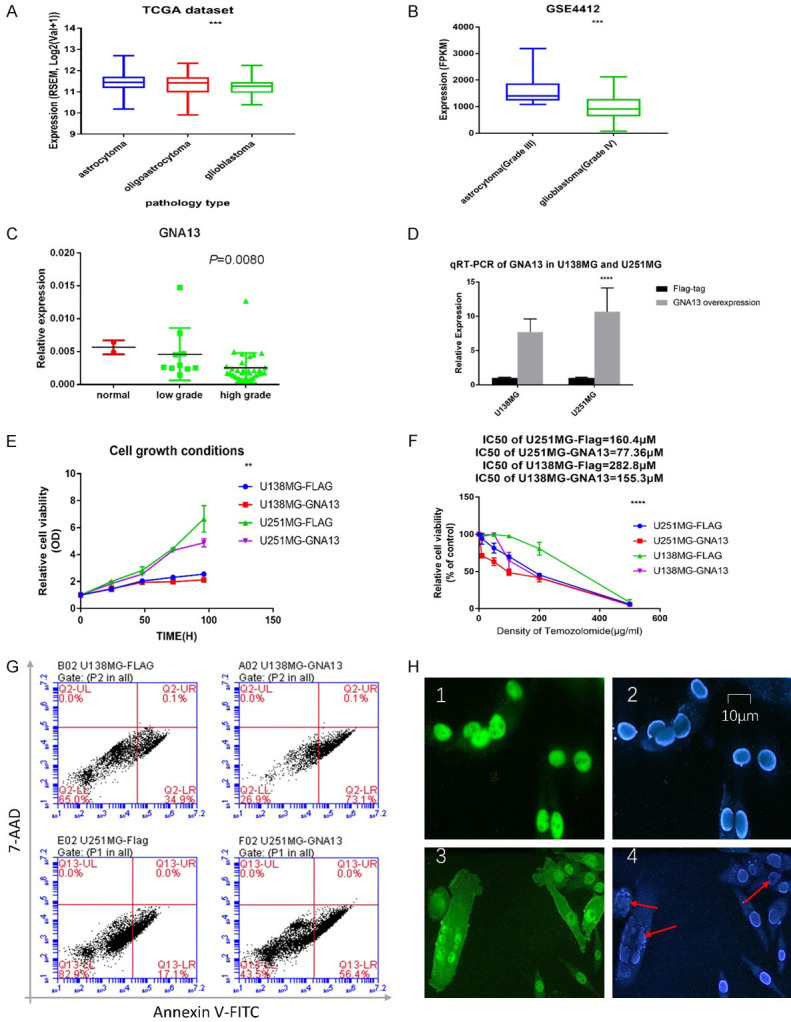
Figure 1
Figure 1
Basic bioinformation of GNA13 in datasets and glioma cell lines. A. The mRNA level of GNA13 is inversely correlated with tumor grade in TCGA datasets and. B. The mRNA level of GNA13 is inversely correlated with tumor grade in GSE4412. C. GNA13 is inversely correlated to glioma grade at mRNA level, as proven by qRT-PCR. D. The GNA13-overexpressed cell lines were confirmed through qRT-PCR. E. Cell growth inhibition is observed in GNA13-overexpressed cell lines when compared with the cell growth of vector cell lines, both U138MG and U251MG were significantly inhibited while GNA13 was overexpressed (P<0.01). F. The relative cell viability is significantly decreased in GNA13-overexpressed glioma cells after TMZ treatment (P<0.01). G. 24 hours after TMZ treatment, the proportion of cells at end stage apoptosis or dead was seen to be significantly increased in the GNA13-overexpressed group (P<0.01). X axis represented the conditions of Annexin V-FITC incubated shown in 575 nm light while Y axis represent the 7-AAD incubated shown in 488 nm light. H. 24 hours after TMZ treatment, the proportion of karyorrhexis occurrence was significantly increased in the GNA13-overexpressed group (P<0.01). Green represented the GNA13 expressed conditions, blue means the nucleus staining by DAPI and red arrow was used for emphasizing the karyorrhexis.
Figure 5
Figure 5
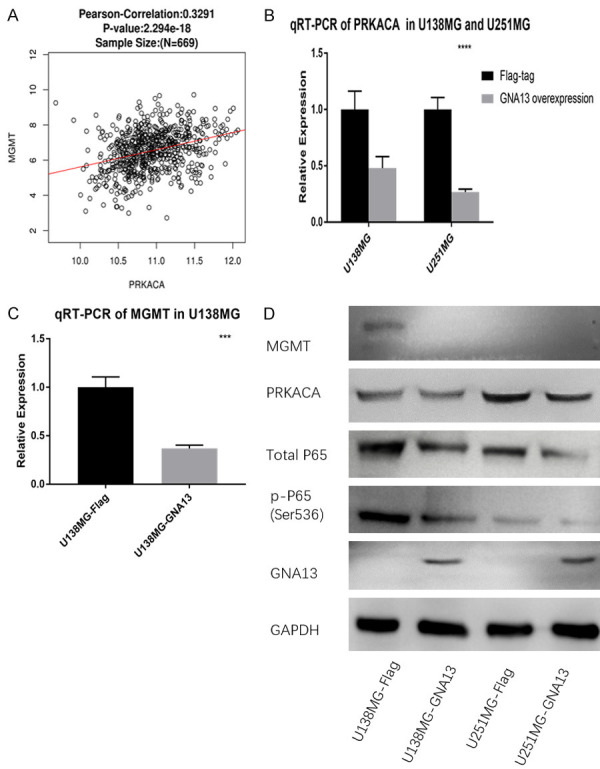
Cell lines and datasets evidence of GNA13 and TMZ sensitizations. A. Pearson’s correlation analysis shows that PRKACA is proportional to the expression of MGMT. B. qRT-PCR suggests that mRNA of PRKACA is downregulated in both GNA13-overexpressed cell lines of U251MG and U138MG. C. mRNA of MGMT decreases in GNA13-overexpressed U138MG cells. D. Result of immunoblot suggests that MGMT, total P65, p-P65 (Ser536) and PRKACA are significantly decreased in GNA13-overexpressed cells.
Figure 2
Figure 2
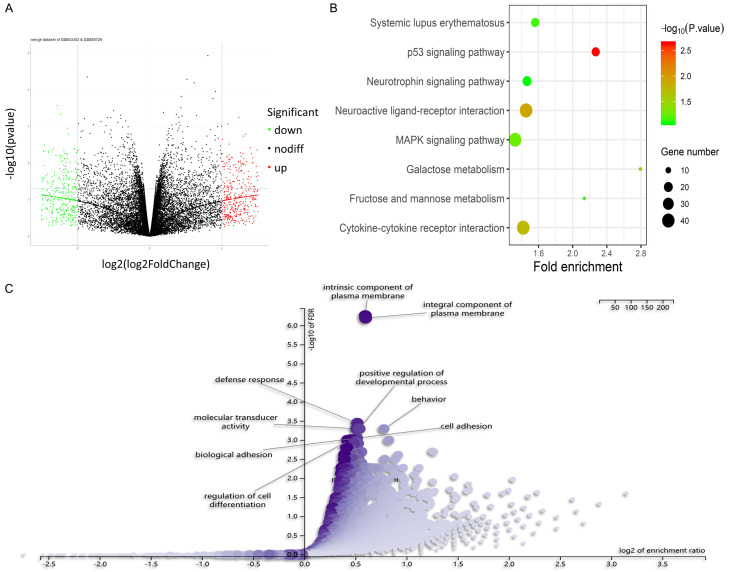
Preliminary bioinformatic analysis about TMZ resistance based on GSE data. A. A total of 2121 DEGs that were identified in the merged datasets and the logical relations of them in GSE80729 and GSE43452; 1695 of those were from GSE80729 while the other 426 were from GSE43452; 1038 were upregulated and 1083 were downregulated. B. The KEGG pathway analyses of DEGs in merged datasets indicated that the key genes responding to TMZ treatment are possibly associated with signal transduction activity, p53 signaling pathways and multicellular organismal process. C. The GO analyses of DEGs in merged datasets indicated that the key genes responding to TMZ treatment are possibly associated with plasma membrane.
Figure 3
Figure 3
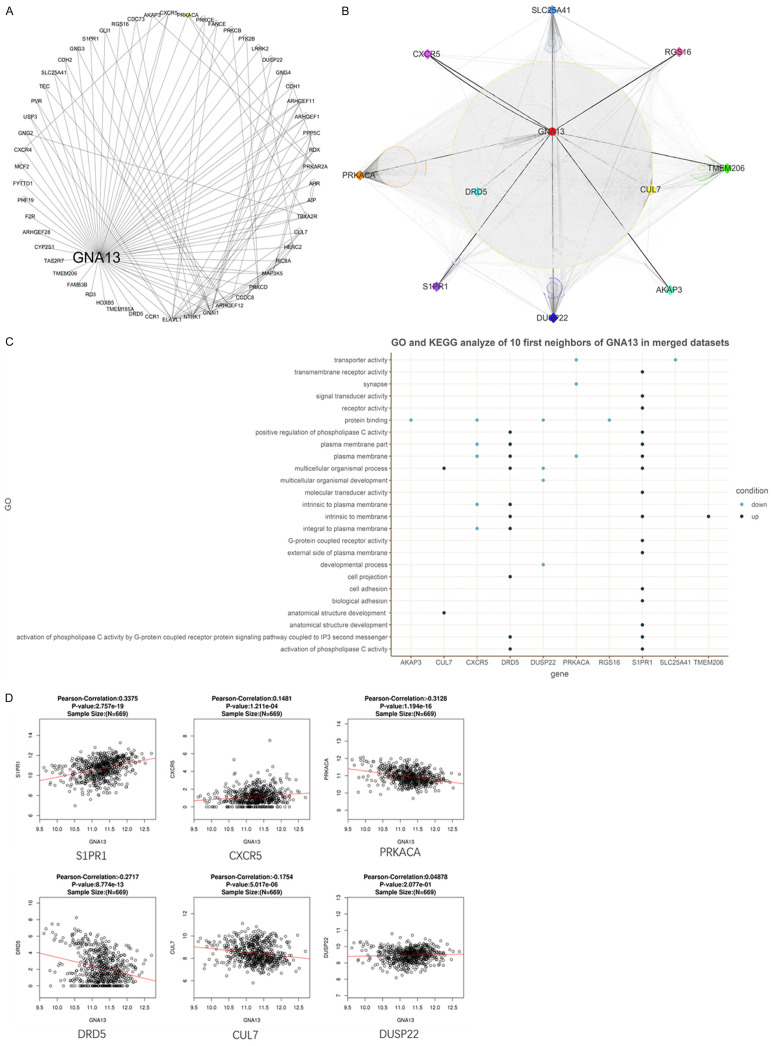
Basic informatic analysis of GNA13. A. A total of 56 first neighbors of GNA13 were identified in the PPI analysis of HRPD and BioGRID databases. B. The PPI network of 11 selected genes in HRPD and BioGRID databases. The black lines represent direct interactions among the 10 genes. The dark gray lines represent the interactions between the 10 genes and their first neighbors. The light gray lines represent the interactions among these first neighbors. PRKACA interacted with the most neighbors (directly and indirectly) among the 10 genes. C. The GO analysis of the merged datasets indicated that most of these 10 genes are plasma membrane (part). This analysis suggests that CUL7, CXCR5, DRD5, PRKACA, CUL7 and DUSP22 may be the downstream genes of GNA13 in regulating TMZ sensitization. D. Pearson’s correlation test pointed out that S1PR1 and CXCR5 are positively correlated to the expressed alteration of GNA13 while PRKACA, DRD5 and CUL7 are negatively correlated. DUSP22 shows no correlation with GNA13 in the GBMLGG dataset of TCGA.
Figure 4
Figure 4
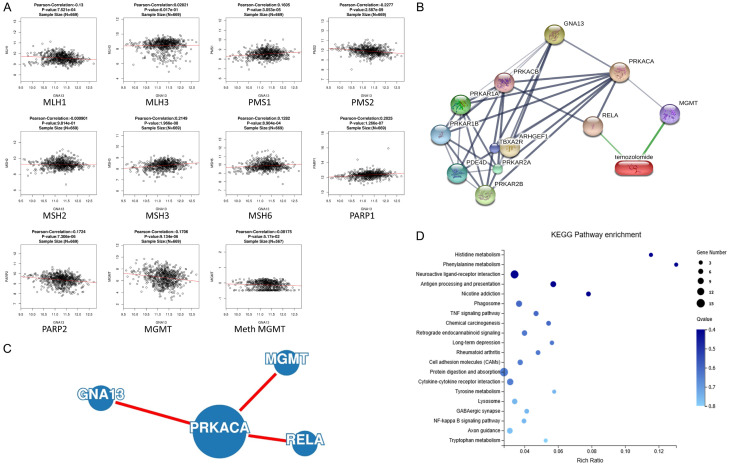
Bioinformatic analysis among GNA13 and TMZ resistance factors. A. Pearson’s correlation analysis shows that GNA13 is proportional to the expression of MGMT. B. The interactional network among GNA13, PRKACA and TMZ suggests that PRKACA can interact with MGMT and RELA, therefore it is responsive to TMZ stimulation. C. The PPI network among GNA13, PRKACA, RELA and MGMT as proven by one of the most effective PPI network tool, GeNets. D. RNA-seq indicated that 4 DEGs were enriched in NF-κB signaling pathway, which is one of the top 20 KEGG pathway enrichment analyses.

References

    1. Ahmed R, Oborski MJ, Hwang M, Lieberman FS, Mountz JM. Malignant gliomas: current perspectives in diagnosis, treatment, and early response assessment using advanced quantitative imaging methods. Cancer Manag Res. 2014;6:149–70. - PMC - PubMed
    1. O’Hayre M, Inoue A, Kufareva I, Wang Z, Mikelis CM, Drummond RA, Avino S, Finkel K, Kalim KW, DiPasquale G, Guo F, Aoki J, Zheng Y, Lionakis MS, Molinolo AA, Gutkind JS. Inactivating mutations in GNA13 and RHOA in Burkitt’s lymphoma and diffuse large B-cell lymphoma: a tumor suppressor function for the Galpha13/RhoA axis in B cells. Oncogene. 2016;35:3771–80. - PMC - PubMed
    1. Zhang JX, Yun M, Xu Y, Chen JW, Weng HW, Zheng ZS, Chen C, Xie D, Ye S. GNA13 as a prognostic factor and mediator of gastric cancer progression. Oncotarget. 2016;7:4414–27. - PMC - PubMed
    1. Rasheed SAK, Leong HS, Lakshmanan M, Raju A, Dadlani D, Chong FT, Shannon NB, Rajarethinam R, Skanthakumar T, Tan EY, Hwang JSG, Lim KH, Tan DS, Ceppi P, Wang M, Tergaonkar V, Casey PJ, Iyer NG. GNA13 expression promotes drug resistance and tumor-initiating phenotypes in squamous cell cancers. Oncogene. 2018;37:1340–53. - PMC - PubMed
    1. Kelley GG, Reks SE, Smrcka AV. Hormonal regulation of phospholipase Cepsilon through distinct and overlapping pathways involving G12 and Ras family G-proteins. Biochem J. 2004;378:129–39. - PMC - PubMed

LinkOut - more resources