


Blockchain-Empowered Multi-Robot Collaboration to Fight COVID-19 and Future Pandemics
- PMID: 34786312
- PMCID: PMC8545252
- DOI: 10.1109/ACCESS.2020.3032450
Blockchain-Empowered Multi-Robot Collaboration to Fight COVID-19 and Future Pandemics
Abstract
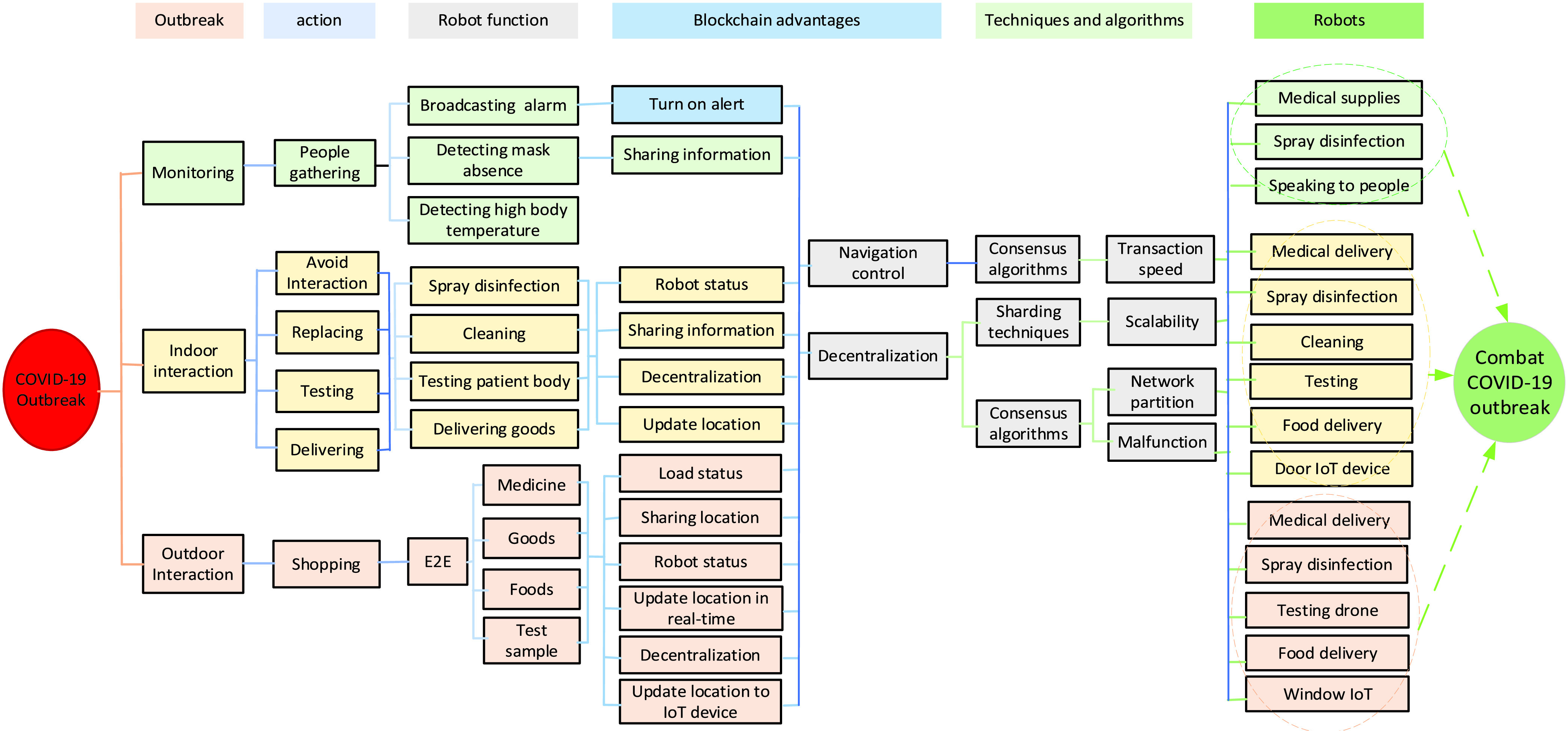
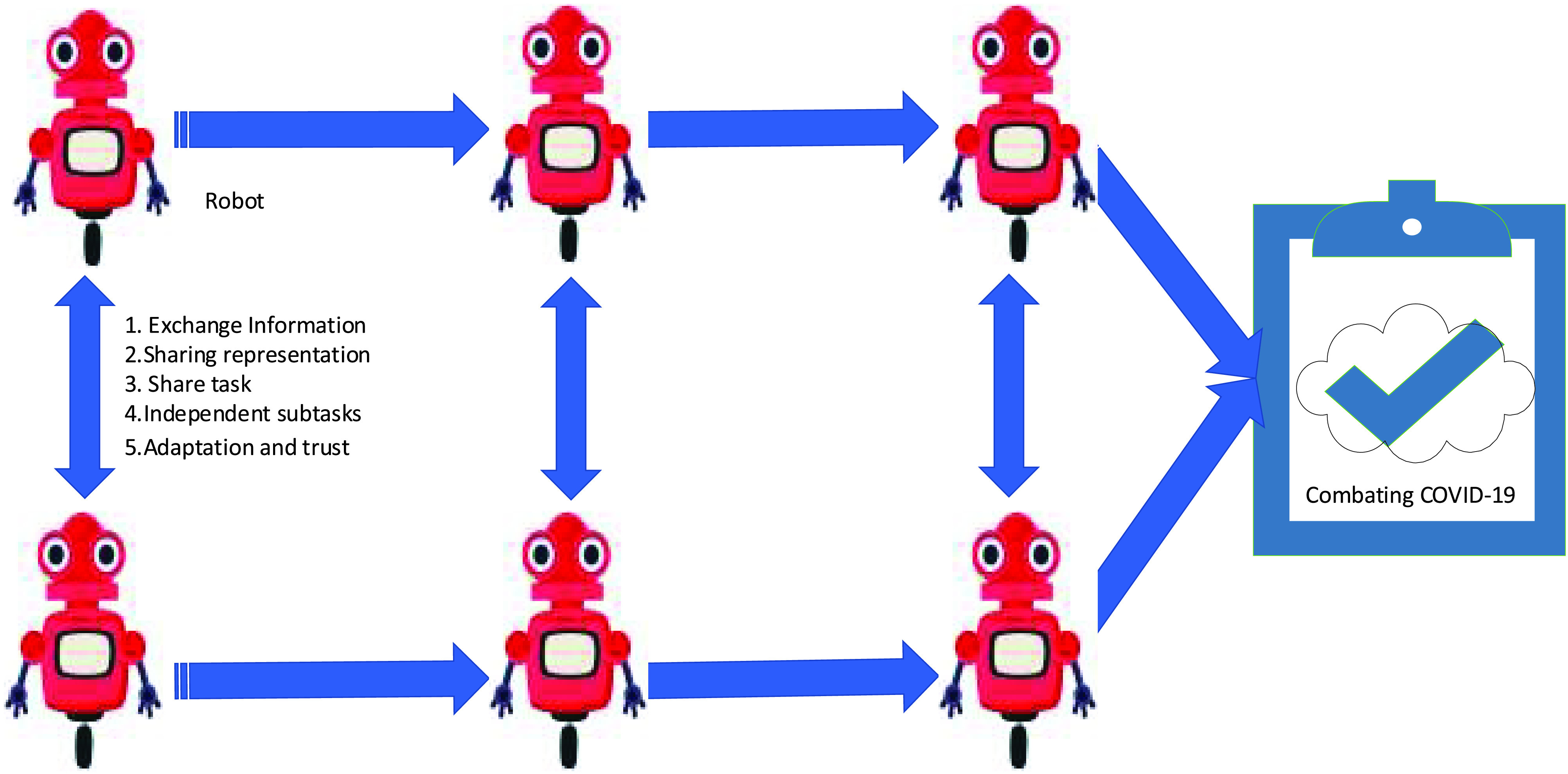
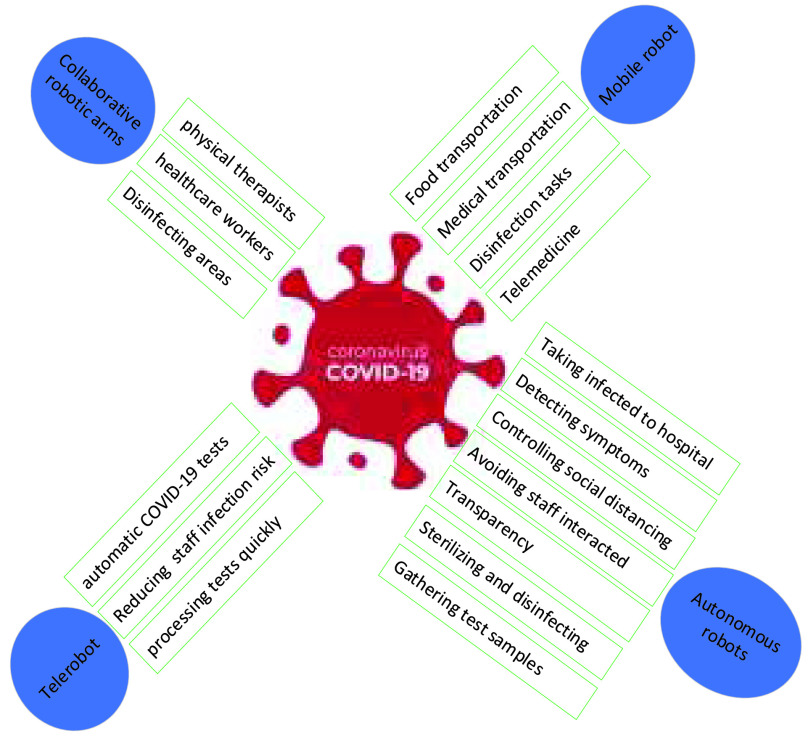
This conceptual paper overviews how blockchain technology is involving the operation of multi-robot collaboration for combating COVID-19 and future pandemics. Robots are a promising technology for providing many tasks such as spraying, disinfection, cleaning, treating, detecting high body temperature/mask absence, and delivering goods and medical supplies experiencing an epidemic COVID-19. For combating COVID-19, many heterogeneous and homogenous robots are required to perform different tasks for supporting different purposes in the quarantine area. Managmnt and decentralizing multi-robot play a vital role in combating COVID-19 by reducing human interaction, monitoring, delivering goods. Blockchain technology can manage multi-robot collaboration in a decentralized fashion, improve the interaction among them to exchange information, share representation, share goals, and trust. We highlight the challenges and provide the tactical solutions enabled by integrating blockchain and multi-robot collaboration to combat the COVID-19 pandemic. The proposed conceptual framework can increase the intelligence, decentralization, and autonomous operations of connected multi-robot collaboration in the blockchain network. We overview blockchain potential benefits to defining a framework of multi-robot collaboration applications to combat COVID-19 epidemics such as monitoring and outdoor and hospital End to End (E2E) delivery systems. Furthermore, we discuss the challenges and opportunities of integrated blockchain, multi-robot collaboration, and the Internet of Things (IoT) for combating COVID-19 and future pandemics.
Keywords: Blockchain; COVID-19; E2E delivery system; decentralization; infectious diseases; multi-robot collaboration; pandemic; quarantine; smart healthcare.
This work is licensed under a Creative Commons Attribution 4.0 License. For more information, see https://creativecommons.org/licenses/by/4.0/.
Figures
References
-
- WHO. (2020). Coronavirus Disease (COVID-19) Pandemics. Accessed Oct. 16, 2020. [Online]. Available: https://www.who.int/emergencies/diseases/novel-coronavirus-2019
-
- To K. K.-W., Tsang O. T.-Y., Yip C., Chan K.-H., Wu T.-C., Chan J. M.-C., Leung W.-S., Chik T. S.-H., Choi C. Y.-C., Kandamby D. H., Lung D. C., Tam A. R., Poon R. W.-S., Fung A. Y.-F., Hung I. F.-N., Cheng V. C.-C., Cheng V. C.-C., and Yuen K.-Y., “Consistent detection of 2019 novel coronavirus in saliva,” Clinical Infectious Diseases, vol. 71, no. 15, Aug. 2020, doi: 10.1093/cid/ciaa149. - DOI - PMC - PubMed
-
- Demaitre E.. (2020). Coronavirus Response Growing From Robotics Companies. Accessed: Mar. 3, 2020. [Online]. Available: https://www.therobotreport.com/coronavirus-response-growing-robotics-com...
-
- Chamola V., Hassija V., Gupta V., and Guizani M., “A comprehensive review of the COVID-19 pandemic and the role of IoT, drones, AI, blockchain, and 5G in managing its impact,” IEEE Access, vol. 8, pp. 90225–90265, 2020.
-
- Alsamhi S., Ma O., and Ansari M. S., “Convergence of machine learning and robotics communication in collaborative assembly: Mobility, connectivity and future perspectives,” J. Intell. Robotic Syst., vol. 98, pp. 1–26, Jun. 2020, doi: 10.1007/s10846-019-01079-x. - DOI
LinkOut - more resources
Full Text Sources
Other Literature Sources