


Neoadjuvant radiotherapy dose escalation for locally advanced rectal cancers in the new era of radiotherapy: A review of literature
- PMID: 34786390
- PMCID: PMC8567526
- DOI: 10.12998/wjcc.v9.i30.9077
Neoadjuvant radiotherapy dose escalation for locally advanced rectal cancers in the new era of radiotherapy: A review of literature
Abstract
Background: The standard treatment of locally advanced rectal cancers (LARC) consists on neoadjuvant chemoradiotherapy followed by total mesorectal excision. Different data in literature showed a benefit on tumor downstaging and pathological complete response (pCR) rate using radiotherapy dose escalation, however there is shortage of studies regarding dose escalation using the innovative techniques for LARC (T3-4 or N1-2).
Aim: To analyze the role of neoadjuvant radiotherapy dose escalation for LARC using innovative radiotherapy techniques.
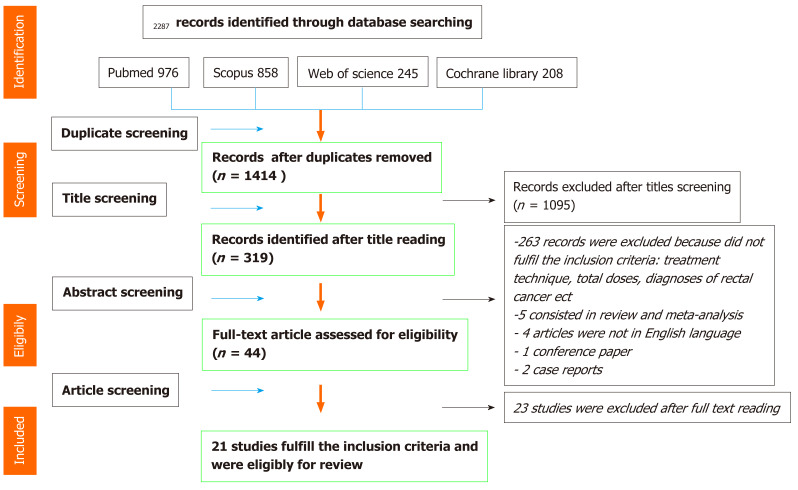
Methods: In December 2020, we conducted a comprehensive literature search of the following electronic databases: PubMed, Web of Science, Scopus and Cochrane library. The limit period of research included articles published from January 2009 to December 2020. Screening by title and abstract was carried out to identify only studies using radiation doses equivalent dose 2 Gy fraction (EQD2) ≥ 54 Gy and Volumetric Modulated Arc Therapy (VMAT), intensity-modulated radiotherapy or image-guided radiotherapy (IGRT) techniques. The authors' searches generated a total of 2287 results and, according to PRISMA Group (2009) screening process, 21 publications fulfil selection criteria and were included for the review.
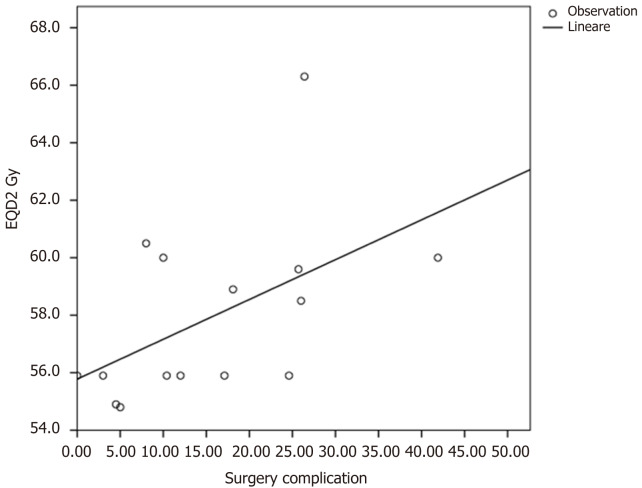
Results: The main radiotherapy technique used consisted in VMAT and IGRT modality. The mainly dose prescription was 55 Gy to high risk volume and 45 Gy as prophylactic volume in 25 fractions given with simultaneous integrated boosts technique (42.85%). The mean pCR was 28.2% with no correlation between dose prescribed and response rates (P value ≥ 0.5). The R0 margins and sphincter preservation rates were 98.88% and 76.03%, respectively. After a mean follow-up of 35 months local control was 92.29%. G3 or higher toxicity was 11.06% with no correlation between dose prescription and toxicities. Patients receiving EQD2 dose > 58.9 Gy and BED > 70.7 Gy had higher surgical complications rates compared to other group (P value = 0.047).
Conclusion: Dose escalation neoadjuvant radiotherapy using innovative techniques is safe for LARC achieving higher rates of pCR. EQD2 doses > 58.9 Gy is associated with higher rate of surgical complications.
Keywords: Image-guided radiotherapy; Intensity-modulated radiotherapy; Neoadjuvant radiotherapy; Radiotherapy; Rectal cancer; Volumetric Modulated Arc Therapy.
©The Author(s) 2021. Published by Baishideng Publishing Group Inc. All rights reserved.
Conflict of interest statement
Conflict-of-interest statement: The authors declare that they have no conflict of interest.
Figures
References
-
- Siegel RL, Miller KD, Goding Sauer A, Fedewa SA, Butterly LF, Anderson JC, Cercek A, Smith RA, Jemal A. Colorectal cancer statistics, 2020. CA Cancer J Clin. 2020;70:145–164. - PubMed
-
- Glynne-Jones R, Wyrwicz L, Tiret E, Brown G, Rödel C, Cervantes A, Arnold D ESMO Guidelines Committee. Rectal cancer: ESMO Clinical Practice Guidelines for diagnosis, treatment and follow-up. Ann Oncol. 2017;28:iv22–iv40. - PubMed
-
- Clinical Practice Guidelines in Oncology (NCCN Guidelines), Rectal Cancer. Version 1 2021. [cited 20 February 2021]. Available from: https://www.nccn.org/professionals/physician_gls/PDF/rectal.pdf .
-
- Swedish Rectal Cancer Trial, Cedermark B, Dahlberg M, Glimelius B, Påhlman L, Rutqvist LE, Wilking N. Improved survival with preoperative radiotherapy in resectable rectal cancer. N Engl J Med. 1997;336:980–987. - PubMed
-
- Chen ET, Mohiuddin M, Brodovsky H, Fishbein G, Marks G. Downstaging of advanced rectal cancer following combined preoperative chemotherapy and high dose radiation. Int J Radiat Oncol Biol Phys. 1994;30:169–175. - PubMed
LinkOut - more resources
Full Text Sources
