


What is Standard Dose of Rivaroxaban in Elderly Asian Patients with Atrial Fibrillation: 20ms versus. 15mg?
- PMID: 34786989
- PMCID: PMC8606923
- DOI: 10.1177/10760296211061148
What is Standard Dose of Rivaroxaban in Elderly Asian Patients with Atrial Fibrillation: 20ms versus. 15mg?
Abstract
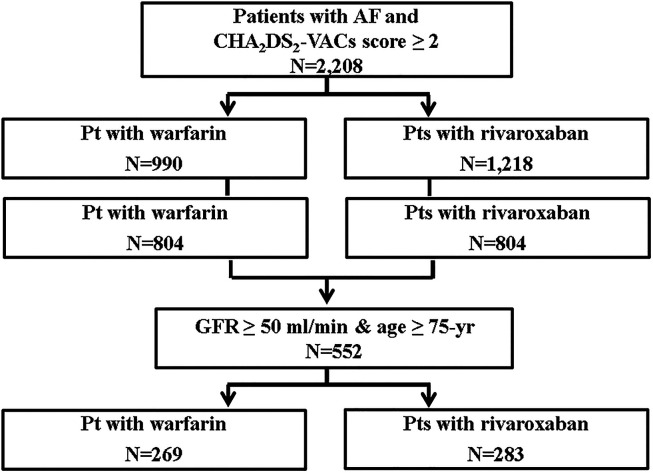
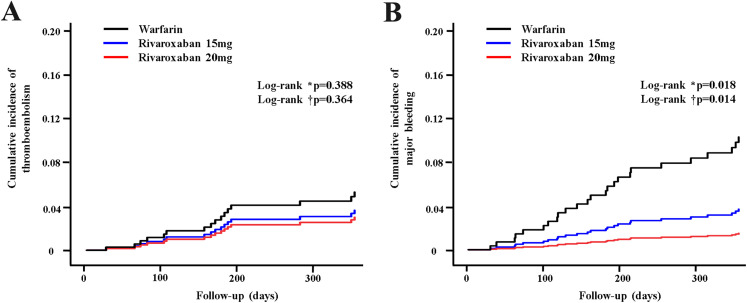
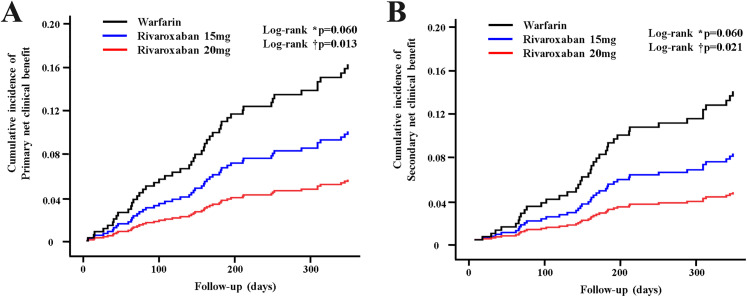
Although there is no age criterion for rivaroxaban dose reduction, elderly patients with atrial fibrillation (AF) are often prescribed an off-label reduced dose. We aimed to evaluate whether age is a necessary criterion for rivaroxaban dose reduction in Korean patients with AF. Among 2208 patients who prescribed warfarin or rivaroxaban, 552 patients over 75 years without renal dysfunction (creatinine clearance >50 mL/min) were compared based on propensity score matching. The rivaroxaban group was further divided into a 20 mg (R20; on-label) and a 15 mg (R15; off-label). Primary net clinical benefit (NCB) was defined as the composite of stroke, systemic embolism, major bleeding, and all-cause mortality. Secondary NCB was defined as the composite of stroke, systemic embolism, and major bleeding. Patients were followed for 1 year, or until the first outcome occurrence. Both rivaroxaban groups had comparable efficacy compared with warfarin. However, both R20 (0.9% vs 7.4%, p = .014) and R15 (2.3% vs 7.4%, p = .018) had a significant reduction in major bleeding. There were no differences in efficacy or safety outcomes between R20 and R15. R20 had significantly reduced primary (hazard ratio [HR] 0.33, 95% confidence interval [CI]: 0.12-0.93) and secondary (HR 0.31, 95% CI: 0.10-0.93) NCBs compared with warfarin. However, primary and secondary NCBs were not reduced in R15. In real-world practice with elderly patients with AF, off-label rivaroxaban dose reduction to 15 mg conferred no benefits. Therefore, guideline-adherent rivaroxaban 20 mg is favorable in elderly Korean patients with AF.
Keywords: age groups; atrial fibrillation; reference standards; rivaroxaban.
Conflict of interest statement
Figures
References
-
- Lee SR, Choi EK, Han KD, Cha MJ, Oh S. Trends in the incidence and prevalence of atrial fibrillation and estimated thromboembolic risk using the CHA2DS2-VASc score in the entire Korean population. Int J Cardiol. 2017 ;236:226-231. - PubMed
-
- Connolly S, Pogue J, Hart R, et al. Clopidogrel plus aspirin versus oral anticoagulation for atrial fibrillation in the atrial fibrillation clopidogrel trial with irbesartan for prevention of vascular events (ACTIVE W): a randomised controlled trial. Lancet. 2006;367(9526):1903-1912. - PubMed
-
- Shen AY, Yao JF, Brar SS, Jorgensen MB, Chen W. Racial/ethnic differences in the risk of intracranial hemorrhage among patients with atrial fibrillation. J Am Coll Cardiol. 2007;50(4):309-315. - PubMed
-
- Lee SR, Choi EK, Han KD, Cha MJ, Oh S, Lip GYH. Temporal trends of antithrombotic therapy for stroke prevention in Korean patients with non-valvular atrial fibrillation in the era of non-vitamin K antagonist oral anticoagulants: a nationwide population-based study. PLoS One. 2017;12(12):e0189495. - PMC - PubMed
-
- Ruff CT, Giugliano RP, Braunwald E, et al. Comparison of the efficacy and safety of new oral anticoagulants with warfarin in patients with atrial fibrillation: a meta-analysis of randomised trials. Lancet. 2014;383(9921):955-962. - PubMed
MeSH terms
Substances
LinkOut - more resources
Full Text Sources
Medical
