Prevalence of Vitiligo Among Adults in the United States
- PMID: 34787670
- PMCID: PMC8600454
- DOI: 10.1001/jamadermatol.2021.4724
Prevalence of Vitiligo Among Adults in the United States
Abstract
Importance: Vitiligo can have profound effects on patients and is often associated with other autoimmune comorbid conditions. It is important to understand the current prevalence of vitiligo, including diagnosed, undiagnosed, and subtypes (nonsegmental and segmental).
Objective: To estimate the point prevalence of vitiligo in the US.
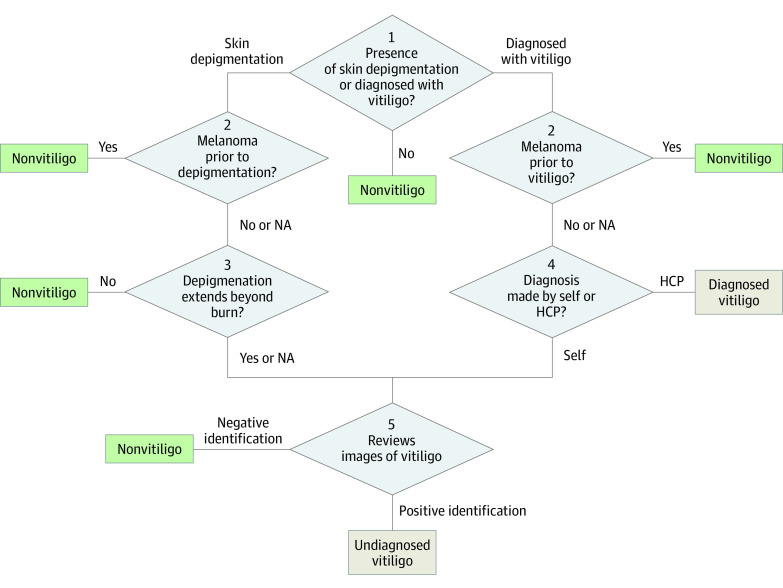
Design, setting, and participants: For this population-based study of adults in the US, a cross-sectional online survey was administered between December 2019 and March 2020 to obtain participant self-reported vitiligo status. A representative sample of the US adult general population, aged 18 to 85 years, was recruited using a stratified proportional, sampling design from general population research panels. Additionally, 3 expert dermatologists adjudicated participants' self-reported vitiligo diagnosis by reviewing photographs uploaded by the participants using a teledermatology app designed and tested specifically for this study.
Main outcomes and measures: The main outcomes were the point prevalence estimates of overall vitiligo, as well as diagnosed, undiagnosed, nonsegmental, and segmental vitiligo.
Results: Among the 40 888 eligible adult participants, the mean (SD) age was 44.9 (17.4) years, 23 170 (56.7%) were female, 30 428 (74.4%) were White, and 4225 (10.3%) were of Hispanic, Latino, or Spanish origin. Self-reported vitiligo prevalence was 1.38% (95% CI, 1.26%-1.49%), with 0.77% (95% CI, 0.68%-0.85%) for diagnosed and 0.61% (95% CI, 0.54%-0.69%) for undiagnosed. Based on expert dermatologist review of 113 photographs of participants with self-reported vitiligo, clinician-adjudicated vitiligo prevalence (sensitivity bounds) was 0.76% (0.76%-1.11%), with 0.46% (0.46%-0.61%) for diagnosed and 0.29% (0.29%-0.50%) for undiagnosed. Self-reported nonsegmental vitiligo prevalence was 0.77% (95% CI, 0.68%-0.85%), with 0.48% (95% CI, 0.41%-0.55%) for diagnosed and 0.29% (95% CI, 0.23%-0.34%) for undiagnosed. Clinician-adjudicated nonsegmental vitiligo prevalence (sensitivity bounds) was 0.58% (0.57%-0.84%), with 0.37% (0.37%-0.49%) for diagnosed and 0.21% (0.20%-0.36%) for undiagnosed. Self-reported segmental vitiligo prevalence was 0.61% (95% CI, 0.53%-0.69%), with 0.28% (95% CI, 0.23%-0.33%) for diagnosed and 0.33% (95% CI, 0.27%-0.38%) for undiagnosed. Clinician-adjudicated segmental vitiligo prevalence (sensitivity bounds) was 0.18% (0.18%-0.27%), with 0.09% (0.09%-0.12%) for diagnosed and 0.08% (0.08%-0.15%) for undiagnosed.
Conclusions and relevance: Results of this survey study demonstrated that the current US population-based prevalence estimate of overall (diagnosed and undiagnosed combined) vitiligo in adults is between 0.76% (1.9 million cases in 2020) and 1.11% (2.8 million cases in 2020). Additionally, this study suggests that approximately 40% of adult vitiligo in the US may be undiagnosed. Future studies should be performed to confirm these findings.
Conflict of interest statement
Figures
References
-
- MedlinePlus . Vitiligo. US National Library of Medicine . Updated August 18, 2020. Accessed October 19, 2021. https://medlineplus.gov/genetics/condition/vitiligo/
Publication types
MeSH terms
LinkOut - more resources
Full Text Sources
Other Literature Sources
Medical