


Serum nitric oxide levels are depleted in depressed patients treated with electroconvulsive therapy
- PMID: 34789933
- PMCID: PMC8522622
- DOI: 10.4103/indianjpsychiatry.indianjpsychiatry_1441_20
Serum nitric oxide levels are depleted in depressed patients treated with electroconvulsive therapy
Abstract
Background: Nitric oxide (NO) is an endogenous substance which has several endocrine functions and may act as neurotransmitter in the brain. High levels of NO may provoke nitrosative stress.
Aim: It was aimed to examine serum levels of NO in patients with depressive episodes who were treated with electroconvulsive therapy (ECT) in this study.
Methods: The design was a case-control, follow-up study. Patients with depressive episodes (n = 23) and a healthy control group (n = 21) were enrolled. Three serum samples were obtained from the patient group (before ECT, after first and seventh sessions). NO, nitrite, and nitrate levels were examined.
Statistical analysis: Differences between groups were examined with t-test or Mann-Whitney U-test. Longitudinal data were evaluated with Panel Regression Analysis and Kruskal-Wallis Test.
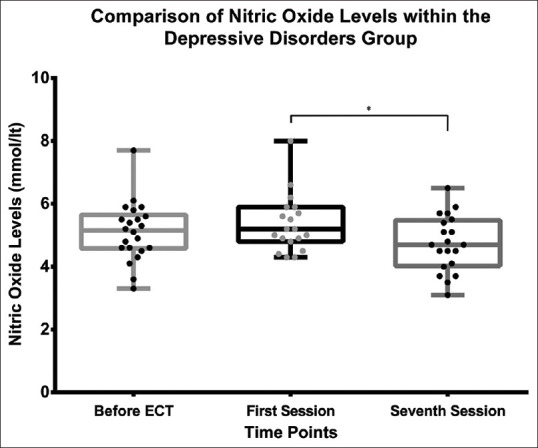
Results: Serum levels of NO and nitrite decreased significantly after the seventh session of ECT administration compared to the baseline and first session. Nitrate levels did not differ between the assessments.
Conclusions: Reduction of the serum NO and nitrite levels might be a contributing factor for hypertension during the sessions. These findings are reflect the circulating NO levels. Further studies may dissect NO physiology in the brain in mental disorders and potential external effects.
Keywords: Depressive disorder; electroconvulsive therapy; nitric oxide.
Copyright: © 2021 Indian Journal of Psychiatry.
Conflict of interest statement
There are no conflicts of interest.
Figures
References
-
- Iancu SC, Wong YM, Rhebergen D, van Balkom AJ, Batelaan NM. Long-term disability in major depressive disorder: A 6-year follow-up study. Psychol Med. 2020;50:1644–52. - PubMed
-
- Malhi GS, Outhred T, Morris G, Boyce PM, Bryant R, Fitzgerald PB, et al. Royal Australian and New Zealand College of Psychiatrists clinical practice guidelines for mood disorders: Bipolar disorder summary. Med J Aust. 2018;208:219–25. - PubMed
-
- Canbek O, Menges OO, Atagun MI, Kutlar MT, Kurt E. Report on 3 years’ experience in electroconvulsive therapy in Bakirkoy Research and Training Hospital for psychiatric and neurological diseases: 2008-2010. J ECT. 2013;29:51–7. - PubMed
-
- Canbek O, Yuksel G, Atagun MI, Ipekcıoglu D, Kurt E, Menges OO, et al. Geriatric ECT at a Turkish Teaching Hospital: A 5-year experience. J ECT. 2014;30:e28–9. - PubMed
-
- Tørring N, Sanghani SN, Petrides G, Kellner CH, Østergaard SD. The mortality rate of electroconvulsive therapy: A systematic review and pooled analysis. Acta Psychiatr Scand. 2017;135:388–97. - PubMed
LinkOut - more resources
Full Text Sources