


Development of an EAT-Lancet index and its relation to mortality in a Swedish population
- PMID: 34791011
- PMCID: PMC8895215
- DOI: 10.1093/ajcn/nqab369
Development of an EAT-Lancet index and its relation to mortality in a Swedish population
Abstract
Background: Current global food systems threaten human health and environmental sustainability. In 2019, the EAT-Lancet Commission on healthy diets from sustainable food systems defined the first global reference diet to improve both areas, but there is no consensus on how to quantify the EAT-Lancet reference diet as a diet index, and its relation to mortality has not been widely studied.
Objectives: We sought to develop a new dietary index to quantify adherence to the EAT-Lancet diet and assess its association with mortality in a large, population-based Swedish cohort. We also examined food components included in the index and their individual associations with mortality.
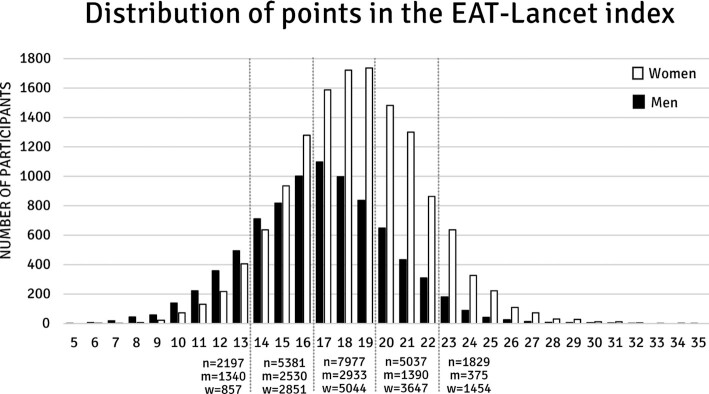
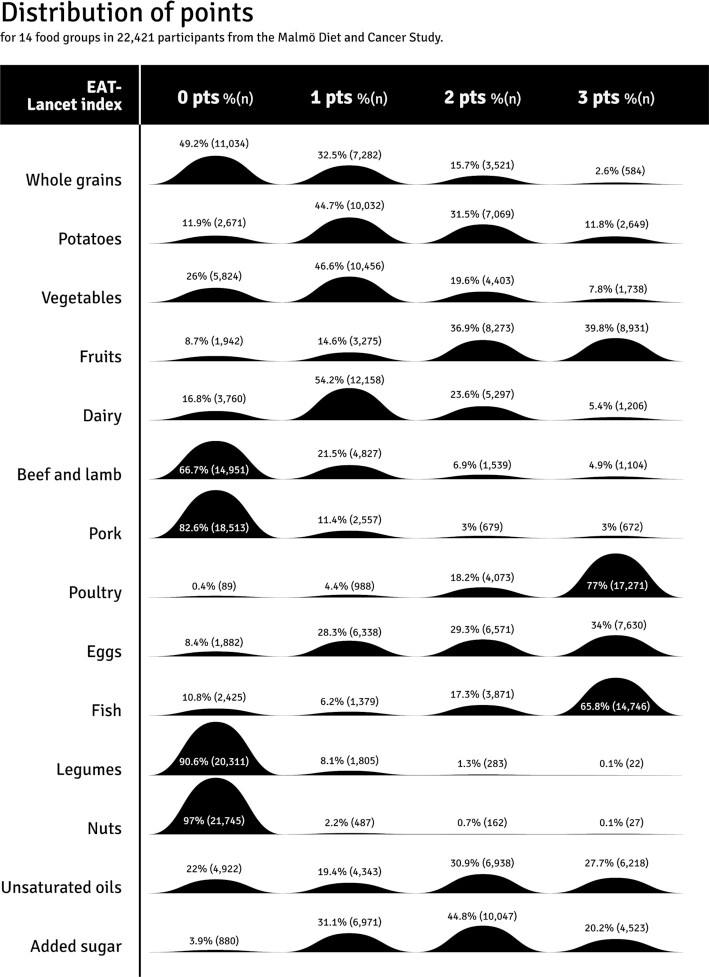
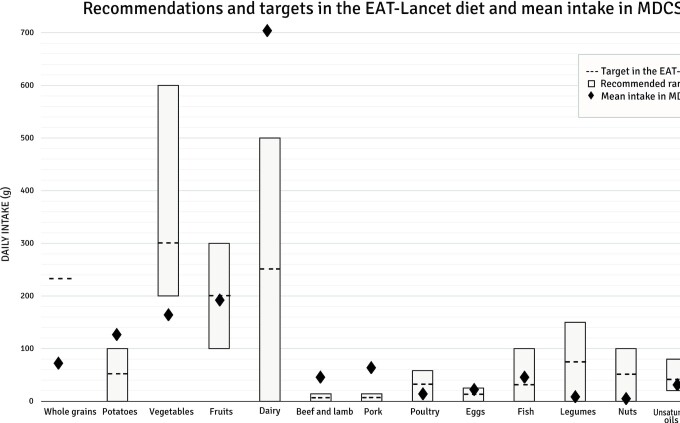
Methods: We used the Malmö Diet and Cancer cohort (n = 22,421; 45-73 years old at baseline). Dietary data were collected using a modified diet history method. The EAT-Lancet index was developed based on intake levels and reference intervals of 14 food components defined in the EAT-Lancet diet (0-3 points per component; 0-42 points in total). Associations with mortality were examined based on registers during a mean of 20 years of follow-up and were adjusted for potential confounders.
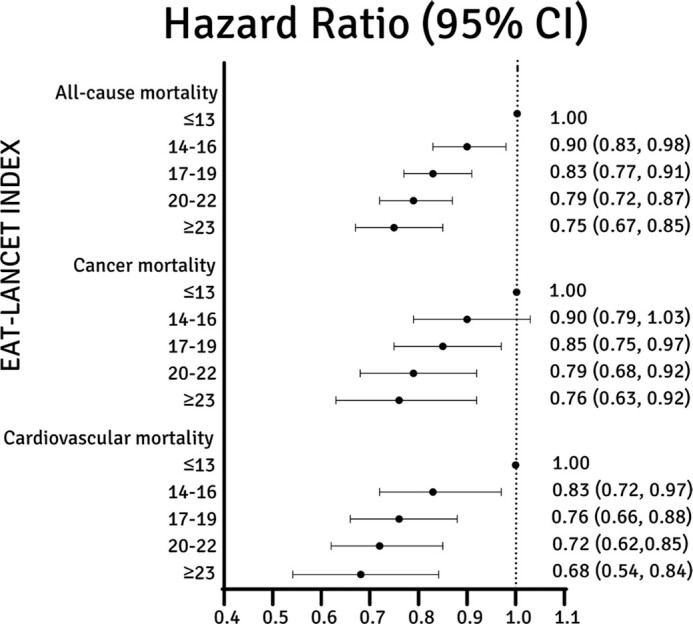
Results: Divided into 5 adherence groups, the highest adherence to the EAT-Lancet diet (≥23 points) was associated with lower all-cause mortality (HR, 0.75; 95% CI, 0.67-0.85), cancer mortality (HR, 0.76; 95% CI, 0.63-0.92), and cardiovascular mortality (HR, 0.68; 95% CI, 0.54-0.84) than the lowest adherence (≤13 points). Several food components included in the index contributed to the observed reductions in mortality.
Conclusions: We developed a new dietary index to investigate adherence to the EAT-Lancet diet. The findings indicate a 25% lower risk of mortality among those with the highest adherence to the EAT-Lancet diet, as defined using our index, which adds to the evidence base for the development of sustainable dietary guidelines.
Keywords: diet; environment; healthy eating; mortality; nutrition; survival; sustainable development.
© The Author(s) 2021. Published by Oxford University Press.
Figures
Comment in
-
The Planetary Health Diet Index scores proportionally and considers the intermediate values of the EAT-Lancet reference diet.Am J Clin Nutr. 2022 Apr 1;115(4):1237. doi: 10.1093/ajcn/nqac006. Am J Clin Nutr. 2022. PMID: 35362057 No abstract available.
References
-
- Fanzo J. Healthy and sustainable diets and food systems: The key to achieving Sustainable Development Goal 2?. Food Ethics. 2019;4(2):159–74.
-
- Food and Agrigulture Organization of the United Nations (FAO) . Our actions are our future–Healthy diets for a #ZEROHUNGER world. Rome, Italy: FAO; 2019.
-
- Springmann M, Clark M, Mason-D'Croz D, Wiebe K, Bodirsky BL, Lassaletta L, de Vries W, Vermeulen SJ, Herrero M, Carlson KMet al. Options for keeping the food system within environmental limits. Nature. 2018;562(7728):519–25. - PubMed
-
- The Intergovernmental Panel on Climate Change . Climate change 2014: Mitigation of climate change: Working Group III contribution to the IPCC Fifth Assessment Report. Cambridge, UK: Cambridge University Press; 2015.
-
- The Intergovernmental Panel on Climate Change . Climate change and land: an IPCC special report on climate change, desertification, land degradation, sustainable land management, food security, and greenhouse gas fluxes in terrestrial ecosystem. Geneva, Switzerland:The Interngovernmental Panel on Climate Change (IPCC);2019.
Publication types
MeSH terms
LinkOut - more resources
Full Text Sources
Medical
