


proChIPdb: a chromatin immunoprecipitation database for prokaryotic organisms
- PMID: 34791440
- PMCID: PMC8728212
- DOI: 10.1093/nar/gkab1043
proChIPdb: a chromatin immunoprecipitation database for prokaryotic organisms
Erratum in
-
Correction to 'proChIPdb: a chromatin immunoprecipitation database for prokaryotic organisms'.Nucleic Acids Res. 2025 Jul 19;53(14):gkaf769. doi: 10.1093/nar/gkaf769. Nucleic Acids Res. 2025. PMID: 40737097 Free PMC article. No abstract available.
Abstract
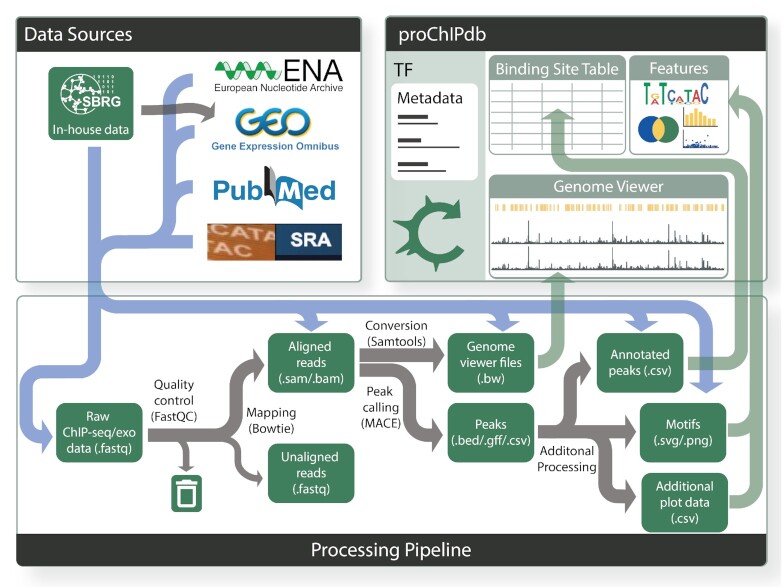
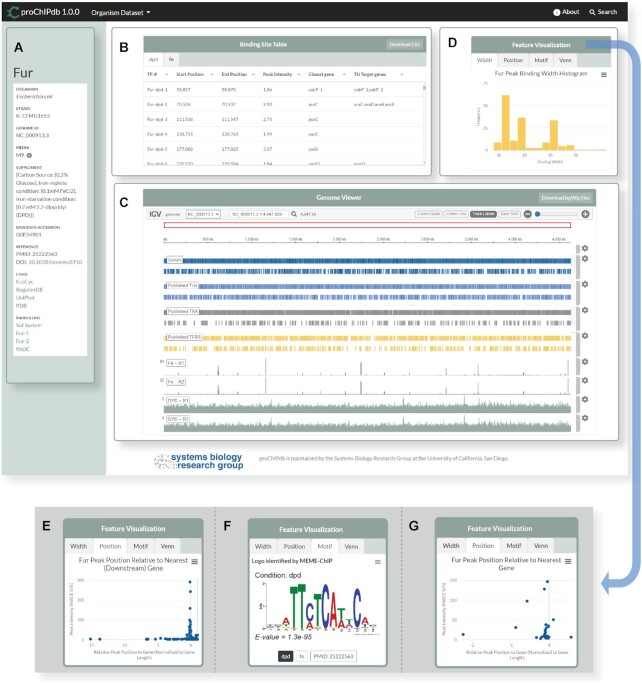
The transcriptional regulatory network in prokaryotes controls global gene expression mostly through transcription factors (TFs), which are DNA-binding proteins. Chromatin immunoprecipitation (ChIP) with DNA sequencing methods can identify TF binding sites across the genome, providing a bottom-up, mechanistic understanding of how gene expression is regulated. ChIP provides indispensable evidence toward the goal of acquiring a comprehensive understanding of cellular adaptation and regulation, including condition-specificity. ChIP-derived data's importance and labor-intensiveness motivate its broad dissemination and reuse, which is currently an unmet need in the prokaryotic domain. To fill this gap, we present proChIPdb (prochipdb.org), an information-rich, interactive web database. This website collects public ChIP-seq/-exo data across several prokaryotes and presents them in dashboards that include curated binding sites, nucleotide-resolution genome viewers, and summary plots such as motif enrichment sequence logos. Users can search for TFs of interest or their target genes, download all data, dashboards, and visuals, and follow external links to understand regulons through biological databases and the literature. This initial release of proChIPdb covers diverse organisms, including most major TFs of Escherichia coli, and can be expanded to support regulon discovery across the prokaryotic domain.
© The Author(s) 2021. Published by Oxford University Press on behalf of Nucleic Acids Research.
Figures
References
-
- Raha D., Hong M., Snyder M.. ChIP-Seq: a method for global identification of regulatory elements in the genome. Curr. Protoc. Mol. Biol. 2010; Chapter 21:Unit 21.19.1–Unit 21.19.14. - PubMed
