


Implementation of platform trials in the COVID-19 pandemic: A rapid review
- PMID: 34793985
- PMCID: PMC8591985
- DOI: 10.1016/j.cct.2021.106625
Implementation of platform trials in the COVID-19 pandemic: A rapid review
Abstract
Motivation: Platform designs - master protocols that allow for new treatment arms to be added over time - have gained considerable attention in recent years. Between 2001 and 2019, 16 platform trials were initiated globally. The COVID-19 pandemic seems to have provided a new motivation for these designs. We conducted a rapid review to quantify and describe platform trials used in COVID-19.
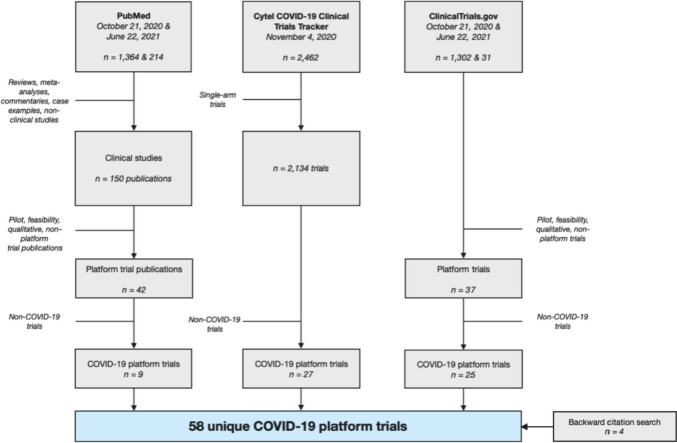
Methods: We cross-referenced PubMed, ClinicalTrials.gov, and the Cytel COVID-19 Clinical Trials Tracker to identify platform trials, defined by their stated ability to add future arms.
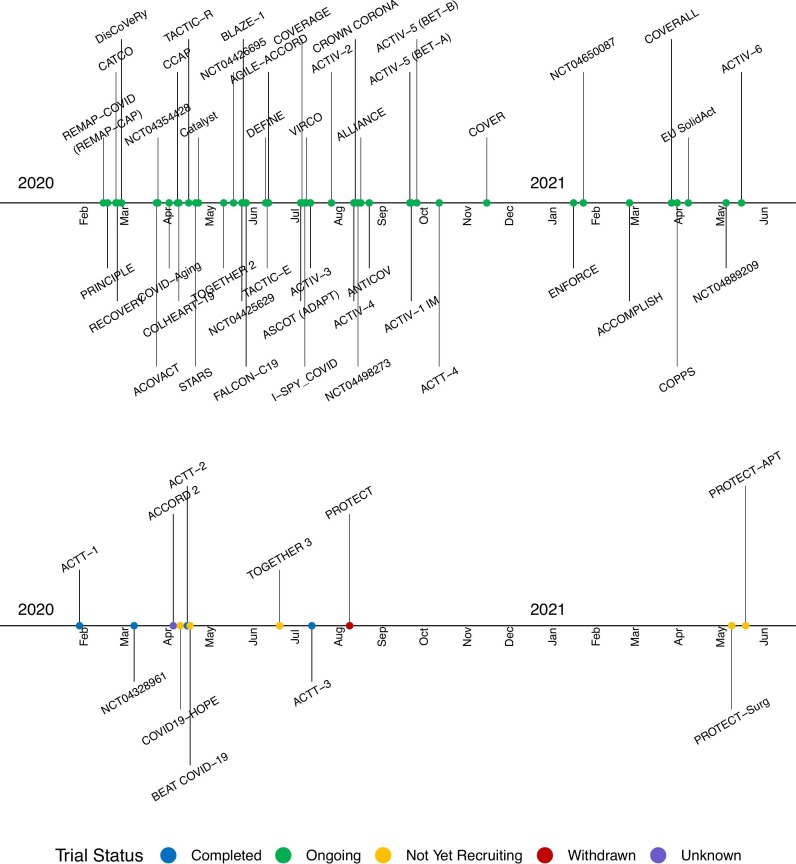
Results: We identified 58 COVID-19 platform trials globally registered between January 2020 and May 2021. According to trial registries, 16 trials have added new therapies (median 3, IQR 4) and 11 have dropped arms (median 3, IQR 2.5). About 50% of trials publicly share their protocol, and 31 trials (53%) intend to share trial data. Forty-nine trials (84%) explicitly report adaptive features, and 21 trials (36%) state Bayesian methods.
Conclusions: During the pandemic, there has been a surge in the number of platform trials compared to historical use. While transparency in statistical methods and clarity of data sharing policies needs improvement, platform trials appear particularly well-suited for rapid evidence generation. Trials secured funding quickly and many succeeded in adding new therapies in a short time period, thus demonstrating the potential for these trial designs to be implemented beyond the pandemic. The evidence gathered here may provide ample insight to further inform operational, statistical, and regulatory aspects of future platform trial conduct.
Keywords: Adaptive design; COVID-19; Drug development; Master protocols; Platform trials.
Copyright © 2021 The Authors. Published by Elsevier Inc. All rights reserved.
Conflict of interest statement
CY serves as a consultant/independent contractor with Faron Pharmaceuticals, and as an honorarium recipient with Celgene. JMB reports grants and non-financial support from AstraZeneca, Merck Sharp & Dohme, Puma Biotechnology, Clovis Oncology, Pfizer, Janssen-Cilag, Novartis, Roche, and Eli Lilly.
Figures
References
-
- Nasrallah A.A., Farran S.H., Nasrallah Z.A., Chahrour M.A., Salhab H.A., Fares M.Y., Khachfe H.H., Akl E.A. A large number of COVID-19 interventional clinical trials were registered soon after the pandemic onset: a descriptive analysis. J. Clin. Epidemiol. 2020;125:170–178. doi: 10.1016/j.jclinepi.2020.06.005. - DOI - PMC - PubMed
-
- National Library of Medicine ClinicalTrials.gov COVID-19 Studies. 2021. https://clinicaltrials.gov/ct2/results?cond=COVID-19&age_v=&gndr=&type=I... (n.d.) (accessed July 19, 2021)
-
- Dimairo M., Pallmann P., Wason J., Todd S., Jaki T., Julious S.A., Mander A.P., Weir C.J., Koenig F., Walton M.K., Nicholl J.P., Coates E., Biggs K., Hamasaki T., Proschan M.A., Scott J.A., Ando Y., Hind D., Altman D.G., ACE Consensus Group The Adaptive designs CONSORT extension (ACE) statement: a checklist with explanation and elaboration guideline for reporting randomised trials that use an adaptive design. BMJ. 2020;369:m115. doi: 10.1136/bmj.m115. - DOI - PMC - PubMed
Publication types
MeSH terms
LinkOut - more resources
Full Text Sources
Medical
