


Antimicrobial resistance and antibiotic consumption in intensive care units, Switzerland, 2009 to 2018
- PMID: 34794535
- PMCID: PMC8603405
- DOI: 10.2807/1560-7917.ES.2021.26.46.2001537
Antimicrobial resistance and antibiotic consumption in intensive care units, Switzerland, 2009 to 2018
Abstract
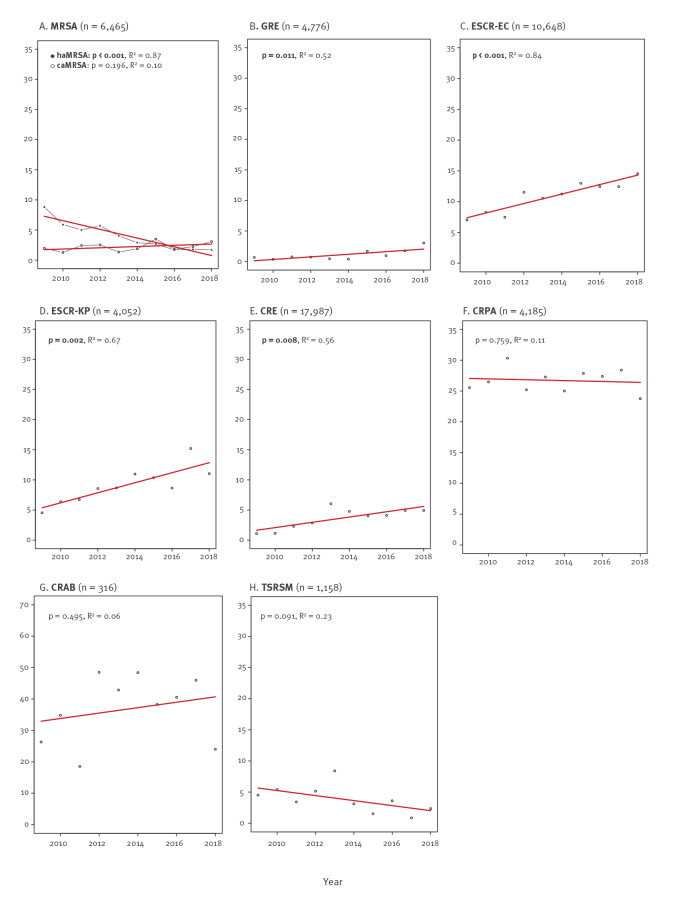
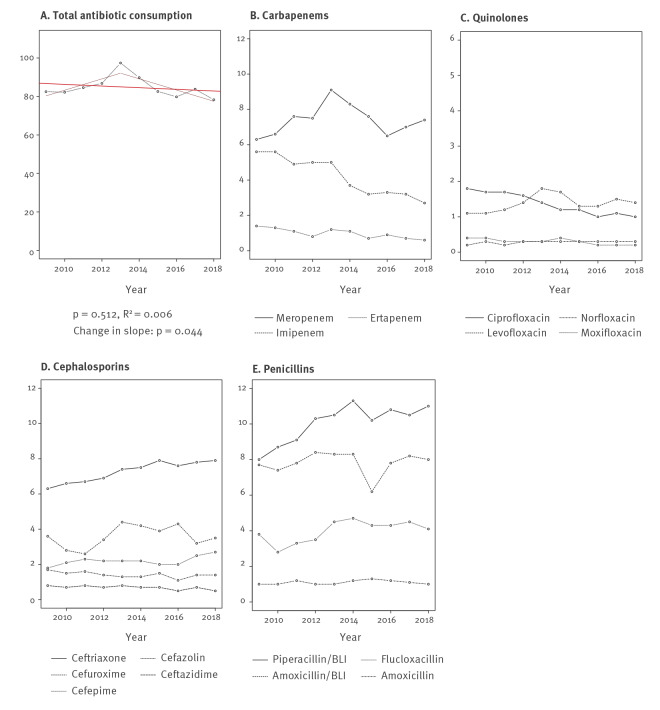
BackgroundIntensive care units (ICU) constitute a high-risk setting for antimicrobial resistance (AMR).AimWe aimed to describe secular AMR trends including meticillin-resistant Staphylococcus aureus (MRSA), glycopeptide-resistant enterococci (GRE), extended-spectrum cephalosporin-resistant Escherichia coli (ESCR-EC) and Klebsiella pneumoniae (ESCR-KP), carbapenem-resistant Enterobacterales (CRE) and Pseudomonas aeruginosa (CRPA) from Swiss ICU. We assessed time trends of antibiotic consumption and identified factors associated with CRE and CRPA.MethodsWe analysed patient isolate and antibiotic consumption data of Swiss ICU sent to the Swiss Centre for Antibiotic Resistance (2009-2018). Time trends were assessed using linear logistic regression; a mixed-effects logistic regression was used to identify factors associated with CRE and CRPA.ResultsAmong 52 ICU, MRSA decreased from 14% to 6% (p = 0.005; n = 6,465); GRE increased from 1% to 3% (p = 0.011; n = 4,776). ESCR-EC and ESCR-KP increased from 7% to 15% (p < 0.001, n = 10,648) and 5% to 11% (p = 0.002; n = 4,052), respectively. CRE, mostly Enterobacter spp., increased from 1% to 5% (p = 0.008; n = 17,987); CRPA remained stable at 27% (p = 0.759; n = 4,185). Antibiotic consumption in 58 ICU increased from 2009 to 2013 (82.5 to 97.4 defined daily doses (DDD)/100 bed-days) and declined until 2018 (78.3 DDD/100 bed-days). Total institutional antibiotic consumption was associated with detection of CRE in multivariable analysis (odds ratio per DDD: 1.01; 95% confidence interval: 1.0-1.02; p = 0.004).DiscussionIn Swiss ICU, antibiotic-resistant Enterobacterales have been steadily increasing over the last decade. The emergence of CRE, associated with institutional antibiotic consumption, is of particular concern and calls for reinforced surveillance and antibiotic stewardship in this setting.
Keywords: CRE; Carbapenem resistance; Carbapenem-resistant Enterobacterales; Gram-negative bacteria; ICU; Switzerland; antibiotic consumption; intensive care.
Conflict of interest statement
Figures
References
-
- Vincent JL, Bihari DJ, Suter PM, Bruining HA, White J, Nicolas-Chanoin MH, et al. The prevalence of nosocomial infection in intensive care units in Europe. Results of the European Prevalence of Infection in Intensive Care (EPIC) Study. JAMA. 1995;274(8):639-44. 10.1001/jama.1995.03530080055041 - DOI - PubMed
MeSH terms
Substances
LinkOut - more resources
Full Text Sources
Medical
Research Materials
Miscellaneous