Clinical Trial
. 2021 Nov;7(3):e001845.
doi: 10.1136/rmdopen-2021-001845.

Clinically relevant patient clusters identified by machine learning from the clinical development programme of secukinumab in psoriatic arthritis

Affiliations
Clinical Trial

Clinically relevant patient clusters identified by machine learning from the clinical development programme of secukinumab in psoriatic arthritis

Effie Pournara et al. RMD Open. 2021 Nov.

Abstract

Objectives: Identify distinct clusters of psoriatic arthritis (PsA) patients based on their baseline articular, entheseal and cutaneous disease manifestations and explore their clinical and therapeutic value.

Methods: Pooled baseline data in PsA patients (n=1894) treated with secukinumab across four phase 3 studies (FUTURE 2-5) were analysed to determine phenotypes based on clusters of clinical indicators. Finite mixture models methodology was applied to generate clinical clusters and mean longitudinal responses were compared between secukinumab doses (300 vs 150 mg) across identified clusters and clinical indicators through week 52 using machine learning (ML) techniques.

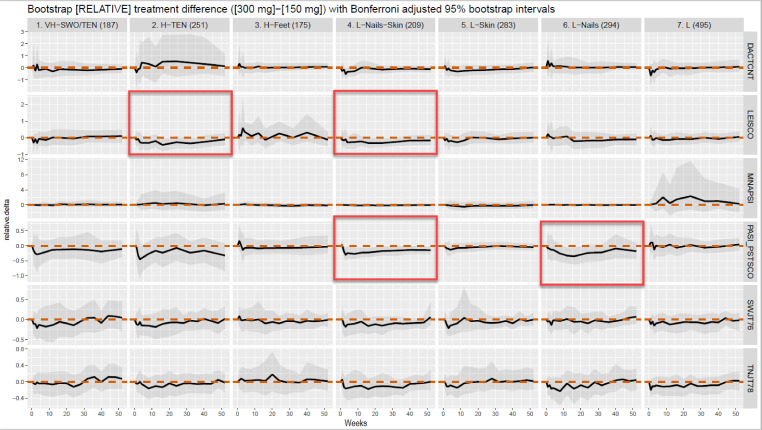
Results: Seven distinct patient clusters were identified. Cluster 1 (very-high (VH) - SWO/TEN (swollen/tender); n=187) was characterised by VH polyarticular burden for both tenderness and swelling of joints, while cluster 2 (H (high) - TEN; n=251) was marked by high polyarticular burden in tender joints and cluster 3 (H - Feet - Dactylitis; n=175) by high burden in joints of feet and dactylitis. For cluster 4 (L (Low) - Nails - Skin; n=209), cluster 5 (L - skin; n=283), cluster 6 (L - Nails; n=294) and cluster 7 (L; n=495) articular burden was low but nail and skin involvement was variable, with cluster 7 marked by mild disease activity across all domains. Greater improvements in the longitudinal responses for enthesitis in cluster 2, enthesitis and Psoriasis Area and Severity Index (PASI) in cluster 4 and PASI in cluster 6 were shown for secukinumab 300 mg compared with 150 mg.

Conclusions: PsA clusters identified by ML follow variable response trajectories indicating their potential to predict precise impact on patients' outcomes.

Trial registration numbers: NCT01752634, NCT01989468, NCT02294227, NCT02404350.

Keywords: arthritis; biological therapy; inflammation; psoriatic; t-lymphocyte subsets; tumor necrosis factor inhibitors.


Conflict of interest statement

Competing interests: EP: Shareholder and Employee of Novartis. MK: Shareholder and Employee of Novartis. PN: Speaker’s bureau: Novartis, Eli Lilly and AbbVie. CTR: Research grants: AbbVie, Amgen, UCB; Consultant for: AbbVie, Amgen, UCB, Novartis, Pfizer, Lilly, Janssen, BMS. BWK: Research grants, consultation fees, or speaker honoraria: AbbVie, Gilead, Janssen, Lilly, Novartis, Pfizer and UCB. GL: Shareholder and Employee of Novartis. LP: Shareholder and Employee of Novartis. AO: Consultant: AbbVie, Amgen, BMS, Celgene, Corrona, Gilead, Janssen, Lilly, Novartis, Pfizer, UCB. Research grants: Novartis (to Penn), Pfizer (to Penn), Amgen (to Forward). Royalties to husband from Novartis. LCC: Grant/research support: AbbVie, Amgen, Gilead, Janssen, Lilly, Novartis, Pfizer Consultant/speaker for: AbbVie, Amgen, Biogen, Celgene, Pfizer, UCB, Boehringer Ingelheim, Novartis, Lilly, Janssen, Gilead, Medac. GS: Speakers honoraria from AbbVie, BMS, Celgene, Janssen, Lilly, Novartis, Roche and UCB. IBM: Research grants, consultation fees, or speaker honoraria: AbbVie, Amgen, BMS, Celgene, Janssen, Lilly, Novartis, Pfizer and UCB.

Figures
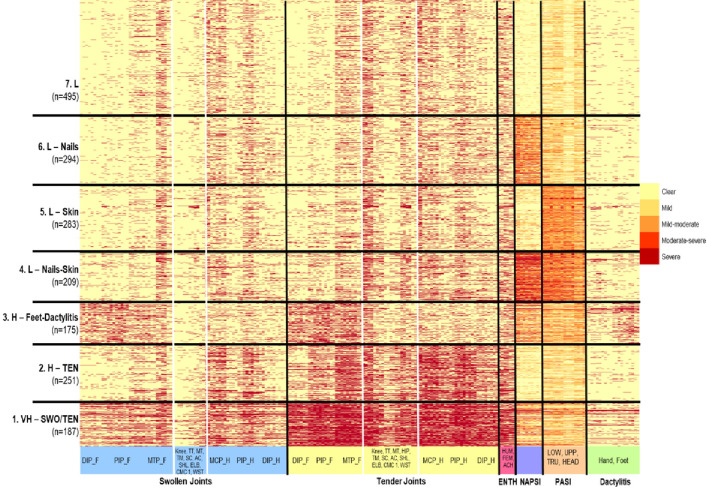
Figure 1
Figure 1
Heat map of baseline clusters from FUTURE 2–5 studiesA dark red colour signifies the presence of a symptom or sign in the case of binary variables (swollen joints, tender joints, enthesitis or dactylitis) or severe symptom or sign (value of 4 on the scale 0–4) for categorical variables (mNAPSI and PASI). A light yellow signifies absence of a symptom or sign for both binary and categorical variables. Gradual shades of yellow-orange-red refer to mild, mild-to-moderate, moderate-to-severe signs among the categorical variables. AC, acromioclavicular; ACh, Achilles; CMC 1, Carpometacarpal 1; DAC, Dactylitis; DIP_F, distal interphalangeal joints feet; DIP_H, distal interphalangeal joints hand; Dist., distance; ELB, elbow; Fem, femur; hum: humerus; LEI, Leeds Enthesitis Index; low, lower limbs; MCP_H, metacarpophalangeal joints hand; mNAPSI, modified nail psoriasis severity index; MT, Mid-tarsal; MTP_F, Metatarsophalangeal joint; N, number of evaluable patients; PASI, psoriasis area severity index; PIP_F, proximal interphalangeal joints feet; PIP_H, proximal interphalangeal joints hand; SC, sternoclavicular; SHL, shoulder; swo, swollen; ten, tender; TM, temporomandibular joint; Tru, trunk; TT, Talo-tibial; UPP, upper limbs; WST, wrist.
Figure 2
Figure 2
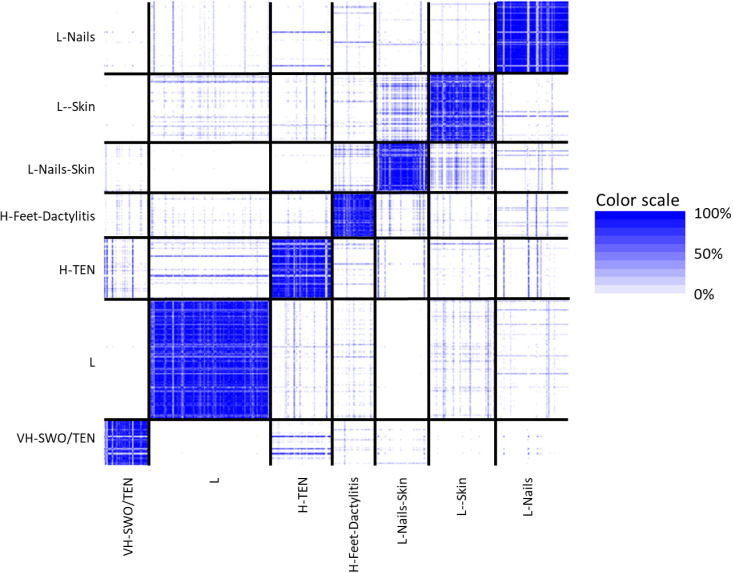
Consensus matrix to measure cluster stability. Cluster 1: VH-SWO/TEN cluster (n=187); cluster 2: H – TEN (n=251); cluster 3: H – feet – Dactylitis (n=175); cluster 4: L – nails –s kin (n=209); cluster 5: L–skin (n=283); cluster 6: L–nails (n=294); cluster 7: L (low) (n=495). H, high; L, low; SWO, swollen; TEN, tender; VH, very high.
Figure 3
Figure 3
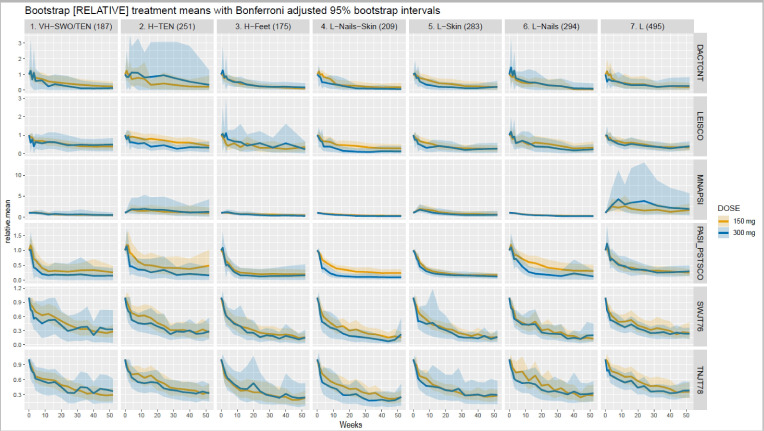
Relative mean response curves for patients on secukinumab. Relative mean response curves for patients on secukinumab 150 mg (red curves) and 300 mg (green curves) across the seven clusters for the six clinical indicators. The red curves depicted the relative mean responses for patients having received secukinumab 150 mg, while the green curves depicted that for secukinumab 300 mg. It is to be noted that the two relative dose response curves always started at baseline at the same mean value equal to 1 to adjust for different starting values. The coloured shaded regions represented 95% bootstrap CIs.
Figure 4
Figure 4
Differences between the relative mean responses to secukinumab doses. Differences between the relative mean responses to secukinumab 300 and 150 mg across the seven clusters for each of the six clinical indicators. The curves pass through zero at baseline to ensure that the observed treatment differences are not due to the two patient populations starting from a different baseline disease activity. The shaded region provides a Bonferroni adjusted 95% bootstrap CI to make inference on treatment differences. If the shaded region excluded the zero line, (the red dashed line) then the longitudinal treatment difference between secukinumab 300 and 150 mg is deemed statistically significant. If, however, the shaded region included the zero line then there was not enough evidence to claim a treatment difference for that cluster and clinical indicator.

References

    1. Coates LC, Helliwell PS. Psoriatic arthritis: state of the art review. Clin Med 2017;17:65–70. 10.7861/clinmedicine.17-1-65 - DOI - PMC - PubMed
    1. Hügle M, Omoumi P, van Laar JM, et al. . Applied machine learning and artificial intelligence in rheumatology. Rheumatol Adv Pract 2020;4:rkaa005. 10.1093/rap/rkaa005 - DOI - PMC - PubMed
    1. Watson DS, Krutzinna J, Bruce IN, et al. . Clinical applications of machine learning algorithms: beyond the black box. BMJ 2019;364:l886. 10.1136/bmj.l886 - DOI - PubMed
    1. Grys BT, Lo DS, Sahin N, et al. . Machine learning and computer vision approaches for phenotypic profiling. J Cell Biol 2017;216:65–71. 10.1083/jcb.201610026 - DOI - PMC - PubMed
    1. Orange DE, Agius P, DiCarlo EF, et al. . Identification of three rheumatoid arthritis disease subtypes by machine learning integration of synovial histologic features and RNA sequencing data. Arthritis Rheumatol 2018;70:690–701. 10.1002/art.40428 - DOI - PMC - PubMed

Publication types

Substances

Associated data