


Comment
doi: 10.1038/s41582-021-00593-7.
Counting the neurological cost of COVID-19
Affiliations
- PMID: 34795449
- PMCID: PMC8600497
- DOI: 10.1038/s41582-021-00593-7
Item in Clipboard
Comment
Counting the neurological cost of COVID-19
Nat Rev Neurol.
2022 Jan.
Abstract
The neurological deficits caused by COVID-19, which were first reported in the early months of 2020, continue to intrigue neurologists and health-care professionals worldwide. As two new studies highlight, these manifestations are frequent and are expected to increase the burden of morbidity and mortality in the acute and chronic phases of COVID-19.
Conflict of interest statement
The author declares no competing interests.
Figures
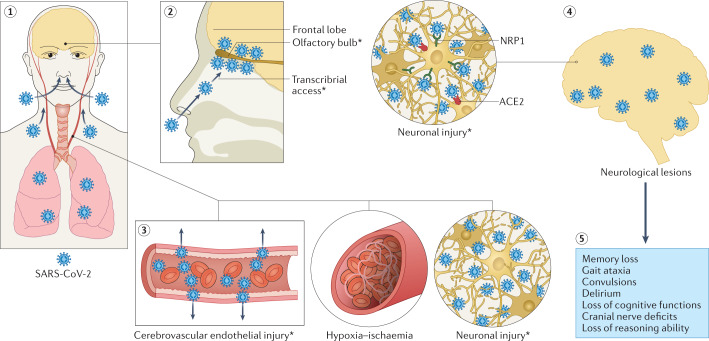
The figure illustrates proposed routes of the spread of SARS-CoV-2 across the CNS and the possible mechanisms involved in neuronal injury in COVID-19. Mechanisms indicated by asterisks were proposed on the basis of data that emerged from hospitals in Wuhan, China in the first two months of 2020 (ref.). SARS-CoV-2 produces viral loads in the oral cavity and nose (1) that cause infection of the olfactory mucosa and olfactory bulb to reach the brain (2–4). Viral budding from neuronal cells in the frontal lobe has been documented. Vascular mechanisms that can cause neuronal damage are shown (3). Brain involvement (4) is thought to elicit specific clinical features (5) that are indicative of CNS injury. ACE2, angiotensin-converting enzyme 2 receptor; NRP1, neuropilin-1. Adapted with permission from ref..
Comment on
-
Autoimmune Encephalitis After SARS-CoV-2 Infection: Case Frequency, Findings, and Outcomes.Neurology. 2021 Dec 7;97(23):e2262-e2268. doi: 10.1212/WNL.0000000000012931. Epub 2021 Oct 11. Neurology. 2021. PMID: 34635560 Free PMC article.
-
Frequency of Neurologic Manifestations in COVID-19: A Systematic Review and Meta-analysis.Neurology. 2021 Dec 7;97(23):e2269-e2281. doi: 10.1212/WNL.0000000000012930. Epub 2021 Oct 11. Neurology. 2021. PMID: 34635561 Free PMC article.
References
Publication types
MeSH terms
LinkOut - more resources
Full Text Sources
Medical
