


Potential of Nanocarrier-Based Drug Delivery Systems for Brain Targeting: A Current Review of Literature
- PMID: 34795481
- PMCID: PMC8593899
- DOI: 10.2147/IJN.S333657
Potential of Nanocarrier-Based Drug Delivery Systems for Brain Targeting: A Current Review of Literature
Erratum in
-
Erratum: Potential of Nanocarrier-Based Drug Delivery Systems for Brain Targeting: A Current Review of Literature [Corrigendum].Int J Nanomedicine. 2022 Jan 11;17:183-184. doi: 10.2147/IJN.S356441. eCollection 2022. Int J Nanomedicine. 2022. PMID: 35046653 Free PMC article.
Abstract
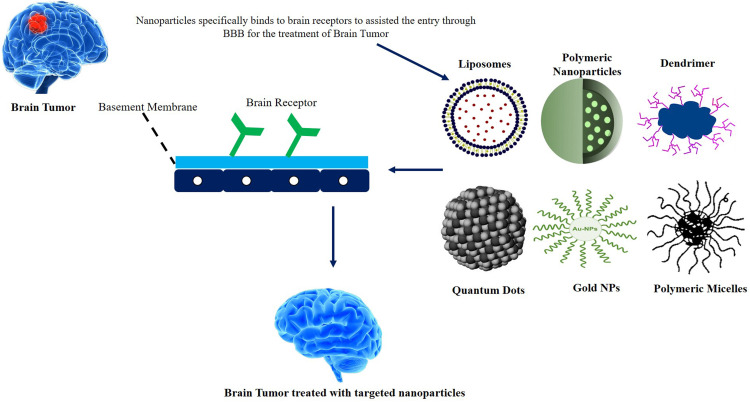
The advent of nanotechnologies such as nanocarriers and nanotherapeutics has changed the treatment strategy and developed a more efficacious novel drug delivery system. Various drug delivery systems are focused on drug-targeting of brain cells. However, the manifestation of the brain barrier is the main hurdle for the effective delivery of chemotherapeutics, ultimately causing treatment failure of various drugs. To solve this problem, various nanocarrier-based drug delivery system has been developed for brain targeting. This review outlines nanocarrier-based composites for different brain diseases and highlights nanocarriers for drug targeting towards brain cells. It also summarizes the latest developments in nanocarrier-based delivery systems containing liposomal systems, dendrimers, polymeric micelles, polymeric nanocarriers, quantum dots (QDs), and gold nanoparticles. Besides, the optimal properties of nanocarriers and therapeutic implications for brain targeting have been extensively studied. Finally, the potential applications and research opportunities for nanocarriers in brain targeting are discussed.
Keywords: blood–brain barrier; brain targeting; in-vivo; nanocarriers; nanotherapeutics.
© 2021 Alotaibi et al.
Conflict of interest statement
The authors report no conflicts of interest for this work.
Figures


References
-
- Agrawal M, Saraf S, Saraf S, et al. Recent advancements in the field of nanotechnology for the delivery of anti-Alzheimer drug in the brain region. Expert Opin Drug Deliv. 2018;15(6):589–617. - PubMed
-
- Singh AV, Chandrasekar V, Janapareddy P, et al. Emerging Application of Nanorobotics and Artificial Intelligence To Cross the BBB: advances in Design, Controlled Maneuvering, and Targeting of the Barriers. ACS Chem Neurosci. 2021;1:448–455. - PubMed
-
- Agrawal M, Saraf S, Saraf S, et al. Stimuli-responsive In situ gelling system for nose-to-brain drug delivery. J Controlled Release. 2020;24:12–85. - PubMed
-
- Persano F, Batasheva S, Fakhrullina G, Gigli G, Leporatti S, Fakhrullin R. Recent advances in the design of inorganic and nano-clay particles for the treatment of brain disorders. J Mater Chem B. 2021;9(12):2756–2784. - PubMed
Publication types
MeSH terms
Substances
LinkOut - more resources
Full Text Sources
