. 2021 Oct 26;31(44):2008701.
doi: 10.1002/adfm.202008701. Epub 2020 Dec 4.

Drug Delivery across Barriers to the Middle and Inner Ear

Affiliations

Drug Delivery across Barriers to the Middle and Inner Ear

Zipei Zhang et al. Adv Funct Mater. .

Abstract

The prevalence of ear disorders has spurred efforts to develop drug delivery systems to treat these conditions. Here, recent advances in drug delivery systems that access the ear through the tympanic membrane (TM) are reviewed. Such methods are either non-invasive (placed on the surface of the TM), or invasive (placed in the middle ear, ideally on the round window [RW]). The major hurdles to otic drug delivery are identified and highlighted the representative examples of drug delivery systems used for drug delivery across the TM to the middle and (crossing the RW also) inner ear.

Keywords: drug delivery; invasive; noninvasive; trans-tympanic.


Conflict of interest statement

Conflict of Interest The authors declare no conflict of interest.

Figures
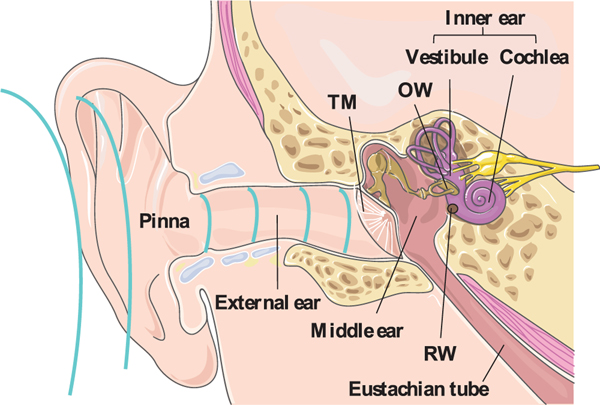
Figure 1.
Figure 1.
Anatomy of the human ear. TM: tympanic membrane; OW: oval window; RW: round window. The ear anatomy image was adapted under the terms and conditions of the CC BY 3.0 Unported License. Copyright Servier Medical Art.
Figure 2.
Figure 2.
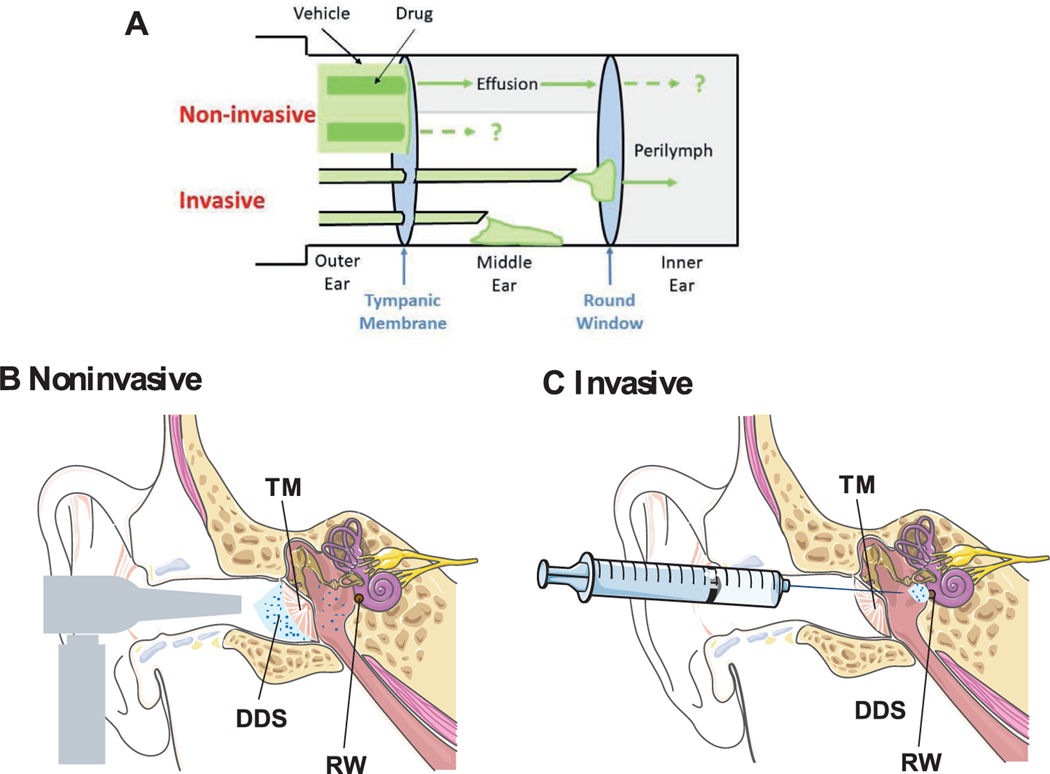
Trans-tympanic drug delivery. A) Schematic of trans-tympanic drug delivery systems. In non-invasive delivery, drug fluxes into middle ear fluid, with substantial dilution. It is unknown whether substantial drug flux can occur into the inner ear, or into the middle ear in the absence of fluid. Invasive delivery is via injection or incision into the middle ear, or in the round window niche, for drug flux into the middle or (more commonly) inner ear. Anatomy of B) noninvasive trans-tympanic drug delivery systems (TM: tympanic membrane, DDS: drug delivery system), C) invasive trans-tympanic drug delivery systems. RW: Round window. The ear anatomy and syringe images were adapted under the terms and conditions of the CC BY 3.0 Unported License. Copyright Servier Medical Art.
Figure 3.
Figure 3.
A formulation for noninvasive trans-tympanic delivery to the middle ear. A) The formulation included a polymer with reverse thermal gelling properties, a combination of chemical permeation enhancers (3CPE), and an antibiotic, ciprofloxacin. B) The mechanical properties of P407 and P407-PBP with or without the combination of chemical permeation enhancers in panel A (3CPE) as a function of temperature. Without CPEs, P407 gels (G′ > G″) at 27 °C; addition of 3CPE prevents gelation. In contrast, 3CPE enhanced the gelation of P407-PBP. C) Time course of elimination of bacteria (CFU: colony-forming units, a metric of bacterial presence) from middle ear fluid of chinchillas with OM after trans-tympanic treatment with different formulations. (B and C) Reproduced with permission.[29c] Copyright 2016, AAAS.
Figure 4.
Figure 4.
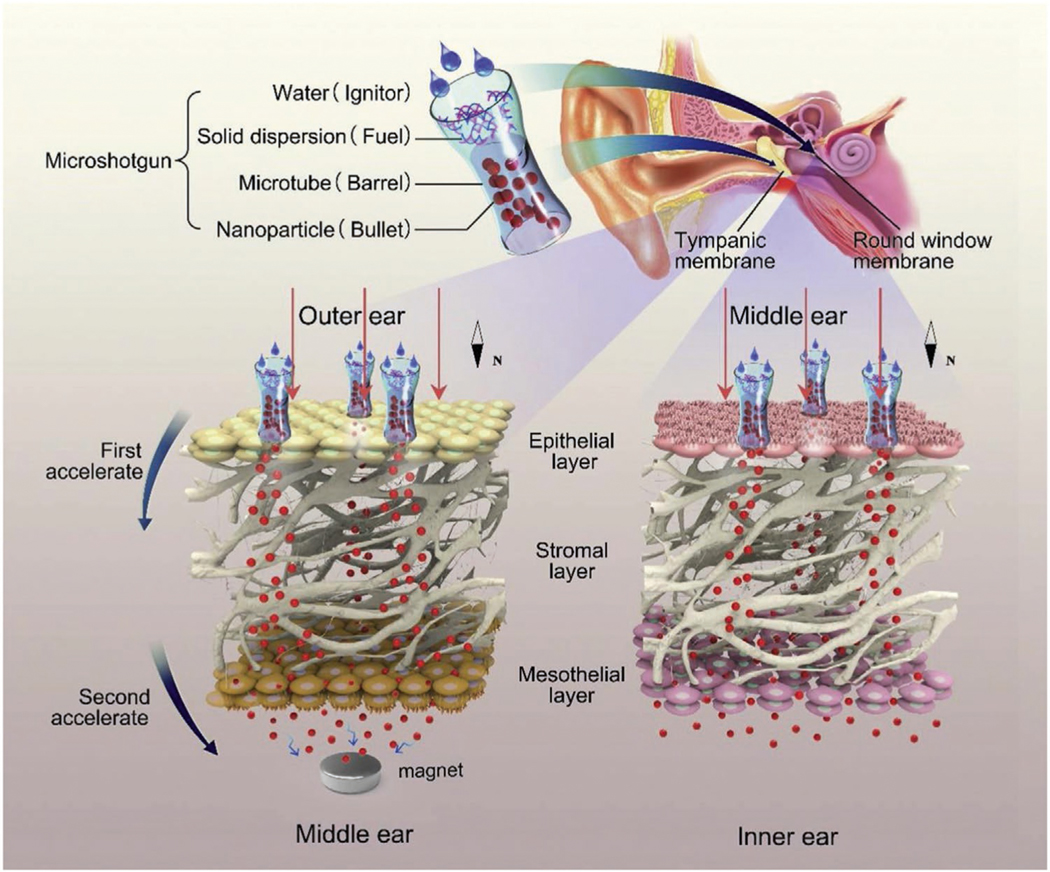
A microshotgun delivery device for the noninvasive trans-tympanic delivery of magnetic NPs. Reproduced with permission.[83] Copyright 2020, Elsevier.
Figure 5.
Figure 5.
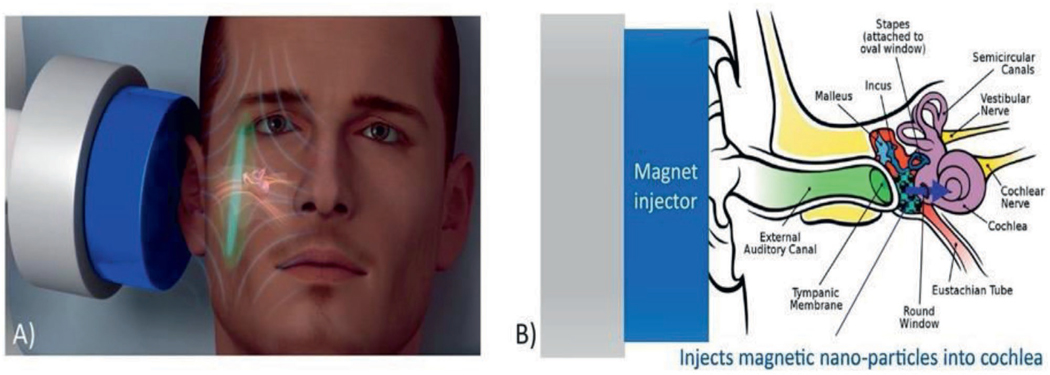
Magnetically driven nanoparticles. A) The placement of a proposed magnet device for inner drug delivery. B) A schematic of injection of magnetic nanoparticles through the RW for inner ear drug delivery. (A and B) Reproduced with permission.[76] Copyright 2019, Elsevier.
Figure 6.
Figure 6.
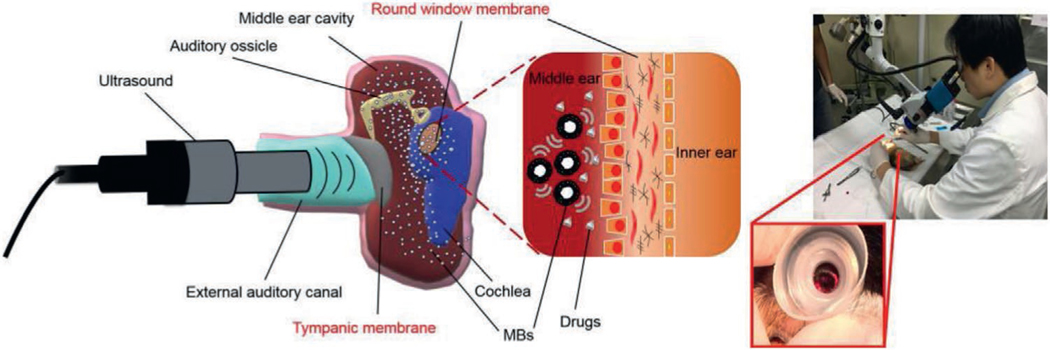
Ultrasound-driven devices. Schematic of ultrasound-induced microbubble (USMB) cavitation to facilitate drug delivery to the inner ear. Reproduced with permission.[77] Copyright 2020, ASCI.
Figure 7.
Figure 7.
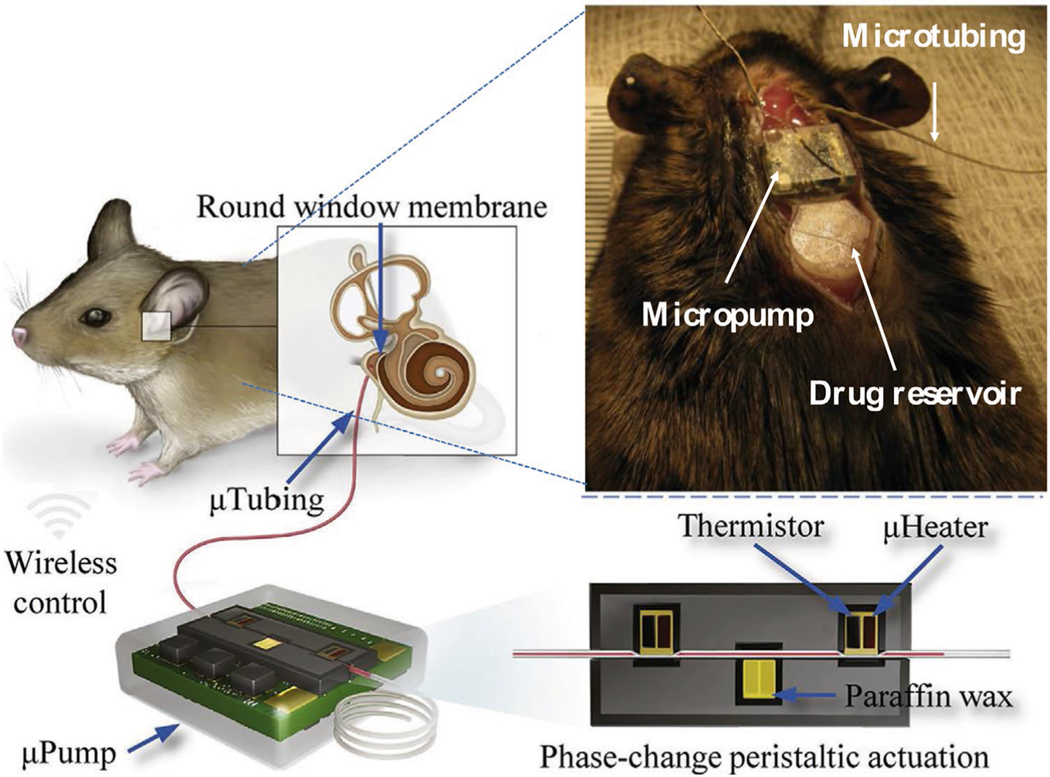
Pump- and catheter-based systems. Schematic illustration of the peristaltic micropump designed for drug delivery across the round window. Reproduced with permission.[78] Copyright 2019, Elsevier.

References

    1. Yang R, Wei T, Goldberg H, Wang W, Cullion K, Kohane DS, Adv. Mater. 2017, 29, 1606596; - PMC - PubMed
    2. Kurabi A, Pak KK, Bernhardt M, Baird A, Ryan AF, Sci. Rep. 2016, 6, 22663. - PMC - PubMed
    1. Hoberman A, Paradise JL, Rockette HE, Shaikh N, Wald ER, Kearney DH, Colborn DK, Kurs-Lasky M, Bhatnagar S, Haralam MA, Cunha BA, Med. Clin. North Am. 2001, 85, 149;
    2. Cox LM, Blaser MJ, Nat. Rev. Endocrinol. 2015, 11, 182; - PMC - PubMed
    3. McLane J, J. Am. Acad. Dermatol. 2001, 45, S188; - PubMed
    4. Çetinkaya A, Akova YA, Am. J. Ophthalmol. 2006, 142, 816. - PubMed
    1. Zielnik-Jurkiewicz B, Bielicka A, Int. J. Pediatr. Otorhinolaryngol. 2015, 79, 2129; - PubMed
    2. Anderson RM, Nat. Med. 1999, 5, 147; - PubMed
    3. Barkai G, Greenberg D, Givon-Lavi N, Dreifuss E, Vardy D, Dagan R, Emerging Infect. Dis. 2005, 11, 829. - PMC - PubMed
    1. Wang X, Fernandez R, Tsivkovskaia N, Harrop-Jones A, Hou HJ, Dellamary L, Dolan DF, Altschuler RA, LeBel C, Piu F, Otol. Neurotol. 2014, 35, 459; - PMC - PubMed
    2. Spektor Z, Jasek MC, Jasheway D, Dahlin DC, Kay DJ, Mitchell R, Faulkner R, Wall GM, Int. J. Pediatr. Otorhinolaryngol. 2008, 72, 97. - PubMed
    1. Juhn SK, Acta Oto-Laryngol. 1988, 105, 79;
    2. Nyberg S, Abbott NJ, Shi X, Steyger PS, Dabdoub A, Sci. Transl. Med. 2019, 11, eaao0935; - PMC - PubMed
    3. Juhn SK, Hunter BA, Odland RM, Int. Tinnitus J. 2001, 7, 72. - PubMed

LinkOut - more resources