


Cutaneous squamous cell carcinoma staging may influence management in users: A survey study
- PMID: 34796670
- PMCID: PMC8704160
- DOI: 10.1002/cam4.4426
Cutaneous squamous cell carcinoma staging may influence management in users: A survey study
Abstract
Purpose: This study aims to determine whether there is consensus regarding staging and management of cutaneous squamous cell carcinoma (CSCC) across the various specialties that manage this disease.
Materials and methods: A survey regarding CSCC high-risk features, staging, and management was created and emailed to cutaneous oncology experts including dermatology, head and neck surgery/surgical oncology, radiation oncology, and medical oncology.
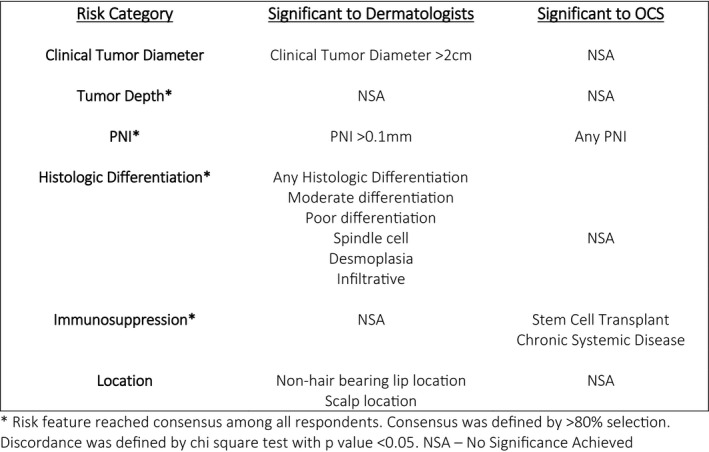
Results: One hundred fifty-six (46%) of 357 invited physicians completed the survey. Depth of invasion (92%), perineural invasion (99%), histologic differentiation (85%), and patient immunosuppression (90%) achieved consensus (>80%) as high-risk features of CSCC. Dermatologists were more likely to also choose clinical tumor diameter (79% vs. 54%) and histology (99% vs. 66%) as a high-risk feature. Dermatologists were also more likely to utilize the Brigham and Women's Hospital (BWH) staging system alone or in conjunction with American Joint Committee on Cancer (AJCC) (71%), whereas other cancer specialists (OCS) tend to use only AJCC (71%). Respondents considered AJCC T3 and higher (90%) and BWH T2b and higher (100%) to be high risk and when they consider radiologic imaging, sentinel lymph node biopsy, post-operative radiation therapy, and increased follow-up. Notably, a large number of respondents do not use staging systems or tumor stage to determine treatment options beyond surgery in high-risk CSCC.
Conclusion: This survey study highlights areas of consensus and differences regarding the definition of high-risk features of CSCC, staging approaches, and management patterns between dermatologists and OCS. High-risk CSCC is defined as, but not limited to, BWH T2b and higher and AJCC T3 and higher, and these thresholds can be used to identify cases for which treatment beyond surgery may be considered. Dermatologists are more likely to utilize BWH staging, likely because BWH validation studies showing advantages over AJCC were published in dermatology journals and discussed at dermatology meetings. Additional data are necessary to develop a comprehensive risk-based management approach for CSCC.
Keywords: American Joint Committee on Cancer Staging System; Brigham and Women Staging System; depth of tumor; high-risk cutaneous squamous cell carcinoma; high-risk tumor features; histologic differentiation; immunosuppression; perineural invasion; skin cancer; staging criteria; tumor diameter; tumor location.
© 2021 The Authors. Cancer Medicine published by John Wiley & Sons Ltd.
Conflict of interest statement
None.
Figures
References
-
- Rogers HW, Weinstock MA, Feldman SR, et al. Incidence estimate of nonmelanoma skin cancer (keratinocyte carcinomas) in the US population, 2012. JAMA Dermatol. 2015;151(10):1081‐1086. - PubMed
-
- Brantsch KD, Meisner C, Schönfisch B, et al. Analysis of risk factors determining prognosis of cutaneous squamous cell carcinoma: a prospective study. Lancet Oncol. 2008;9(8):713‐720. - PubMed
-
- Schmults CD, Karia PS, Carter JB, et al. Factors predictive of recurrence and death from cutaneous squamous cell carcinoma: a 10‐year, single‐institution cohort study. JAMA Dermatol. 2013;149(5):541‐547. - PubMed
-
- Czarnecki D, Staples M, Mar A, et al. Metastases from squamous cell carcinoma of the skin in southern Australia. Dermatology. 1994;189:52‐54. - PubMed
MeSH terms
LinkOut - more resources
Full Text Sources
Medical
