


The acute and persisting impact of COVID-19 on trajectories of adolescent depression: Sex differences and social connectedness
- PMID: 34798146
- PMCID: PMC8605896
- DOI: 10.1016/j.jad.2021.11.030
The acute and persisting impact of COVID-19 on trajectories of adolescent depression: Sex differences and social connectedness
Abstract
Background: The COVID-19 era is a time of unprecedented stress, and there is widespread concern regarding its short- and long-term mental health impact. Adolescence is a sensitive period for the emergence of latent psychopathology vulnerabilities, often activated by environmental stressors. The present study examined COVID-19's impact on adolescent depression and possible influences of different domains of social connectedness (loneliness, social media use, social video game time, degree of social activity participation).
Methods: A community sample of 175 adolescents (51% boys, mean age = 16.01 years) completed questionnaires once before and twice during the COVID-19 pandemic. Piecewise growth modeling examined the acute (7 weeks) and persistent (8 months) effects of COVID-19 on depressive symptoms, and differences across sex and social connectedness.
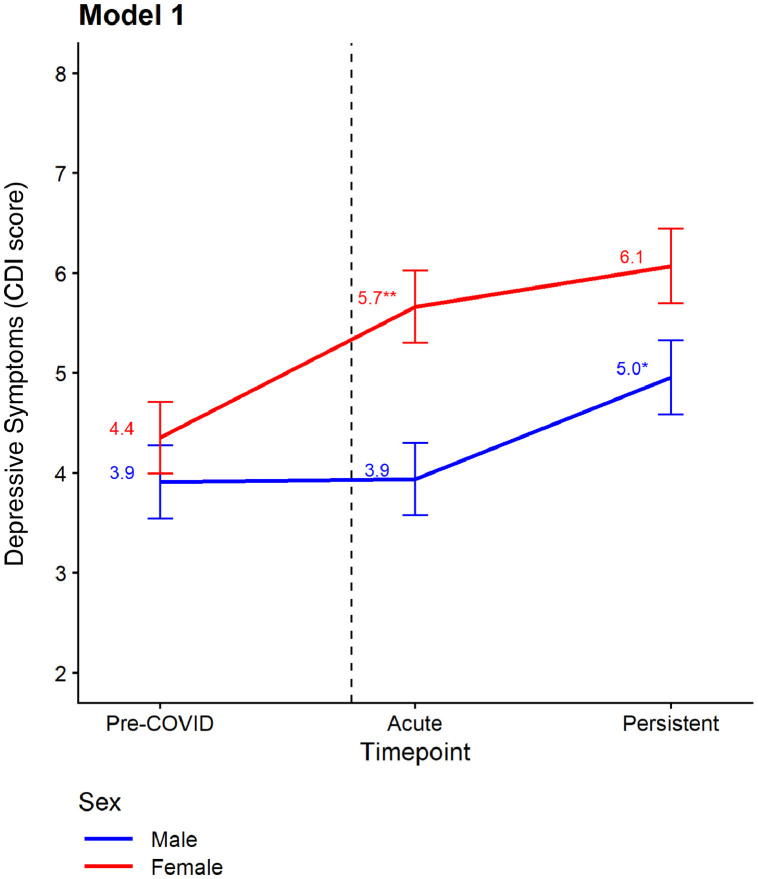
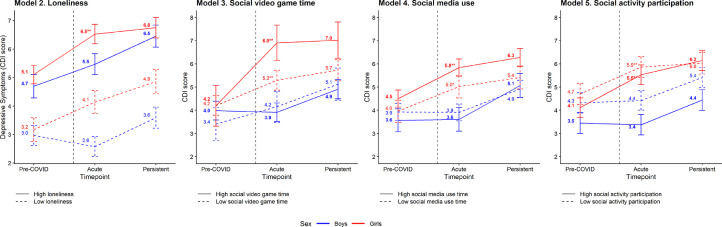
Results: Significant increases in depressive symptoms followed pandemic onset for boys and girls. However, this increase was earlier and more pronounced among girls than boys, whose depression only increased significantly during the persistent period and to a lesser degree. Trajectories of depression were influenced by loneliness and social connections.
Limitations: Most participants had economic stability and minimal exposure to the virus. Exacerbation of depressive symptoms may be more severe in higher risk populations.
Conclusions: Adolescent depression levels have increased during COVID-19, and are higher for girls and those who are lonely. Enhanced screening and management for adolescent depression and social connectedness could play a critical role in mitigating the negative mental health fallout of COVID-19 and future pandemics within this population.
Keywords: Adolescent; COVID-19; Depression; Mental health; Pandemic; Social.
Copyright © 2021 The Author(s). Published by Elsevier B.V. All rights reserved.
Conflict of interest statement
The authors have no conflicts of interest to report.
Figures
References
-
- Adams Z.W., Sumner J.A., Danielson C.K., Mccauley J.L., Resnick H.S., Grös K., Paul L.A., Welsh K.E., Kenneth J. Prevalence and predictors of PTSD and depression among adolescent victims of the spring 2011 tornado outbreak. J. Child Psychol. Psychiatry. 2014;55(9):1047–1055. doi: 10.1111/jcpp.12220. - DOI - PMC - PubMed
-
- AJMC Staff . A Timeline of COVID-19 Developments in 2020. AJMC; 2020.
-
- American Psychological Association . 2020. Stress in America 2020: A National Mental Health Crisis. https://www.apa.org/news/press/releases/stress/2020/sia-mental-health-cr....
-
- Anderson J., Rainie L. Pew Research Center: Internet & Technology; 2012. Main Findings: Teens, Technology, and Human Potential in 2020 | Pew Research Center. February 29. https://www.pewresearch.org/internet/2012/02/29/main-findings-teens-tech...
-
- Antczak J., Thompson D. Associated Press; 2020. California COVID-19: 2 Million Confirmed Cases and Counting. December 24. https://apnews.com/article/pandemics-los-angeles-california-coronavirus-....
