Review
. 2017 Jan 20;5(1):7.
doi: 10.1186/s40560-016-0198-4.

Monitoring the coagulation status of trauma patients with viscoelastic devices

Affiliations
Review

Monitoring the coagulation status of trauma patients with viscoelastic devices

Yuichiro Sakamoto et al. J Intensive Care. .

Abstract

Coagulopathy is a physiological response to massive bleeding that frequently occurs after severe trauma and is an independent predictive factor for mortality. Therefore, it is very important to grasp the coagulation status of patients with severe trauma quickly and accurately in order to establish the therapeutic strategy. Judging from the description in the European guidelines, the importance of viscoelastic devices in understanding the disease condition of patients with traumatic coagulopathy has been widely recognized in Europe. In the USA, the ACS TQIP Massive Transfusion in Trauma Guidelines proposed by the American College of Surgeons in 2013 presented the test results obtained by the viscoelastic devices, TEG® 5000 and ROTEM®, as the standard for transfusion or injection of blood plasma, cryoprecipitate, platelet concentrate, or anti-fibrinolytic agents in the treatment strategy for traumatic coagulopathy and hemorrhagic shock. However, some studies have reported limitations of these viscoelastic devices. A review in the Cochrane Library published in 2015 pointed out the presence of biases in the abovementioned reports in trauma patients and the absence of a quality study in this field thus far. A quality study on the relationship between traumatic coagulopathy and viscoelastic devices is needed.

Keywords: Abciximab; Activate Partial Thromboplastin Time; Disseminate Intravascular Coagulation; Injury Severity Score; Tranexamic Acid.


Conflict of interest statement

SY has received speaking fees from Asahi Kasei.

Figures
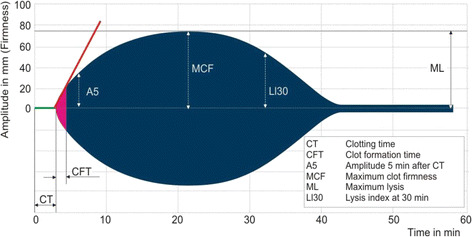
Fig. 1
Fig. 1
An example of results obtained using the ROTEM system. In the ROTEM® system, the results are displayed in a graph in which the horizontal axis is time (min) and the vertical axis is clot amplitude (mm) based on the firmness of the clot. Various parameters can be measured in real time such as clotting time (CT), clot formation time (CFT), the amplitude at 5 min (A5), maximum clot firmness (MCF), maximum lysis (ML), and lysis index at 30 min (LI30)
Fig. 2
Fig. 2
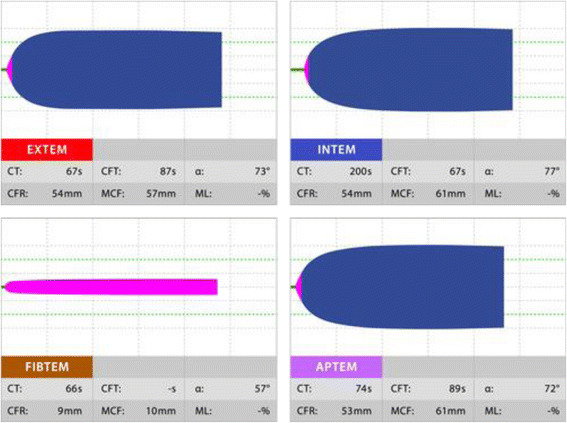
The results in ROTEM in a normal healthy person
Fig. 3
Fig. 3
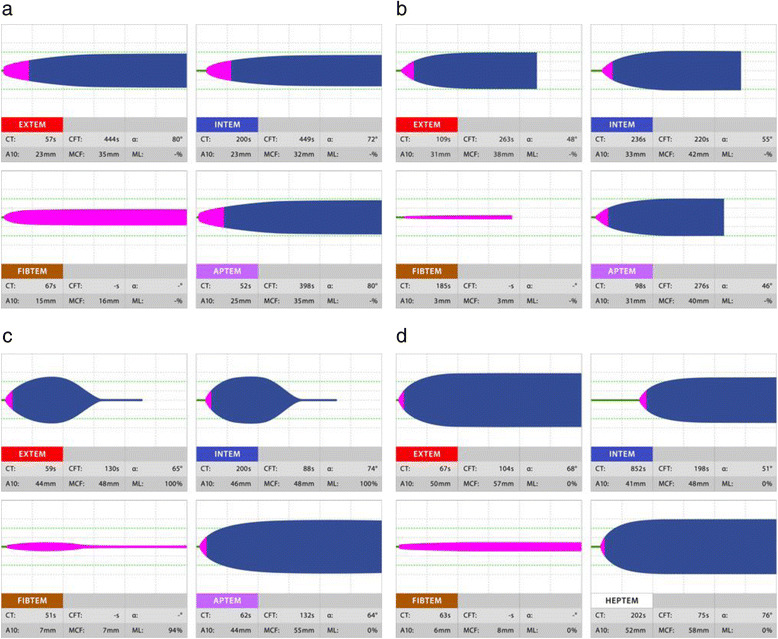
ROTEM results in patients with various hematologic abnormalities. a The result of lower clot amplitude in EXTEM indicates platelet deficiency or fibrinogen deficiency or both. The normal result in FIBTEM indicates platelet deficiency. b The results of lower clot amplitude in EXTEM and decreased clot amplitude in FIBTEM indicate fibrinogen deficiency. c Reduced clot firmness after reaching the MCF indicates the influence of fibrinolysis, and reduced clot firmness by more than 15% from the MCF in EXTEM and FIBTEM but no change in clot firmness after MCF in APTEM indicates hyperfibrinolysis. d CT is prolonged in INTEM but does not change or is shorter in HPTEM, and the influence of heparin should be considered
Fig. 4
Fig. 4
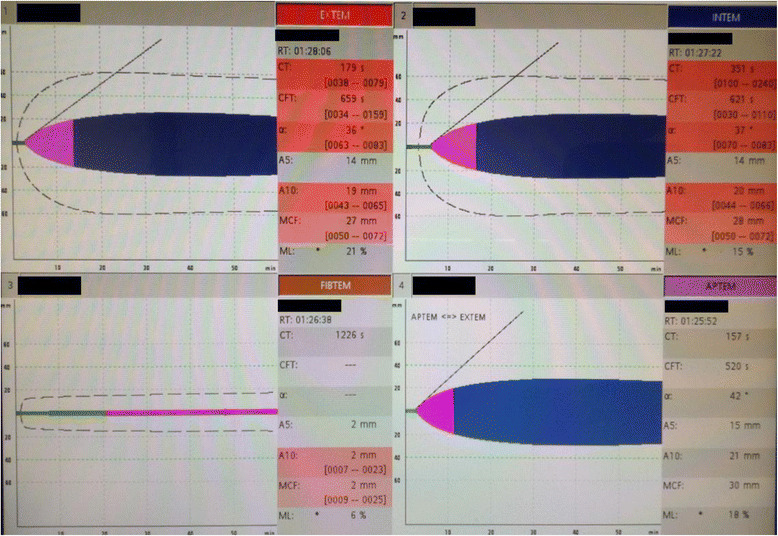
Results using the ROTEM system in a coagulopathic patient with complicated medical conditions. This was a ROTEM result in an 80-year-old woman who complained of vertigo. She had undergone artificial blood vessel replacement surgery for thoracoabdominal aortic aneurysm 8 years previously, and she had chronic hepatitis C, liver cirrhosis (Child-Pugh class B), and chronic atrial fibrillation. The ROTEM test revealed prolonged CT, prolonged CFT, low alpha angle, and low clot amplitude in every test in EXTEM and INTEM. Additionally, significantly reduced clot firmness in FIBTEM indicated fibrinogen dysfunction. This patient was not diagnosed with any acute cerebrovascular disease, and she was discharged on the same day
Fig. 5
Fig. 5
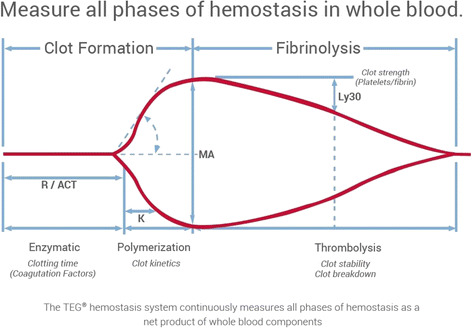
Example of TEG findings. The typical presentation of measurement data obtained by TEG® is shown. The data are displayed in a graph in which the horizontal axis is time (min) and the vertical axis is clot firmness, similar to the ROTEM® system. Parameters are the duration from the start of the measurement to the beginning of clotting (R-time), duration from the beginning of clotting to the time when the amplitude of clot firmness reaches 20 mm (K-time), clot firmness (MA) and the fibrinolytic index (LY30)
Fig. 6
Fig. 6
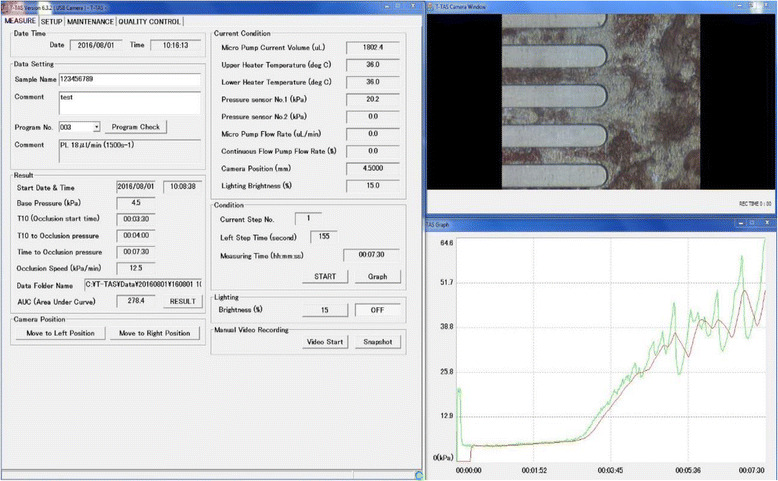
Display screen during measurement with a PL-chip in the T-TAS system. The left window shows the measurement conditions such as flow rate of blood and temperature in the simulated vessel. The status of blood flowing can be observed in the upper right window. The lower right window shows a graph presenting the time course of thrombus formation. Blood flowing in a simulated blood vessel taken by a microcamera can be observed in real time in the upper right window. The lower right window shows a graph presenting the time course of thrombus formation in which the horizontal axis is time and the vertical axis is the measured pressure. This graph allows us to observe the process of thrombus formation visually. The left window shows the measured numerical data and measurement conditions. Measurement conditions are the flow rate of blood flowing in the simulated vessel and the temperature in the vessel, and these flowing conditions can be set freely. Therefore, this device allows us to simulate thrombus formation in various blood vessels in the body. Another chip, the AR-chip, has a built-in simulated blood vessel in which the inner lumen is coated with collagen and tissue factor. After adding Ca++ in the simulated vessel, citrated whole blood is activated by the collagen and tissue factor. Then, a very firm thrombus is formed by activated platelets and coagulation factors. Therefore, the AR-chip enables us to assess the cooperative capacity of platelets and the coagulation system in thrombus formation
Fig. 7
Fig. 7
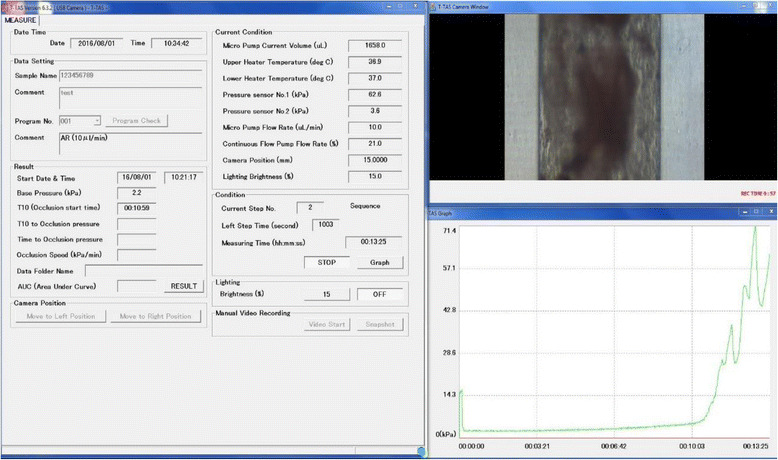
Display screen during measurement with an AR-chip in the T-TAS system. The configuration of the screen is similar to that shown in Fig. 6
Fig. 8
Fig. 8
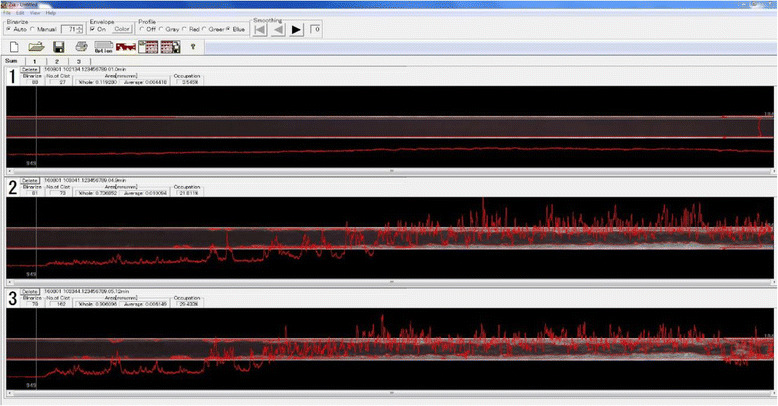
Display screen of T-TAS Zia®. T-TAS Zia® is the built-in software that can analyze thrombus conditions in detail (thrombus formation in the PL-chip can also be analyzed with the software in the most recent model, T-TAS plus®)
Fig. 9
Fig. 9
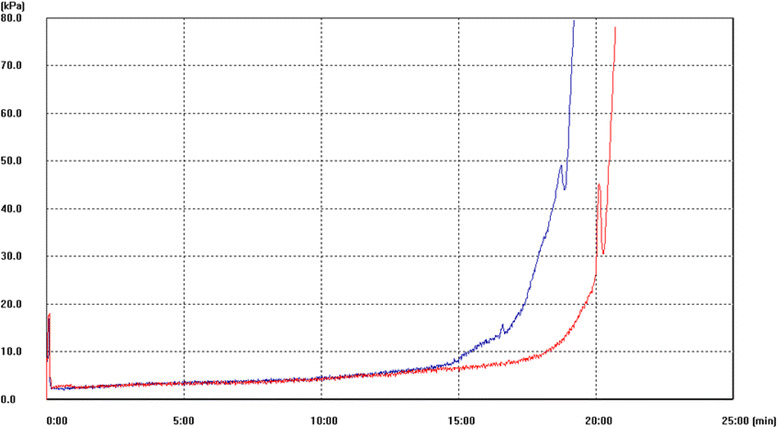
T-TAS® measurement of thrombus formation in a patient who underwent HBOT. The blue line represents the result obtained before HBOT, and the red line represents the result obtained after HBOT. After HBOT, the coagulation function decreased

References

    1. MacLeod JBA, Lynn M, McKenney MG, Cohn SM, Murtha M. Early coagulopathy predicts mortality in trauma. J Trauma. 2003;55:39–44. doi: 10.1097/01.TA.0000075338.21177.EF. - DOI - PubMed
    1. Bolliger D, Gorlinger K, Tanaka KA. Pathophysiology and treatment of coagulopathy in massive hemorrhage and hemodilution. Anesthesiology. 2010;113:1205–1219. doi: 10.1097/ALN.0b013e3181f22b5a. - DOI - PubMed
    1. Wohlauer MV, Moore EE, Droz NM, Harr J, Gonzalez E, Fragoso MF, et al. Hemodilution is not critical in the pathogenesis of the acute coagulopathy of trauma. J Surg Res. 2012;173:26–30. doi: 10.1016/j.jss.2011.04.047. - DOI - PMC - PubMed
    1. Winstedt D, Thomas OD, Nilsson F, Olanders K, Schott U. Correction of hypothermic and dilutional coagulopathy with concentrates of fibrinogen and factor XIII: an in vitro study with ROTEM. Scand J Trauma Resusc Emerg Med. 2014;22:73. doi: 10.1186/s13049-014-0073-z. - DOI - PMC - PubMed
    1. Brohi K, Cohen MJ, Davenport RA. Acute coagulopathy of trauma: mechanism, identification and effect. Curr Opin Crit Care. 2007;13:680–685. doi: 10.1097/MCC.0b013e3282f1e78f. - DOI - PubMed

LinkOut - more resources