


Effectiveness of conventional versus virtual reality-based vestibular rehabilitation exercises in elderly patients with dizziness: a randomized controlled study with 6-month follow-up
- PMID: 34799265
- PMCID: PMC9760985
- DOI: 10.1016/j.bjorl.2021.08.010
Effectiveness of conventional versus virtual reality-based vestibular rehabilitation exercises in elderly patients with dizziness: a randomized controlled study with 6-month follow-up
Abstract
Objectives: To investigate the effect of vestibular rehabilitation exercises supported with virtual reality containing real-life environments on dizziness, static and dynamic balance, functional mobility, fear of falling, anxiety, and depression in elderly patients with dizziness.
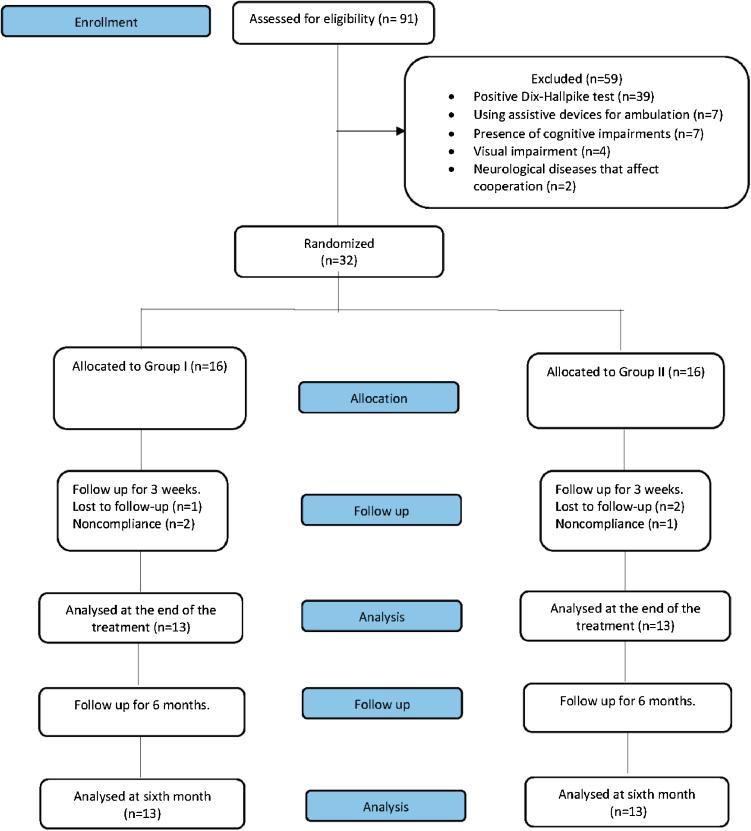
Methods: In this prospective randomized controlled study, 32-patients aged 65-years and older who applied to the otorhinolaryngology clinic with dizziness complaint randomly assigned to 2 groups. In Group 1 (n=16), vestibular rehabilitation program, supported with virtual reality, and in Group 2 (n=16), conventional vestibular rehabilitation program was applied 30-min a day, 5 sessions per week, 15 sessions in total for 3 weeks. Subjects were evaluated with The Vertigo Symptom Scale (VSS), Dizziness Handicap Inventory (DHI), Berg Balance Test (BBT) and Timed Up & Go Test (TUG), Falls Efficacy Scale-International (FES-I), Postural Stability Test (PST), Geriatric Depression Scale (GDS), Hamilton Anxiety Scale (HAS) at baseline, at the end of the treatment and 6-months after the treatment.
Results: Statistically significant improvements were seen in the DHI emotional subscale and TUG in Group 1 compared to Group 2 at the end of the treatment in elderly with dizziness (p<0.05). Also, there were significant improvements in the VSS, all DHI subgroups, and total scores, BBT, HAS in Group 1 compared to Group 2 at the 6-months after the treatment (p<0.05).
Conclusion: The application of vestibular rehabilitation in a virtual reality environment can lead to additional improvements especially in dizziness symptoms, disability, balance, and mobility in the elderly with chronic dizziness.
Keywords: Dizziness; Elderly; Vestibular rehabilitation; Virtual reality.
Copyright © 2021 Associação Brasileira de Otorrinolaringologia e Cirurgia Cérvico-Facial. Published by Elsevier Editora Ltda. All rights reserved.
References
-
- Salles N., Kressig R.W., Michel J.P. Management of chronic dizziness in elderly people. Z Gerontol Geriatr. 2003;36:10–15. - PubMed
-
- Lo A.X., Harada C.N. Geriatric dizziness evolving diagnostic and therapeutic approaches for the emergency department. Clin Geriatr Med. 2013;29:181–204. - PubMed
-
- Yang X.J., Hill K., Moore K., Williams S., Dowson L., Borschmann K., et al. Effectiveness of a targeted exercise intervention in reversing older people’s mild balance dysfunction: a randomized controlled trial. Phys Ther. 2012;92:24–37. - PubMed
-
- Jung J.Y., Kim J.S., Chung P.S., Woo S.H., Rhee C.K. Efficacy of vestibular rehabilitation therapy in reducing falls. Am J Otolaryngol. 2009;30:295–299. - PubMed
Publication types
MeSH terms
LinkOut - more resources
Full Text Sources
Medical
Miscellaneous
