Review
. 2021 Oct;18(4):2337-2350.
doi: 10.1007/s13311-021-01153-z. Epub 2021 Nov 19.

Treatment and Evaluation Advances in Leprosy Neuropathy

Affiliations
Review

Treatment and Evaluation Advances in Leprosy Neuropathy

Gigi J Ebenezer et al. Neurotherapeutics. 2021 Oct.

Abstract

Neuropathy and related disabilities are the major medical consequences of leprosy, which remains a global medical concern. Despite major advances in understanding the mechanisms of M. leprae entry into peripheral nerves, most aspects of the pathogenesis of leprosy neuropathy remain poorly understood. Sensory loss is characteristic of leprosy, but neuropathic pain is sometimes observed. Effective anti-microbial therapy is available, but neuropathy remains a problem especially if diagnosis and treatment are delayed. Currently there is intense interest in post-exposure prophylaxis with single-dose rifampin in endemic areas, as well as with enhanced prophylactic regimens in some situations. Some degree of nerve involvement is seen in all cases and neuritis may occur in the absence of leprosy reactions, but acute neuritis commonly accompanies both Type 1 and Type 2 leprosy reactions and may be difficult to manage. A variety of established as well as new methods for the early diagnosis and assessment of leprosy neuropathy are reviewed. Corticosteroids offer the primary treatment for neuritis and for subclinical neuropathy in leprosy, but success is limited if nerve function impairment is present at the time of diagnosis. A candidate vaccine has shown apparent benefit in preventing nerve injury in the armadillo model. The development of new therapeutics for leprosy neuropathy is greatly needed.

Keywords: Armadillos; Leprosy; M. leprae; Neuritis; Rifampin; Schwann cell.


Figures

Fig. 1
Fig. 1
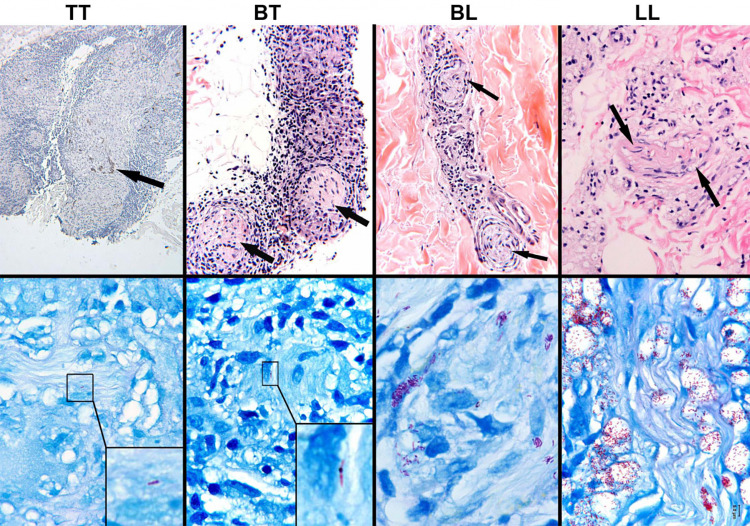
Inflammation and infection of cutaneous nerves across the leprosy spectrum. The inflammatory responses in and around cutaneous nerves are shown in the upper panel; arrows highlight recognizable nerve twigs. The immunopathologic classifications of leprosy, TT to LL, are indicated at the top of the figure (see text; mid-borderline, BB, is not shown). The TT lesion (upper left) is composed of a well-organized epithelioid granuloma that has nearly destroyed the nerve, remnants of which are shown by S-100 staining. The granulomatous inflammatory response becomes less organized across the spectrum until, at the LL extreme, it is composed of disorganized aggregates of foamy histiocytes, seen here surrounding a nerve (upper right). (TT, S-100, original magnification × 10; BT, BL, LL, hematoxylin–eosin, original magnification × 250). The demonstration of acid-fast bacilli within nerves is pathognomonic of leprosy. In the lower panel, Fite-stained sections reveal the corresponding intensity of M leprae infection in cutaneous nerves across the spectrum. M. leprae are rare and difficult to demonstrate in nerves of TT and BT lesions; they have been photographically enlarged in the insets. In contrast, bacilli are abundant and easily recognized in BL and LL lesions. (Fite/methylene blue, original magnification × 1000.) (From Scollard et al., The Continuing Challenges of Leprosy. 2006. Clinical Microbiology Reviews, 19: 338–381
Fig. 2
Fig. 2
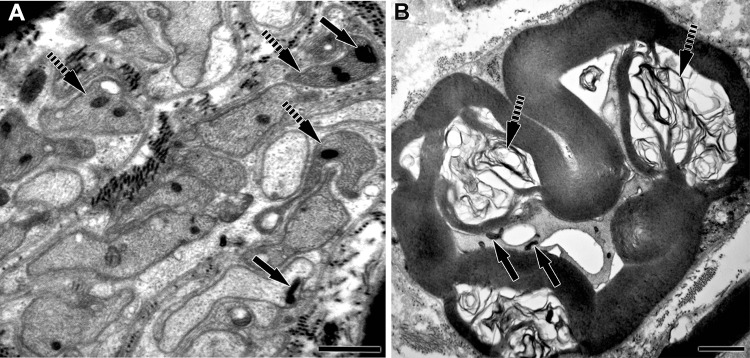
Electron micrographs of Mycobacterium leprae–infected peripheral nerves of Armadillos. A Electron micrograph of a M. leprae-infected tibial nerve section containing Remak bundles (unmyelinated axons) with M. leprae (arrows) in axoplasm and Schwann cell cytoplasm. Many Schwann cell process are denervated (broken arrows) but contain M. leprae. Scale bar: A = 1 µm. B Cross section of a myelinated axon with M. leprae within axoplasm (arrows). The nerve shows extensive demyelination (broken arrows) and axonal disruption. Scale bar: B = 2 µm

References

    1. Han, X.Y., Y.H. Seo, K.C. Sizer, T. Schoberle, G.S. May, J.S. Spencer, et al. A new Mycobacterium species causing diffuse lepromatous leprosy. Am J Clin Pathol 2008;130:(6):856–64. - PubMed
    1. Sharma, R., P. Singh, R.C. McCoy, S.M. Lenz, K. Donovan, M.T. Ochoa, et al. Isolation of Mycobacterium lepromatosis and Development of Molecular Diagnostic Assays to Distinguish Mycobacterium leprae and M. lepromatosis. Clin Infect Dis 2020;71:(8):e262-e269. - PMC - PubMed
    1. Ridley, D.S. Histological classification and the immunological spectrum of leprosy. Bull World Health Organ 1974;51:(5):451–65. - PMC - PubMed
    1. Ridley, D.S. and W.H. Jopling. Classification of leprosy according to immunity. A five-group system. Int J Lepr Other Mycobact Dis 1966;34:(3):255–73. - PubMed
    1. WHO Expert Committee on Leprosy., WHO Expert Committee on Leprosy : sixth report. World Health Organization technical report series,. 1988, Geneva: World Health Organization. 51 p.

MeSH terms