


Toward rebalancing blood pressure instability after spinal cord injury with spinal cord electrical stimulation: A mini review and critique of the evolving literature
- PMID: 34800845
- PMCID: PMC9280330
- DOI: 10.1016/j.autneu.2021.102905
Toward rebalancing blood pressure instability after spinal cord injury with spinal cord electrical stimulation: A mini review and critique of the evolving literature
Abstract
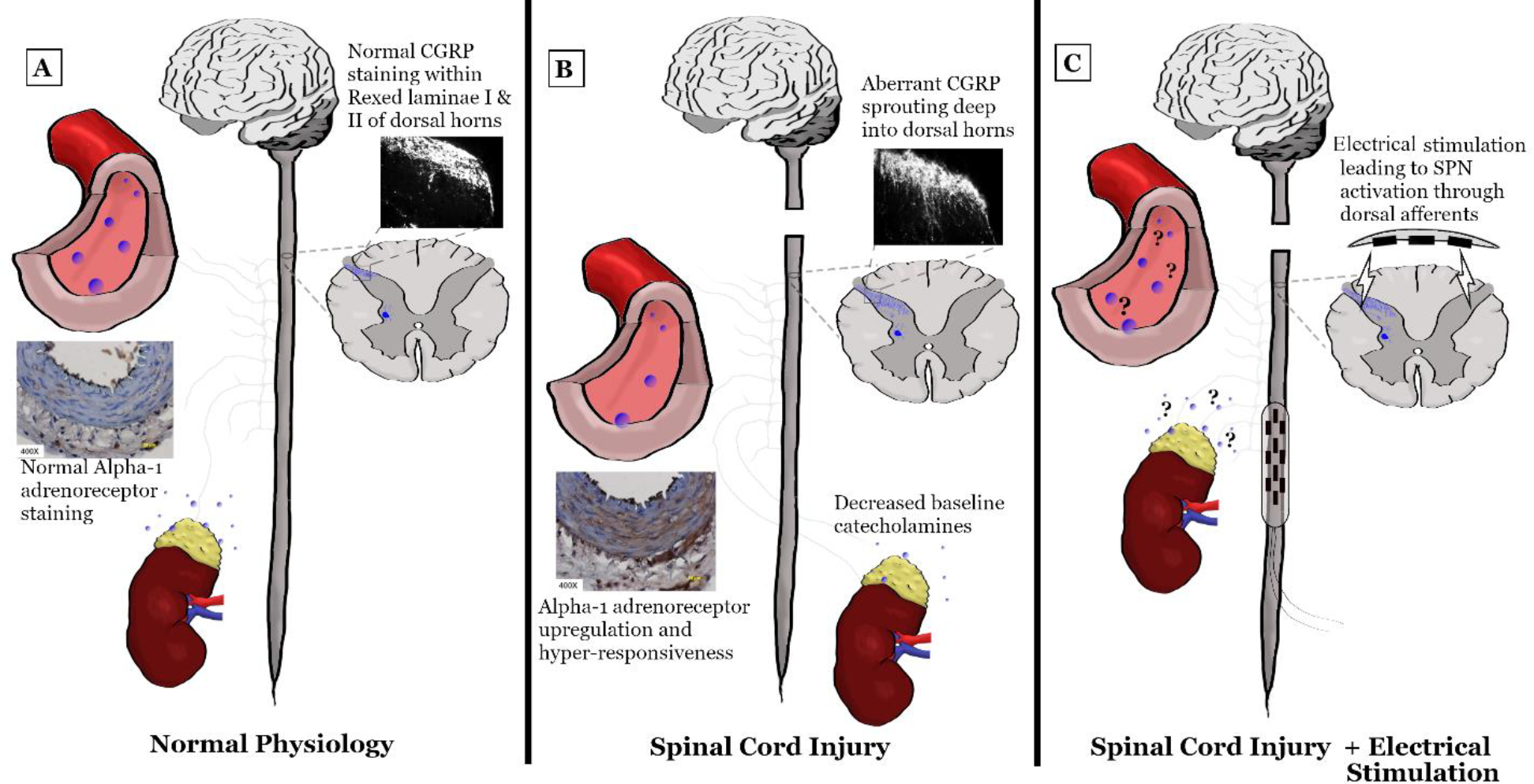
High-level spinal cord injury commonly leads to blood pressure instability. This manifests clinically as orthostatic hypotension (OH), where blood pressure can drop to the point of loss of consciousness, and autonomic dysreflexia (AD), where systolic blood pressure can climb to over 300 mmHg in response to an unperceived noxious stimulus. These blood pressure fluctuations can occur multiple times a day, contributing to increased vessel shear stress and heightened risk of cardiovascular disease. The pathophysiology of both of these conditions is rooted in impairments in regulation of spinal cord sympathetic preganglionic neurons, which control blood pressure by mediating vascular resistance and catecholamine release. Recently, spinal cord electrical stimulation has provided evidence that it may modulate these blood pressure imbalances. Early proposed mechanisms suggest activation of spinal cord dorsal horn neurons that ultimately act upon the sympathetic preganglionic neuronal pathways. For OH, spinal cord stimulation likely induces local activation of these neurons to generate baseline sympathetic tone and accompanying vasoconstriction. The mechanisms for spinal stimulation regulating AD are less clear, though some suggest it activates inhibitory circuits to dampen the overactive sympathetic response. While questions remain, spinal cord electrical stimulation is an intriguing new modality that may restore blood pressure regulation following spinal cord injury.
Keywords: Autonomic dysreflexia; Epidural stimulation; Orthostatic hypotension; Spinal cord injury.
Copyright © 2021 Elsevier B.V. All rights reserved.
Figures
References
-
- Angeli CA, Boakye M, Morton RA, Vogt J, Benton K, Chen Y, Ferreira CK, Harkema SJ, 2018. Recovery of Over-Ground Walking after Chronic Motor Complete Spinal Cord Injury. N Engl J Med 379, pp. 1244–1250. - PubMed
-
- Aslan SC, Legg Ditterline BE, Park MC, Angeli CA, Rejc E, Chen Y, Ovechkin AV, Krassioukov A, Harkema SJ, 2018. Epidural Spinal Cord Stimulation of Lumbosacral Networks Modulates Arterial Blood Pressure in Individuals With Spinal Cord Injury-Induced Cardiovascular Deficits. Front Physiol 9. 565. - PMC - PubMed
-
- Bendersky D, Yampolsky C.. Is spinal cord stimulation safe? A review of its complications. World Neurosurg. 2014;82(6):1359–68. - PubMed
Publication types
MeSH terms
Grants and funding
LinkOut - more resources
Full Text Sources
Medical
