


Subclinical Pulmonary Congestion and Abnormal Hemodynamics in Heart Failure With Preserved Ejection Fraction
- PMID: 34801461
- PMCID: PMC8995316
- DOI: 10.1016/j.jcmg.2021.09.017
Subclinical Pulmonary Congestion and Abnormal Hemodynamics in Heart Failure With Preserved Ejection Fraction
Abstract
Objectives: The authors hypothesized that quantitative computed tomography (QCT) imaging would reveal subclinical increases in lung congestion in patients with heart failure and preserved ejection fraction (HFpEF) and that this would be related to pulmonary vascular hemodynamic abnormalities.
Background: Gross evidence of lung congestion on physical examination, laboratory tests, and radiography is typically absent among compensated ambulatory patients with HFpEF. However, pulmonary gas transfer abnormalities are commonly observed and associated with poor outcomes.
Methods: Patients referred for invasive hemodynamic exercise testing who had undergone chest computed tomography imaging within 1 month were identified (N = 137). A novel artificial intelligence QCT algorithm was used to measure pulmonary fluid content.
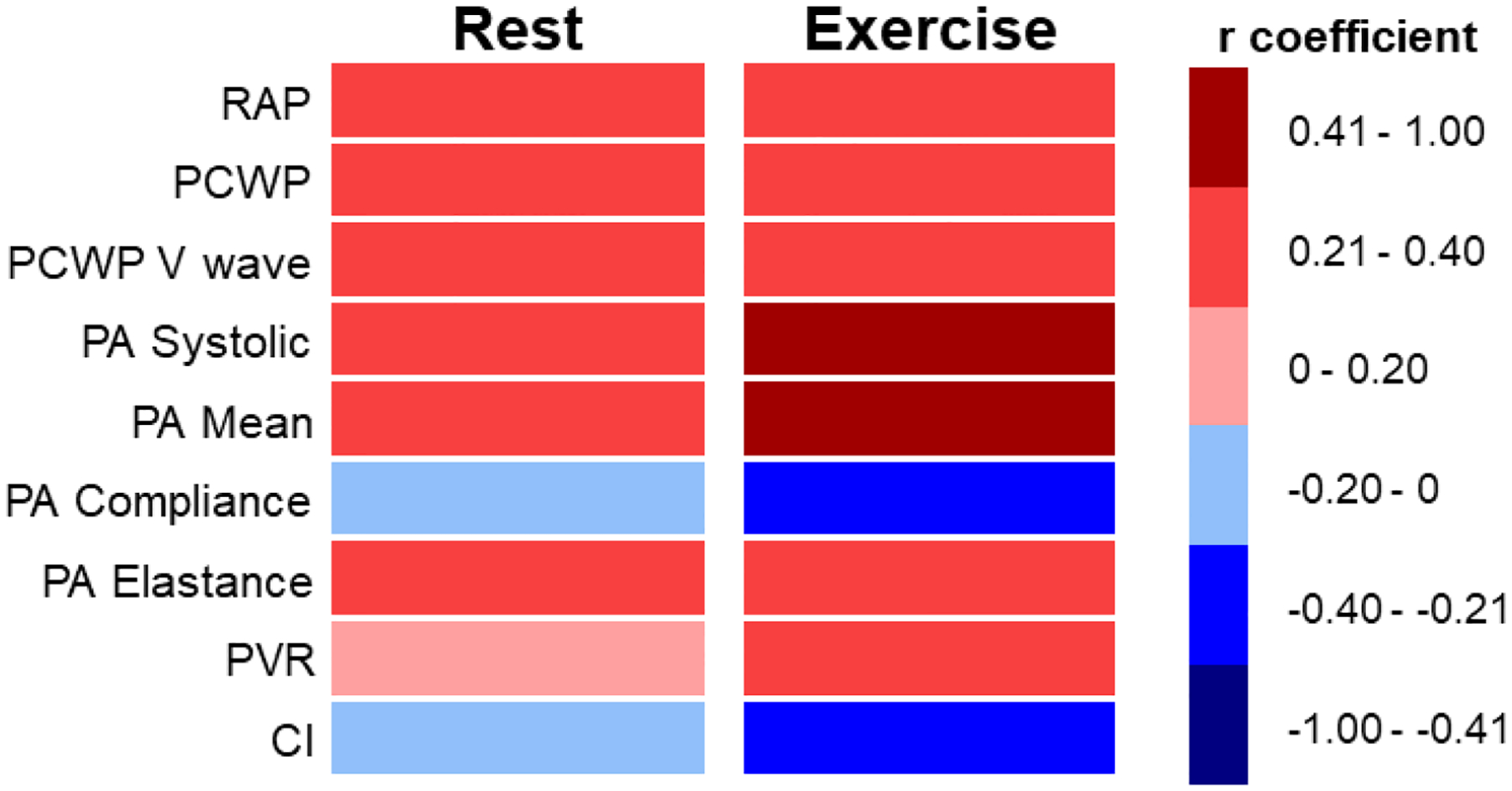
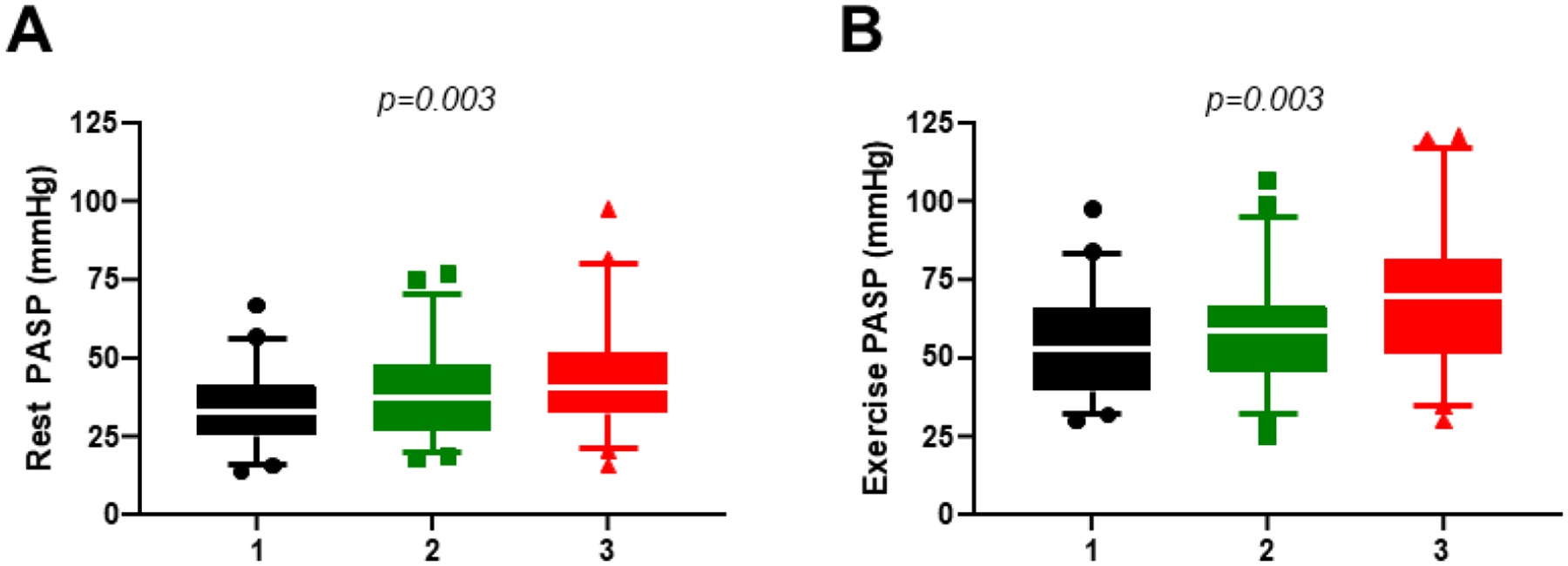
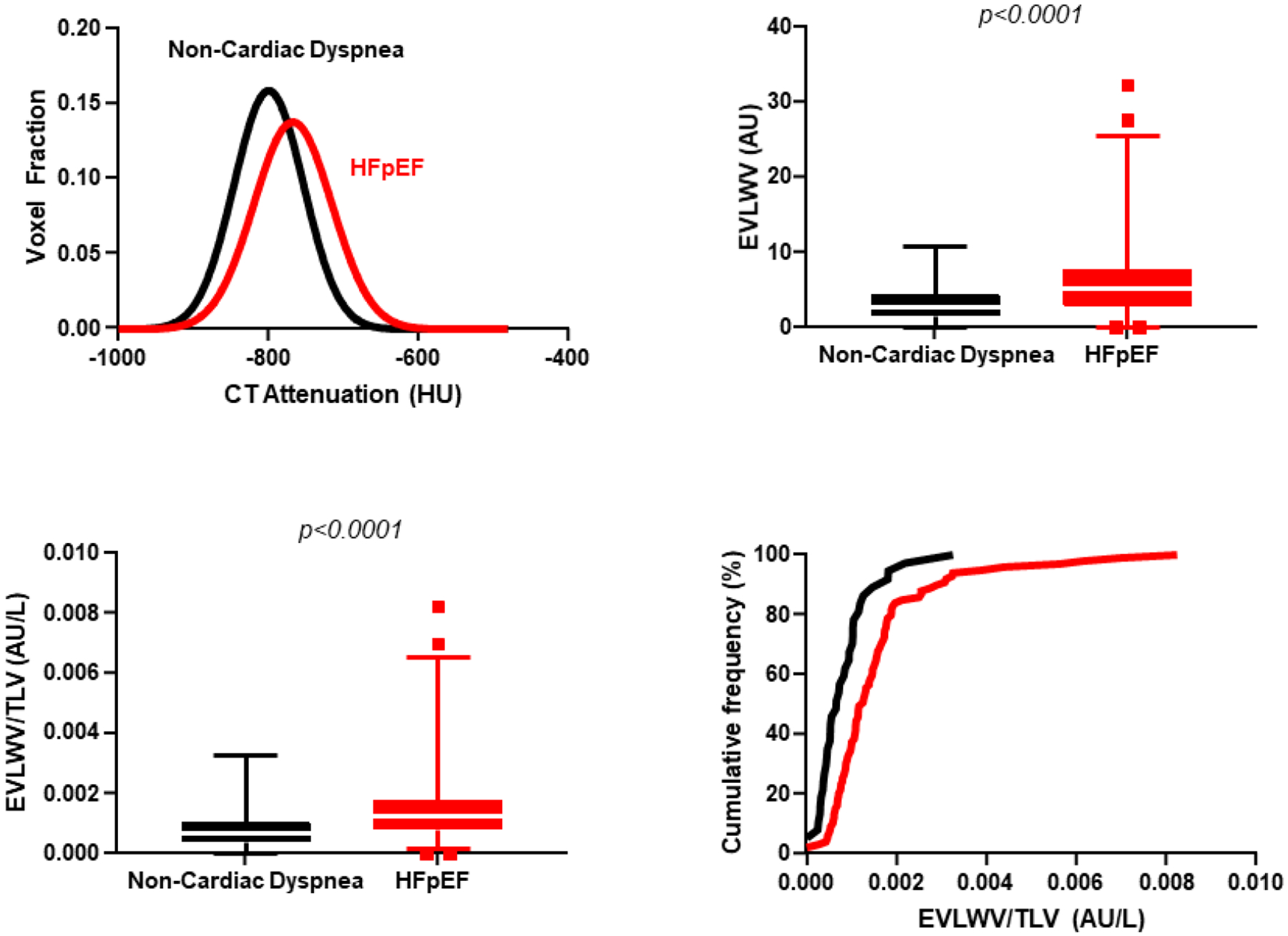
Results: Compared with control subjects with noncardiac dyspnea, patients with HFpEF displayed increased mean lung density (-758 HU [-793, -709 HU] vs -787 HU [-828, -747 HU]; P = 0.002) and a higher ratio of extravascular lung water to total lung volume (EVLWV/TLV) (1.25 [0.80, 1.76] vs 0.66 [0.01, 1.03]; P < 0.0001) by QCT imaging, indicating greater lung congestion. EVLWV/TLV was directly correlated with pulmonary vascular pressures at rest, with stronger correlations observed during exercise. Patients with increasing tertiles of EVLWV/TLV demonstrated higher mean pulmonary artery pressures at rest (34 ± 11 mm Hg vs 39 ± 14 mm Hg vs 45 ± 17 mm Hg; P = 0.0003) and during exercise (55 ± 17 mm Hg vs 59 ± 17 mm Hg vs 69 ± 22 mm Hg; P = 0.0003).
Conclusions: QCT imaging identifies subclinical lung congestion in HFpEF that is not clinically apparent but is related to abnormalities in pulmonary vascular hemodynamics. These data provide new insight into the long-term effects of altered hemodynamics on pulmonary structure and function in HFpEF.
Keywords: computed tomography; congestion; exercise; heart failure; hemodynamics.
Copyright © 2022 American College of Cardiology Foundation. Published by Elsevier Inc. All rights reserved.
Conflict of interest statement
Funding Support and Author Disclosures Dr Borlaug is supported by National Heart, Lung, and Blood Institute grant R01 HL128526. Dr Tschirren is the Director of Engineering at VIDA Diagnostics. All other authors have reported that they have no relationships relevant to the contents of this paper to disclose.
Figures
Comment in
-
Detection of Pulmonary Congestion in Heart Failure With Preserved Ejection Fraction Using Quantitative Chest CT.JACC Cardiovasc Imaging. 2022 Apr;15(4):638-640. doi: 10.1016/j.jcmg.2022.01.017. JACC Cardiovasc Imaging. 2022. PMID: 35393066 No abstract available.
References
-
- Melenovsky V, Andersen MJ, Andress K, Reddy YN, Borlaug BA. Lung congestion in chronic heart failure: haemodynamic, clinical, and prognostic implications. Eur J Heart Fail 2015;17:1161–71. - PubMed
-
- Selvaraj S, Claggett B, Pozzi A et al. Prognostic Implications of Congestion on Physical Examination Among Contemporary Patients With Heart Failure and Reduced Ejection Fraction: PARADIGM-HF. Circulation 2019;140:1369–1379. - PubMed
-
- Zile MR, Bennett TD, El Hajj S et al. Intracardiac Pressures Measured Using an Implantable Hemodynamic Monitor: Relationship to Mortality in Patients With Chronic Heart Failure. Circ Heart Fail 2017;10. - PubMed
Publication types
MeSH terms
Grants and funding
LinkOut - more resources
Full Text Sources
Other Literature Sources
Medical
