. 2022 Jan 10;380(2214):20210122.
doi: 10.1098/rsta.2021.0122. Epub 2021 Nov 22.

Unequal impact and spatial aggregation distort COVID-19 growth rates

Affiliations

Unequal impact and spatial aggregation distort COVID-19 growth rates

Keith Burghardt et al. Philos Trans A Math Phys Eng Sci. .

Abstract

The COVID-19 pandemic has posed unprecedented challenges to public health world-wide. To make decisions about mitigation strategies and to understand the disease dynamics, policy makers and epidemiologists must know how the disease is spreading in their communities. Here we analyse confirmed infections and deaths over multiple geographic scales to show that COVID-19's impact is highly unequal: many regions have nearly zero infections, while others are hot spots. We attribute the effect to a Reed-Hughes-like mechanism in which the disease arrives to regions at different times and grows exponentially at different rates. Faster growing regions correspond to hot spots that dominate spatially aggregated statistics, thereby skewing growth rates at larger spatial scales. Finally, we use these analyses to show that, across multiple spatial scales, the growth rate of COVID-19 has slowed down with each surge. These results demonstrate a trade-off when estimating growth rates: while spatial aggregation lowers noise, it can increase bias. Public policy and epidemic modelling should be aware of, and aim to address, this distortion. This article is part of the theme issue 'Data science approaches to infectious disease surveillance'.

Keywords: COVID-19; Reed–Hughes mechanism; aggregation bias.


Figures

Figure 1.
Figure 1.
The unequal impact of COVID-19. (a) The number of deaths (as of April 2020) has a heavy-tailed distribution for counties, states and nations, with the most cases in New York City, New York State and the USA, respectively. Inset: a stochastic model discussed in the main text qualitatively captures the properties of the distribution. (b) A similar pattern is seen for infections at many spatial scales: from US facilities to neighbourhoods to nations. (c) Deaths over time for New York state and select counties, where we see the disease initially grows at an approximately exponential rate and the disease arrives in counties at different times. (Online version in colour.)
Figure 2.
Figure 2.
Growth of COVID-19 at different spatial scales. (a) We find reasonable agreement between the growth rate of infections (noisy black line) and an exponential growth model (straight fitted line) before the cutoff (vertical grey line). Daily infection rates for a sample of LA county neighbourhoods is also shown. (b) The growth rate of individual neighbourhoods and LA county (vertical line), among 116 neighbourhoods with significant cases (see Methods and materials). Inset: we simulate cases in LA neighbourhoods as exponentially growing without statistical noise and find the aggregation bias is preserved. (c) The growth rate for counties, states and nation simulated using SIR models, of which the transition rates are drawn from normal distributions. (d) The infection growth rate for nations and the world (vertical line). Inset: a plot of the death growth rate for nations and the world. (e) The infection growth rate for Italian provinces, regions and the entire Italian nation. (f ) The infection growth rate for German counties, states and the entire Germany nation. (Online version in colour.)
Figure 3.
Figure 3.
Growth of COVID-19 in the USA. (a) The number of daily new infections in the USA showing three surges of exponential growth. We determine the range of the exponential growth period in the data (shaded region) by selecting the best negative binomial fitting (smooth fitted line). (b) The maps and distributions of growth rate for county, state and US infections during three surges. (Online version in colour.)
Figure 4.
Figure 4.
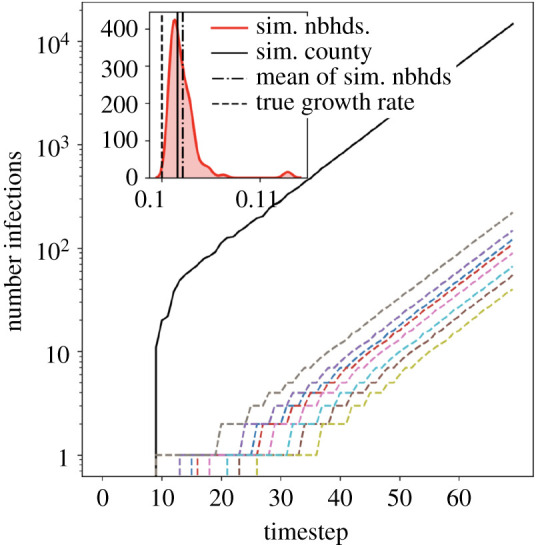
Simulations with the same growth rate but randomized arrival times whose distribution matches that of LA County. (Online version in colour.)
Figure 5.
Figure 5.
Deaths growth rate distribution for counties, states and the nation for the first, second and third surge. (Online version in colour.)
Figure 6.
Figure 6.
Growth rates with alternative aggregation method. The distributions of (a) infections and (b) deaths growth rate during three surges in USA, (c) the distributions of simulated SIR models for county, state and US nation level, and (d) the distributions of infections growth rates in Los Angeles neighbourhoods. The county-level growth rates are estimated by fitting exponential infection curves. The state-level growth rates are estimated by taking the mean of county-level growth rates, weighted by the number of cumulative infections at the end of exponential growth period in each county. The nation-level growth rates are aggregated from state-level growth rates, with the same method. (Online version in colour.)

References

    1. Hossain M, Junus A, Zhu X, Jia P, Wen T, Pfeiffer D, Yuan H. 2020. The effects of border control and quarantine measures on the spread of COVID-19. Epidemics 32, 100397. ( 10.1016/j.epidem.2020.100397) - DOI - PMC - PubMed
    1. Heffernan J, Smith R, Wahl L. 2005. Perspectives on the basic reproductive ratio. J. R. Soc. Interface 2, 281-293. ( 10.1098/rsif.2005.0042) - DOI - PMC - PubMed
    1. Altieri N et al. 2020. Curating a COVID-19 data repository and forecasting county-level death counts in the united states. Preprint (https://arxiv.org/abs/2005.07882).
    1. Lessler J, Azman AS, McKay HS, Moore SM. 2017. What is a hotspot anyway? Am. J. Trop. Med. Hyg. 96, 1270-1273. ( 10.4269/ajtmh.16-0427) - DOI - PMC - PubMed
    1. The New York Times. 2020. Coronavirus in the U.S.: latest map and case count. www.nytimes.com/interactive/2020/us/coronavirus-us-cases.html#clusters (accessed 5 May 2020).