


Does the Presence of Anxiety and Depression Symptoms Mediate the Association Between Family Functions and Self-Efficacy in Pregnant Women in the Third Trimester?: A Community-Based Cross-Sectional Survey
- PMID: 34803756
- PMCID: PMC8599816
- DOI: 10.3389/fpsyt.2021.726093
Does the Presence of Anxiety and Depression Symptoms Mediate the Association Between Family Functions and Self-Efficacy in Pregnant Women in the Third Trimester?: A Community-Based Cross-Sectional Survey
Abstract
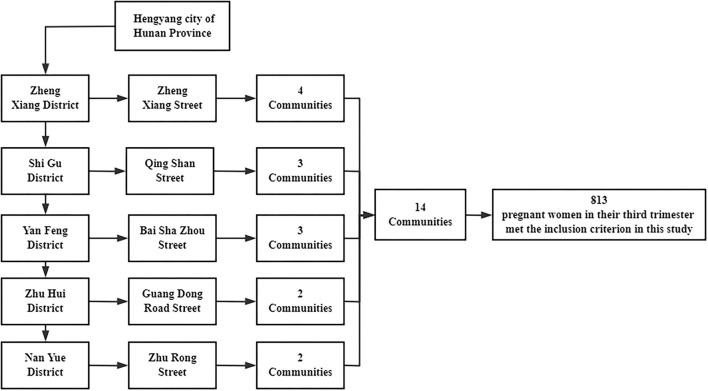
Objectives: Pregnant women in the third trimester can be more vulnerable to adverse mental health outcomes, but there is limited research on the association between family function and self-efficacy and potential mediation by symptoms of anxiety and depression. Methods: The cross-sectional study enrolled 813 pregnant women in the third trimester from 14 communities of Hengyang city, Hunan province of China. All of the participants completed a battery of self-report measures of family function (Family Adaptation Partnership Growth and Resolve Index, APGAR-family), self-efficacy (General Self-Efficacy Scale, GSES), anxiety (measured by Generalized Anxiety Disorder scale with seven items, GAD-7), and depression symptoms (Patient Health Questionnaire with nine items, PHQ-9). The correlation analysis was performed using Spearman's correlation coefficient. Baron and Kenny's method and multiple mediation models with bootstrapping were used to determine whether the symptoms of anxiety and depression mediated the association between family functions and self-efficacy. Results: There were 22.6% pregnant women in the low level of self-efficacy, with 60.9% in the moderate level and 16.5% of respondents in the high level. Self-efficacy had significant correlations with both anxiety symptoms (r = -0.19, p < 0.05), depression symptoms (r = -0.22, p < 0.05), and family function (r = 0.31, p < 0.05). Anxiety symptoms were significantly associated with self-efficacy (β = -0.016, p < 0.05). Depression symptoms were significantly associated with self-efficacy (β = -0.024, p < 0.05). Anxiety and depression symptoms partly mediated the association between family function and self-efficacy, accounting for 11.4 and 16.4% of total effect, respectively. It was indicated that pregnant women with a high degree of family function are less likely to have emotional symptoms and predicted to have higher levels of self-efficacy. Conclusions: Anxiety and depression show mediating effects in the association between family function and self-efficacy. Improved family function can have a positive impact on pregnant women in the third trimester.
Keywords: anxiety symptoms; depression symptoms; family function; mediation modeling; pregnancy; self-efficacy.
Copyright © 2021 Wensu, Xidi, Shaojie, Baohua, Yunhan, Huilan, Zhao and Xiyue.
Conflict of interest statement
The authors declare that the research was conducted in the absence of any commercial or financial relationships that could be construed as a potential conflict of interest.
Figures
References
-
- Mortan RA, Ripoll P, Carvalho C, Bernal MC. Effects of emotional intelligence on entrepreneurial intention and self-efficacy. Revista de Psicología del Trabajo y de las Organizaciones. (2014) 30:97–104. 10.1016/j.rpto.2014.11.004 - DOI
-
- Caprara GV, Barbaranelli C, Pastorelli C, Cervone D. The contribution of self-efficacy beliefs to psychosocial outcomes in adolescence: predicting beyond global dispositional tendencies. Pers Individ Dif. (2004) 37:751–63. 10.1016/j.paid.2003.11.003 - DOI
LinkOut - more resources
Full Text Sources
