


Birth Weight Is Associated With Kidney Size in Middle-Aged Women
- PMID: 34805631
- PMCID: PMC8589725
- DOI: 10.1016/j.ekir.2021.08.029
Birth Weight Is Associated With Kidney Size in Middle-Aged Women
Abstract
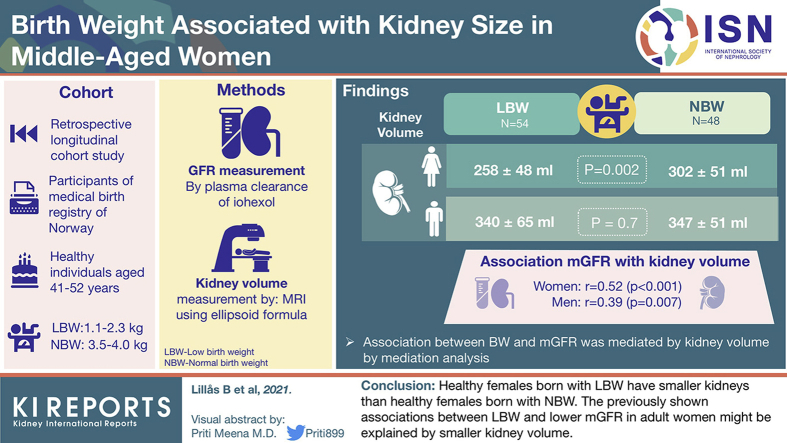
Introduction: Low birth weight (LBW) is associated with increased risk of kidney disease due to lower nephron endowment leading to hyperfiltration and subsequent nephron loss. Kidney size is commonly used as a proxy for nephron number. We compared kidney volume measured by magnetic resonance imaging (MRI) with measured glomerular filtration rate (mGFR) in adults with either normal birth weight (NBW) or low birth weight (LBW).
Methods: Healthy individuals aged 42 to 52 years with LBW (1100-2300 g) and NBW (3500 -4000 g) were invited to participate. The GFR was measured using plasma clearance of iohexol. Kidney volume was measured on magnetic resonance images using axial T2 images and coronal T1 images with fat saturation without contrast enhancement; calculations were performed according to the ellipsoid formula π/6 × length × width × depth.
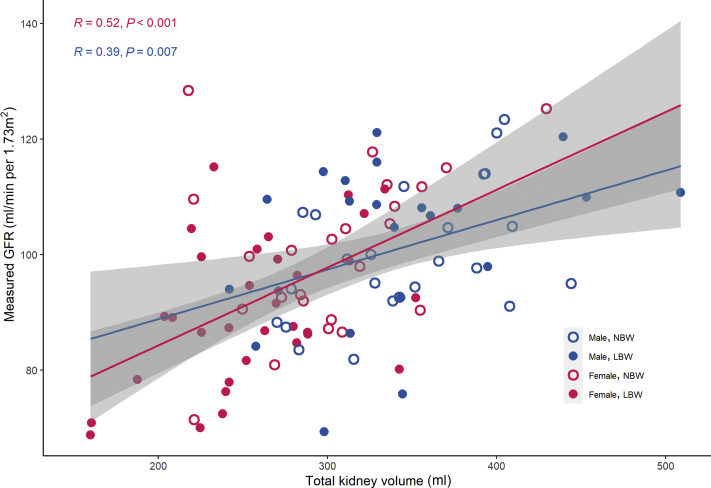
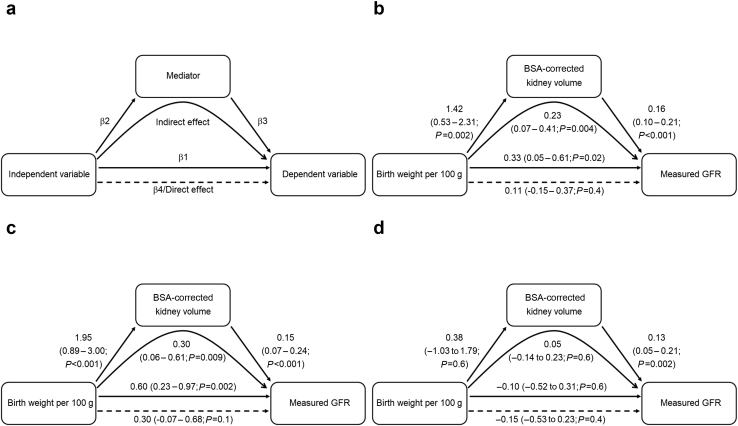
Results: We included 102 individuals (54 LBW and 48 NBW). Total kidney volume was 302 ± 51 ml for female NBW vs 258 ± 48 ml for female LBW individuals (P = 0.002). For male individuals, total kidney volume was 347 ± 51 ml vs. 340 ± 65 ml (P = 0.7). The mGFR was significantly associated with kidney volume, with r = 0.52 (P < 0.001) for women and r = 0.39 (P = 0.007) for men. A mediation analysis showed that the association between birth weight and mGFR (significant in total sample and women) was mediated by kidney volume.
Conclusion: Healthy female individuals born with LBW have smaller kidneys than healthy females born with NBW. The previously shown associations between LBW and lower mGFR in adult women might be explained by smaller kidney volume.
Keywords: kidney size; low birth weight; magnetic resonance imaging; ultrasonography.
© 2021 International Society of Nephrology. Published by Elsevier Inc.
Figures

References
-
- Barker D.J., Osmond C. Infant mortality, childhood nutrition, and ischaemic heart disease in England and Wales. Lancet. 1986;1:1077–1081. - PubMed
-
- Gluckman P.D., Hanson M.A. The developmental origins of the metabolic syndrome. Trends Endocrinol Metab. 2004;15:183–187. - PubMed
-
- White S.L., Perkovic V., Cass A., et al. Is low birth weight an antecedent of CKD in later life? A systematic review of observational studies. Am J Kidney Dis. 2009;54:248–261. - PubMed
-
- Hoy W.E., Rees M., Kile E., et al. A new dimension to the Barker hypothesis: low birthweight and susceptibility to renal disease. Kidney Int. 1999;56:1072–1077. - PubMed
LinkOut - more resources
Full Text Sources
Research Materials
Miscellaneous
