


Sorafenib plus hepatic arterial infusion chemotherapy with oxaliplatin versus sorafenib alone for advanced hepatocellular carcinoma
- PMID: 34805877
- PMCID: PMC8562173
- DOI: 10.1016/j.jimed.2019.07.005
Sorafenib plus hepatic arterial infusion chemotherapy with oxaliplatin versus sorafenib alone for advanced hepatocellular carcinoma
Erratum in
-
Erratum regarding previously published articles.J Interv Med. 2020 Nov 27;3(4):217. doi: 10.1016/j.jimed.2020.10.011. eCollection 2020 Dec. J Interv Med. 2020. PMID: 34826312 Free PMC article.
Abstract
Objective: To compare the efficacy of sorafenib plus hepatic arterial infusion chemotherapy (HAIC) with oxaliplatin to that of sorafenib alone in patients with advanced hepatocellular carcinoma (HCC).
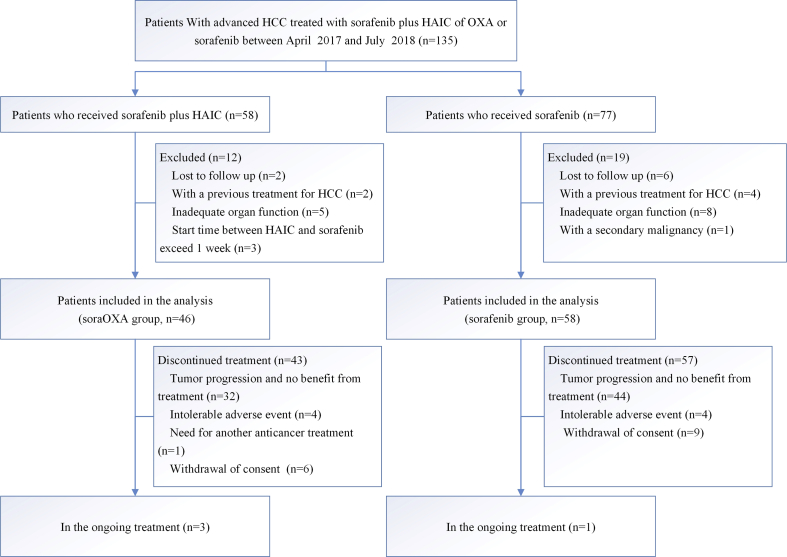
Methods: This was a retrospective, single-center trial. Between April 3, 2017 and July 2, 2018, 104 patients with Child-Pugh A and advanced HCC received either 400 mg of sorafenib orally twice daily plus HAIC with oxaliplatin (oxaliplatin 85 mg/m2, every 3 weeks via repetitive catheterization) (n = 46, soraOXA group) or 400 mg of only sorafenib orally twice daily (n = 58, sorafenib group). Overall survival, progression-free survival, objective response rate, and treatment-related adverse events were compared.
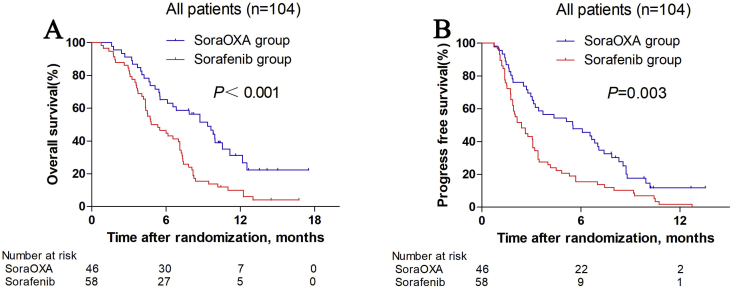
Results: The median overall survival was 9.37 months (95% CI, 7.05-11.68) in the soraOXA group versus 4.8 months (95% CI, 2.98-6.62) in the sorafenib group (HR 0.46 [95% CI, 0.29-0.72]; P < 0.001). The soraOXA group also showed a higher objective response rate (16 [34.8%] vs 1 [1.7%]; P < 0.001) and a longer progression-free survival rate (5.5 months [95% CI, 2.32-8.68] vs 2.4 months [95% CI, 1.65-3.15], HR 0.54 [95% CI, 0.36-0.81], P = 0.003) than the sorafenib group. There was no significant difference in the overall incidence of any grade adverse events, grade 3/4 adverse events, serious adverse events, or incidence of treatment termination due to adverse events between the two groups.
Conclusion: Compared with sorafenib alone, sorafenib plus HAIC with oxaliplatin showed favorable treatment outcomes in patients with advanced HCC. The merits of this approach need to be established with a prospective trial.
Keywords: Barcelona clinic liver cancer stage C; Hepatic arterial infusion chemotherapy; Hepatocellular carcinoma; Oxaliplatin; Sorafenib.
© 2019 Shanghai Journal of Interventional Medicine Press. Production and hosting by Elsevier B.V. on behalf of KeAi.
Figures
References
-
- Global Burden of Disease Cancer C. Global, regional, and national cancer incidence, mortality, years of life lost, years lived with disability, and disability-adjusted life-years for 32 cancer groups, 1990 to 2015: a systematic analysis for the global burden of disease study. JAMA Oncol 3. 2017:524–548. - PMC - PubMed
-
- Cabibbo G., Enea M., Attanasio M. A meta-analysis of survival rates of untreated patients in randomized clinical trials of hepatocellular carcinoma. Hepatology. 2010;51:1274–1283. - PubMed
-
- Forner A., Reig M.E., de Lope C.R. Current strategy for staging and treatment: the BCLC update and future prospects. Semin Liver Dis. 2010;30:61–74. - PubMed
-
- Llovet J.M., Ricci S., Mazzaferro V. Sorafenib in advanced hepatocellular carcinoma. N Engl J Med. 2008;359:378–390. - PubMed
-
- Cheng A.L., Kang Y.K., Chen Z. Efficacy and safety of sorafenib in patients in the Asia-Pacific region with advanced hepatocellular carcinoma: a phase III randomised, double-blind, placebo-controlled trial. Lancet Oncol. 2009;10:25–34. - PubMed
LinkOut - more resources
Full Text Sources
Miscellaneous