


Identifying Long-Term Trajectories of Foot Pain Severity and Potential Prognostic Factors: A Population-Based Cohort Study
- PMID: 34806345
- PMCID: PMC10952181
- DOI: 10.1002/acr.24823
Identifying Long-Term Trajectories of Foot Pain Severity and Potential Prognostic Factors: A Population-Based Cohort Study
Abstract
Objectives: To identify distinct foot pain trajectories over 7 years and examine their associations with potential prognostic factors.
Methods: Adults ages ≥50 years and registered with 4 general practices in North Staffordshire, UK were mailed a baseline health survey. Those reporting current or recent foot pain were invited to attend a research assessment clinic. Follow-up was by repeated postal surveys at 18, 36, 54, and 84 months. Distinct trajectories of foot pain were explored using latent class growth analysis (LCGA). Subsequently, identified trajectories were combined into most and least progressive groups, and covariate-adjusted associations with a range of prognostic factors were examined.
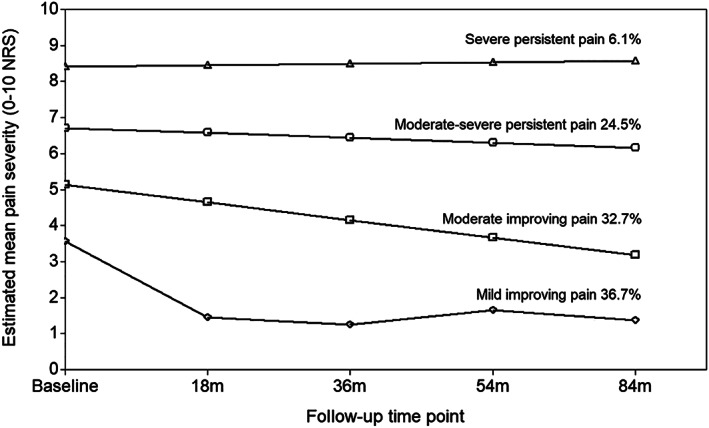
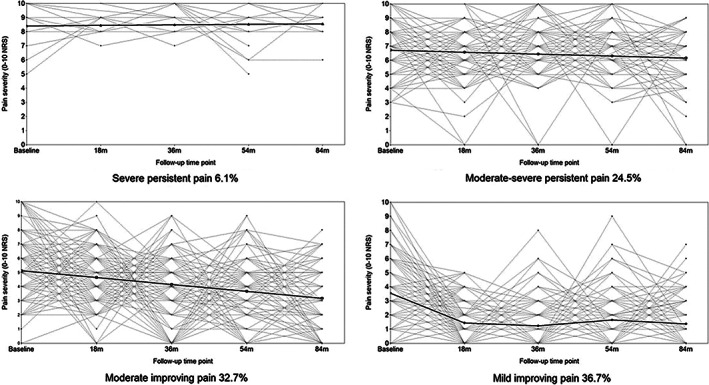
Results: Of 560 adults with foot pain attending baseline research clinics, 425 (76%) provided data at baseline and 2 or more follow-up time points. LCGA for foot pain severity (0-10 numerical rating scale) identified a 4-trajectory model: "mild, improving" (37%); "moderate, improving" (33%); "moderate-severe, persistent" (24%); and "severe, persistent" (6%). Compared with individuals in more favorable (improving) pain trajectories, those in less favorable (persistent) pain trajectories were more likely to be obese, have routine/manual and intermediate occupations, have poorer physical and mental health, have catastrophizing beliefs, have greater foot-specific functional limitation, and have self-assessed hallux valgus at baseline.
Conclusions: Four distinct trajectories of foot pain were identified over a 7-year period, with one-third of individuals classified as having pain that is persistently moderate-severe and severe in intensity. The effect of intervening to target modifiable prognostic factors such as obesity and hallux valgus on long-term outcomes in people with foot pain requires investigation.
© 2021 The Authors. Arthritis Care & Research published by Wiley Periodicals LLC on behalf of American College of Rheumatology.
Figures
References
-
- Thomas MJ, Roddy E, Zhang W, et al. The population prevalence of foot and ankle pain in middle and old age: a systematic review. Pain 2011;152:2870–80. - PubMed
-
- Menz HB, Auhl M, Spink MJ. Foot problems as a risk factor for falls in community‐dwelling older people: a systematic review and meta‐analysis. Maturitas 2018;118:7–14. - PubMed
Publication types
MeSH terms
Grants and funding
LinkOut - more resources
Full Text Sources
