


TLRs in COVID-19: How they drive immunopathology and the rationale for modulation
- PMID: 34806446
- PMCID: PMC8762091
- DOI: 10.1177/17534259211051364
TLRs in COVID-19: How they drive immunopathology and the rationale for modulation
Abstract
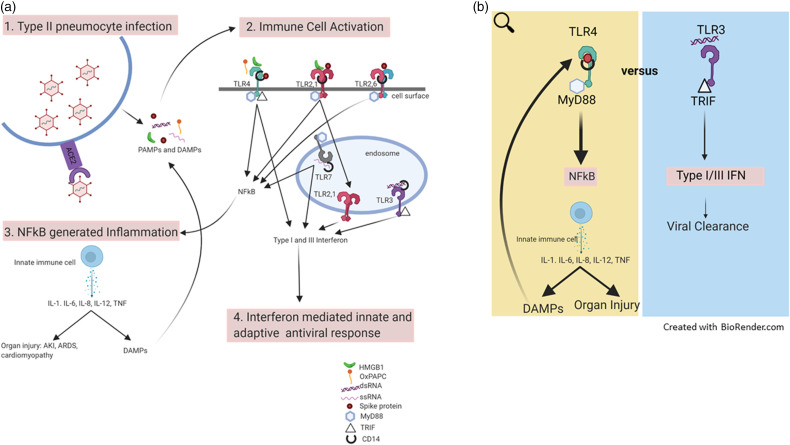
COVID-19 is both a viral illness and a disease of immunopathology. Proximal events within the innate immune system drive the balance between deleterious inflammation and viral clearance. We hypothesize that a divergence between the generation of excessive inflammation through over activation of the TLR associated myeloid differentiation primary response (MyD88) pathway relative to the TIR-domain-containing adaptor-inducing IFN-β (TRIF) pathway plays a key role in COVID-19 severity. Both viral elements and damage associated host molecules act as TLR ligands in this process. In this review, we detail the mechanism for this imbalance in COVID-19 based on available evidence, and we discuss how modulation of critical elements may be important in reducing severity of disease.
Keywords: CD14; COVID-19; TLR; innate immunity; interferon.
Conflict of interest statement
Figures
References
-
- Akira S, Takeda K, Kaisho T. Toll-like receptors: critical proteins linking innate and acquired immunity. Nat Immunol 2001; 2: 675–680. - PubMed
-
- Iwasaki A, Medzhitov R. Toll-like receptor control of the adaptive immune responses. Nat Immunol 2004; 5: 987–995. - PubMed
-
- Aoshi T, Koyama S, Kobiyama Ket al. et al. Innate and adaptive immune responses to viral infection and vaccination. Curr Opin Virol 2011; 1: 226–232. - PubMed
-
- Medzhitov R, Preston-Hurlburt P, Janeway CA. A human homologue of the drosophila toll protein signals activation of adaptive immunity. Nature 1997; 388: 394–397. - PubMed
Publication types
MeSH terms
Substances
Grants and funding
LinkOut - more resources
Full Text Sources
Medical
Research Materials
