Association of County-Level Poverty and Inequities With Firearm-Related Mortality in US Youth
- PMID: 34807238
- PMCID: PMC8609463
- DOI: 10.1001/jamapediatrics.2021.4822
Association of County-Level Poverty and Inequities With Firearm-Related Mortality in US Youth
Abstract
Importance: Youth firearm-related deaths are a public health crisis in the US. The association between county-level poverty and the risk of firearm-related deaths among youth is unknown, however.
Objective: To examine the association between county-level poverty concentration and firearm-related mortality rates in US youth.
Design, setting, and participants: This cross-sectional study analyzed US firearm fatalities in children and young adults aged 5 to 24 years that occurred between January 1, 2007, and December 31, 2016. Data were obtained from the Centers for Disease Control and Prevention's Compressed Mortality File, and annual intercensal county population data were obtained from the US Census Bureau. Data analyses were conducted between November 1, 2019, and June 30, 2020.
Exposures: County-level poverty was categorized into 5 groups: 0% to 4.9%, 5% to 9.9%, 10% to 14.9%, 15% to 19.9%, and ≥20% of the population living below the federal poverty level.
Main outcomes and measures: The main outcomes were firearm-related deaths in total and by specific intent (homicide, suicide, and unintentional) per 100 000 youths over the entire study period. Multivariable negative binomial regression models were used to analyze the association between firearm-related mortality rates and county poverty concentration, controlling for demographic variables, urbanicity, and statewide firearm prevalence. Adjusted incidence rate ratios (IRRs) were calculated, and statewide firearm prevalence was estimated. The population-attributable fraction (PAF) and years of potential life lost for each intent were calculated.
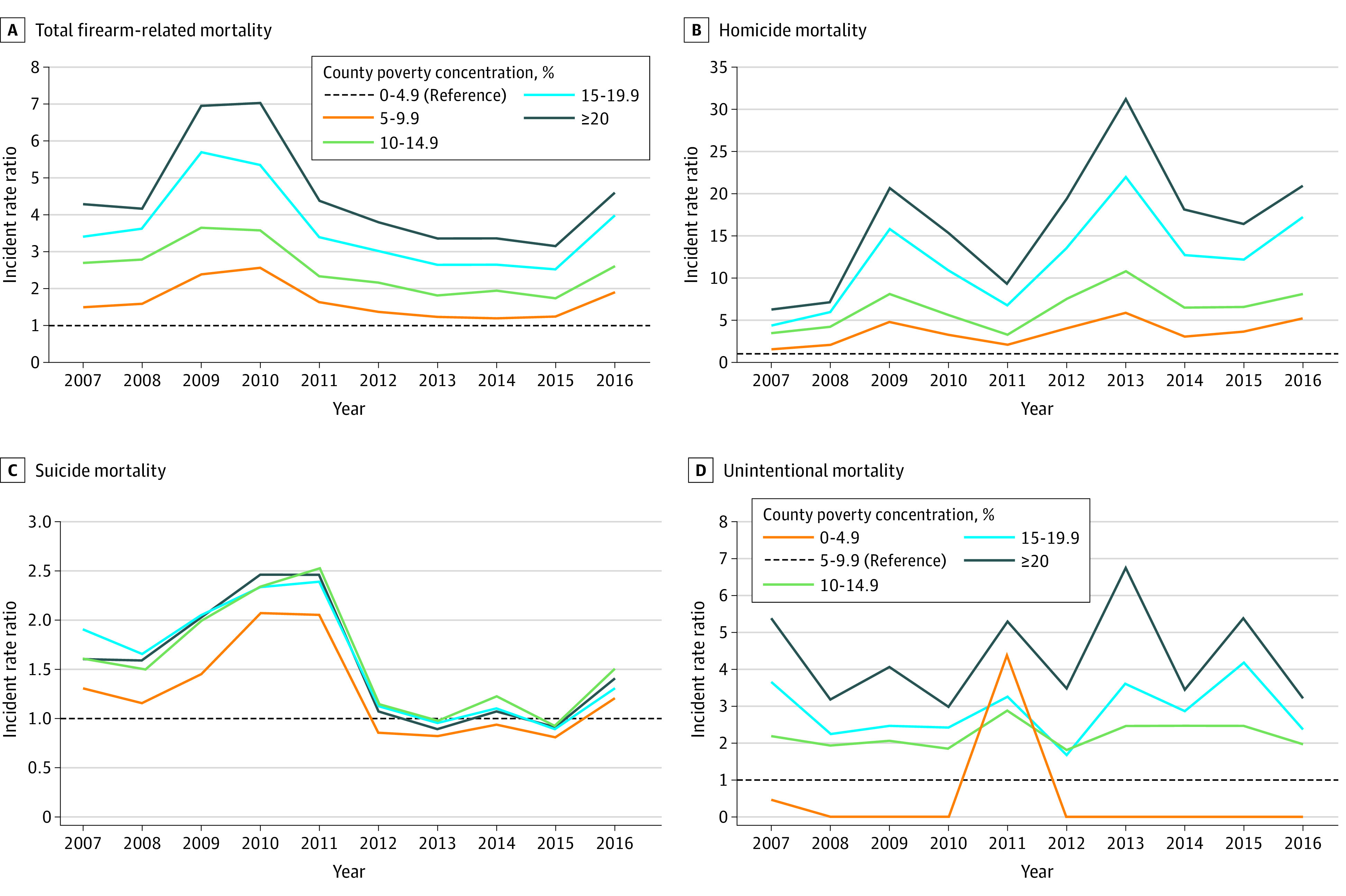
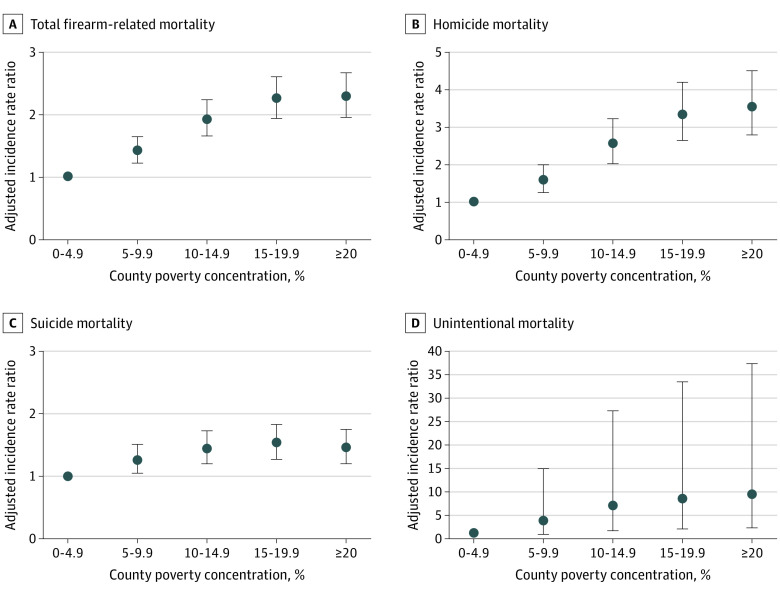
Results: A total of 67 905 firearm-related deaths among youth (predominantly composed of 60 164 male individuals [88.6%]) from 2007 to 2016 were analyzed. Of these deaths, 42 512 were homicides (62.6%), 23 034 were suicides (33.9%), and 1627 were unintentional (2.4%). Firearm-related mortality risk increased in a stepwise manner with increasing county poverty concentration. Compared with counties with the lowest poverty concentration, counties with the highest poverty concentration had an increased rate of total firearm-related deaths (adjusted IRR, 2.29; 95% CI, 1.96-2.67), homicides (adjusted IRR, 3.55; 95% CI, 2.80-4.51), suicides (adjusted IRR, 1.45; 95% CI, 1.20-1.75), and unintentional deaths (adjusted IRR, 9.32; 95% CI, 2.32-37.4). The PAF was 0.51 (95% CI, 0.43-0.57) for all firearm-related deaths, 0.66 (95% CI, 0.57-0.73) for homicides, 0.30 (95% CI, 0.17-0.42) for suicides, and 0.86 (95% CI, 0.46-0.97) for unintentional deaths. This calculation translated to 34 292 firearm-related deaths that would not have occurred if all counties had the same risk as counties with the lowest poverty concentration. A total of 3 833 105 years of potential life lost was observed.
Conclusions and relevance: This study found an association between firearm-related mortality rates among youth and county-level poverty concentration. With more than half of firearm-related deaths and two-thirds of firearm-related homicides potentially associated with living in an area with a high concentration of poverty, a multidimensional strategy to reduce poverty and firearm-related deaths is urgently needed.
Conflict of interest statement
Figures
Comment in
-
Poverty and Firearm-Related Deaths Among US Youth.JAMA Pediatr. 2022 Feb 1;176(2):e214819. doi: 10.1001/jamapediatrics.2021.4819. Epub 2022 Feb 7. JAMA Pediatr. 2022. PMID: 34807266 No abstract available.
References
-
- Centers for Disease Control and Prevention . Wide-ranging Online Data for Epidemiologic Research (WONDER). Accessed March 31, 2021. https://wonder.cdc.gov/
-
- Centers for Disease Control and Prevention . WISQARS (Web-Based Injury Statistics Query and Reporting System). Choice Reviews. 2011;48(08):48-4227.
-
- Centers for Disease Control and Prevention . Leading causes of injury death highlighting violence. WISQARS. Accessed March 31, 2021. https://webappa.cdc.gov/sasweb/ncipc/mortrate.html
MeSH terms
LinkOut - more resources
Full Text Sources
Medical