. 2021 Nov 22;4(1):1319.
doi: 10.1038/s42003-021-02828-1.

Incrimination of shrews as a reservoir for Powassan virus

Affiliations

Incrimination of shrews as a reservoir for Powassan virus

Heidi K Goethert et al. Commun Biol. .

Abstract

Powassan virus lineage 2 (deer tick virus) is an emergent threat to American public health, causing severe neurologic disease. Its life cycle in nature remains poorly understood. We use a host-specific retrotransposon-targeted real time PCR assay to test the hypothesis that white-footed mice, considered the main eastern U.S. reservoir of the coinfecting agent of Lyme disease, is the reservoir for deer tick virus. Of 20 virus-infected host-seeking nymphal black-legged ticks 65% fed on shrews and none on mice. The proportion of ticks feeding on shrews at a site is positively associated with prevalence of viral infection, but not the Lyme disease agent. Viral RNA is detected in the brain of one shrew. We conclude that shrews are a likely reservoir host for deer tick virus and that host bloodmeal analysis can provide direct evidence to incriminate reservoir hosts, thereby promoting our understanding of the ecology of tick-borne infections.


Conflict of interest statement

The authors declare no competing interests.

Figures
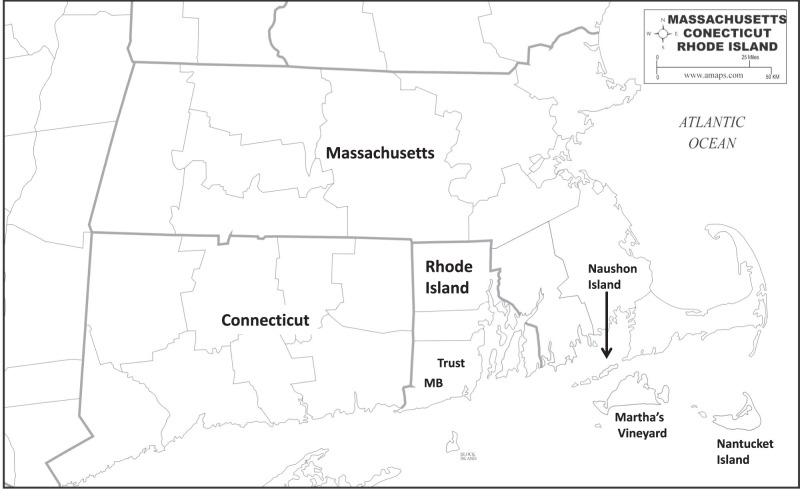
Fig. 1
Fig. 1. Map of the field sites included in this study.
Ticks were collected from two sites in Washington County, Rhode Island, MB and Trust, as well as, from three islands off the coast of Massachusetts: Nantucket, Martha’s Vineyard, and Naushon Island.
Fig. 2
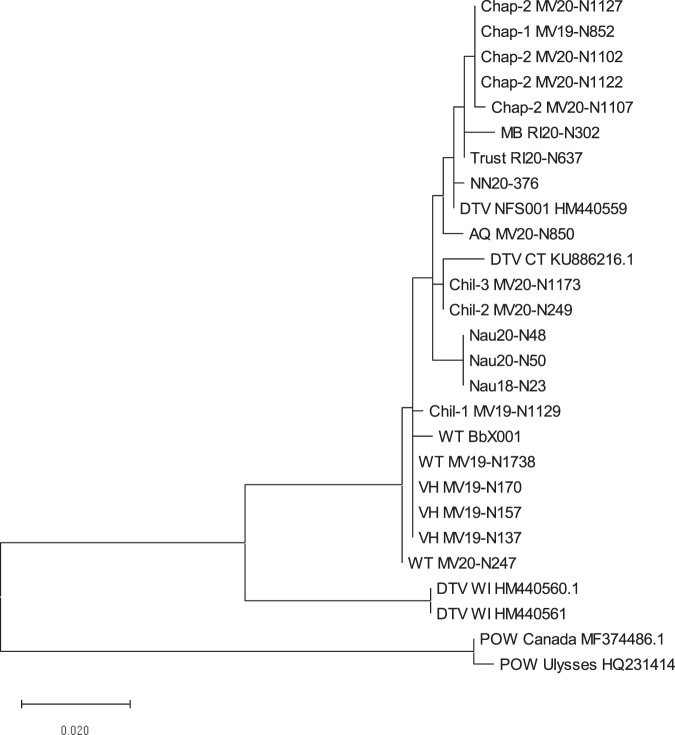
Fig. 2. Maximum likelihood tree of deer tick virus (DTV) detected in this study.
A 248 bp piece of the NS5 gene and the 286 bp piece of the envelope gene were sequenced from each positive tick in the study, as well as the positive shrew. These pieces were concatenated and aligned with deer tick virus (DTV) and Powassan virus (POW) sequences downloaded from GenBank (GenBank numbers are listed on the tree). A maximum likelihood tree was then created using MEGAX.
Fig. 3
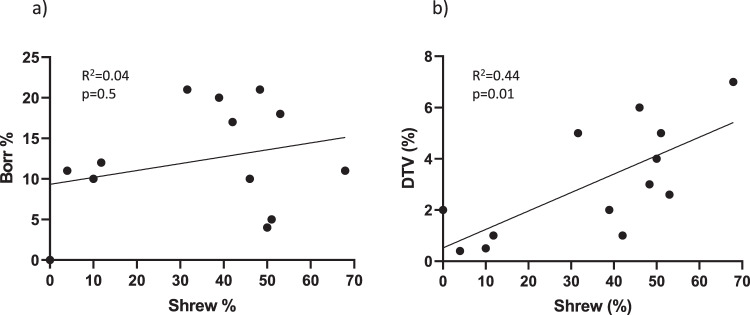
Fig. 3. Correlation analysis of the percentage of ticks that fed on shrews compared to the percentage of infected ticks at our field sites.
The B. burgdorferi (Borr) data are shown in panel a and deer tick virus (DTV) data are shown in panel b. The percentage of DTV (n = 20, p = 0.01), but not B. burgdorferi (n = 128, p = 0.5), in ticks at a site is associated with the percentage of ticks that fed on shrews.
Fig. 4
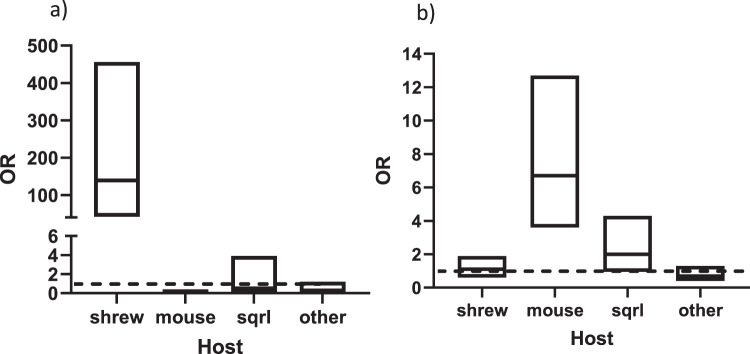
Fig. 4. The likelihood that an infected tick had fed on either a shrew, mouse, squirrel (or other Sciuridae), or other host.
The data for deer tick virus-infected ticks are shown in panel a, and the data for B. burgdorferi-infected ticks are shown in panel b. Data are represented by boxplots of odds ratios (OR) with 95% confidence intervals, and all field sites are combined (n = 20 deer tick virus-infected ticks, n = 128 B. burgdorferi-infected ticks). A line is drawn at OR = 1, and any confidence interval that crosses it is not statistically significant. Sqrl= squirrel (or other Sciuridae).

References

    1. Ebel GD, Spielman A, Telford SR., III Phylogeny of North American Powassan virus. J. Gen. Virol. 2001;82:1657–1665. doi: 10.1099/0022-1317-82-7-1657. - DOI - PubMed
    1. El Khoury MY, et al. Diagnosis of acute deer tick virus encephalitis. Clin. Infect. Dis. 2013;56:e40–e47. doi: 10.1093/cid/cis938. - DOI - PubMed
    1. Beasley DWC, Suderman MT, Holbrook MR, Barrett ADT. Nucleotide sequencing and serological evidence that the recently recognized deer tick virus is a genotype of Powassan virus. Virus Res. 2001;79:81–89. doi: 10.1016/S0168-1702(01)00330-6. - DOI - PubMed
    1. Cavanaugh CE, et al. Fatal deer tick virus infection in Maine. Clin. Infect. Dis. 2017;65:1043–1046. doi: 10.1093/cid/cix435. - DOI - PubMed
    1. Campbell O, Krause PJ. The emergence of human Powassan virus infection in North America. Ticks Tick. Borne Dis. 2020;11:101540. doi: 10.1016/j.ttbdis.2020.101540. - DOI - PubMed

Publication types

MeSH terms