


Effects of intensive multiplanar trunk training coupled with dual-task exercises on balance, mobility, and fall risk in patients with stroke: a randomized controlled trial
- PMID: 34812070
- PMCID: PMC8647262
- DOI: 10.1177/03000605211059413
Effects of intensive multiplanar trunk training coupled with dual-task exercises on balance, mobility, and fall risk in patients with stroke: a randomized controlled trial
Abstract
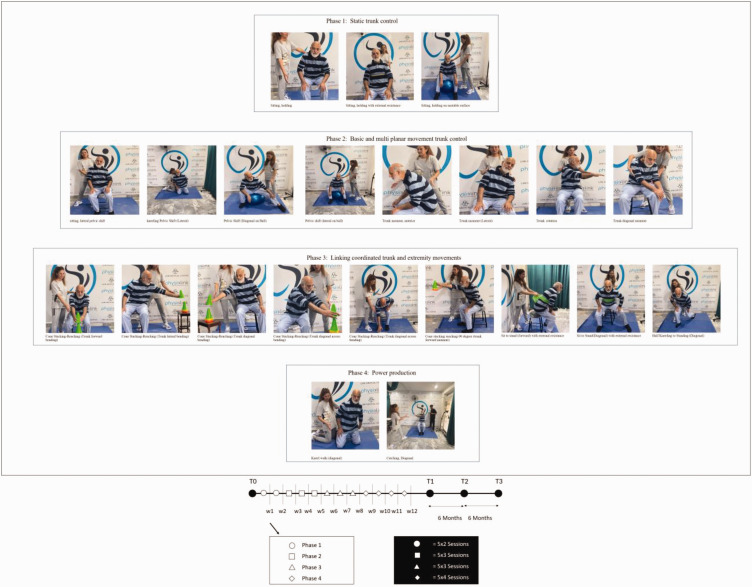
Objective: We determined whether an exercise regime comprising high-intensity training, multiplanar trunk movements, and dual-task practice could improve trunk control, balance, functional mobility, and reduce fall risk in patients with hemiplegic stroke.
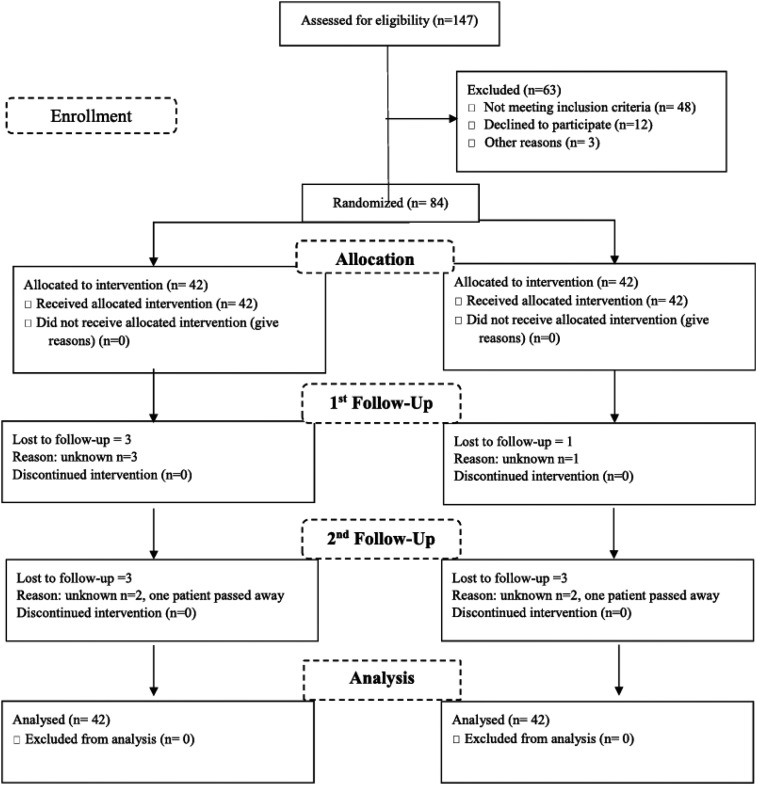
Methods: In this randomized controlled trial, 74 patients (mean age 61.71 years) were randomly assigned to the experimental and comparison groups. Primary outcome was trunk impairment scale (TIS) scores. Secondary outcomes were scores on the Berg balance scale, 10-meter walk test, Timed-up-and-go test, timed-Up-Go-cognitive, and Stroke Impact Scale-16 to measure between-group changes from baseline. We used linear mixed modeling to identify changes over time within and between groups on each scale and whether changes persisted at 6- and 12-month follow-ups.
Results: We observed significantly increased mean TIS scores from baseline to 3 months post-treatment (7.74); the increased scores were maintained at 6- and 12-month follow-ups (8.60 and 8.43, respectively). In the experimental group, all secondary outcomes showed significant and clinically meaningful results. Fall risk between groups was significantly reduced at 6 and 12 months.
Conclusions: Intensive multiplanar trunk movements coupled with dual-task practice promoted trunk control, balance, and functional recovery in patients with stroke, reduced fall risk, and improved independent mobility.Trial registration: #IRCT20200127046275N1.
Keywords: Trunk control; balance; fall risk; function; mobility; stroke.
Conflict of interest statement
Figures
References
-
- Di Monaco M, Trucco M, Di Monaco R, et al.. The relationship between initial trunk control or postural balance and inpatient rehabilitation outcome after stroke: a prospective comparative study. Clin Rehabil 2010; 24: 543–554. - PubMed
-
- Van Criekinge T, Truijen S, Schröder J, et al.. The effectiveness of trunk training on trunk control, sitting and standing balance and mobility post-stroke: a systematic review and meta-analysis. Clin Rehabil 2019; 33: 992–1002. - PubMed
-
- Duarte E, Marco E, Muniesa JM, et al.. Trunk control test as a functional predictor in stroke patients. J Rehabil Med 2002; 34: 267–272. - PubMed
-
- Cabanas-Valdés R, Bagur-Calafat C, Girabent-Farrés M, et al.. The effect of additional core stability exercises on improving dynamic sitting balance and trunk control for subacute stroke patients: a randomized controlled trial. Clin Rehabil 2016; 30: 1024–1033. - PubMed
Publication types
MeSH terms
LinkOut - more resources
Full Text Sources
Medical
