


Seroprevalence of SARS-CoV-2 Antibodies Among Children in School and Day Care in Montreal, Canada
- PMID: 34812845
- PMCID: PMC8611475
- DOI: 10.1001/jamanetworkopen.2021.35975
Seroprevalence of SARS-CoV-2 Antibodies Among Children in School and Day Care in Montreal, Canada
Abstract
Importance: Quebec prioritized in-person learning after the first wave of the COVID-19 pandemic, with school closures being implemented temporarily in selected schools or in hot-spot areas. Quebec's decision to keep most schools open was controversial, especially in Montreal, which was the epicenter of Canada's first and second waves; therefore, understanding the extent to which children were infected with SARS-CoV-2 provides important information for decisions about school closures.
Objective: To estimate the seroprevalence of SARS-CoV-2 antibodies in children and teenagers in 4 neighborhoods of Montreal, Canada.
Design, setting, and participants: This cohort study (the Enfants et COVID-19: Étude de séroprévalence [EnCORE] study) enrolled a convenience sample of children aged 2 to 17 years between October 22, 2020, and March 22, 2021, in Montreal, Canada.
Exposures: Potential exposure to SARS-CoV-2.
Main outcomes and measures: The main outcome was seroprevalence of SARS-CoV-2 antibodies, collected using dried blood spots (DBSs) and analyzed with a research-based enzyme-linked immunosorbent assay (ELISA). Parents also completed an online questionnaire that included questions on self-reported COVID-19 symptoms and tests, along with sociodemographic questions.
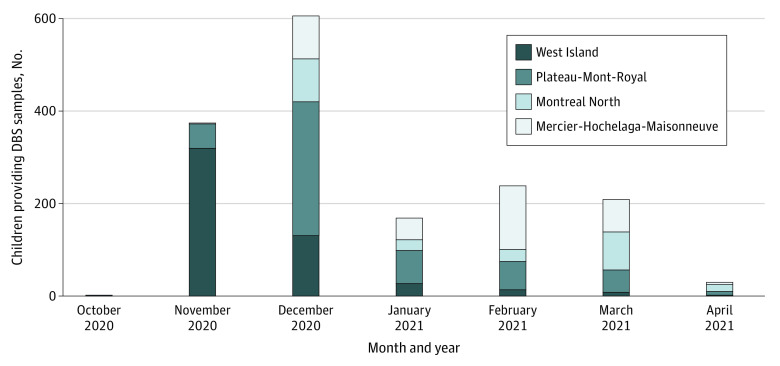
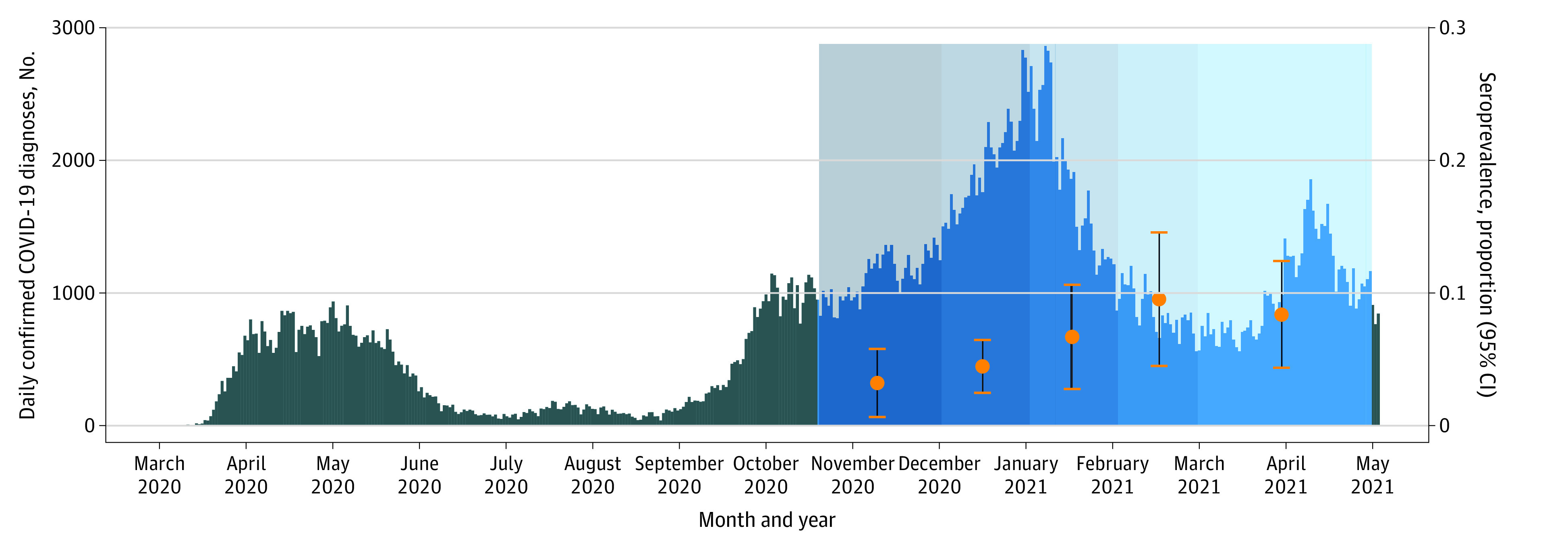
Results: This study included 1632 participants who provided a DBS sample from 30 day cares, 22 primary schools, and 11 secondary schools. The mean (SD) age of the children who provided a DBS sample was 9.0 (4.4) years; 801 (49%) were female individuals, with 354 participants (22%) from day cares, 725 (44%) from primary schools, and 553 (34%) from secondary schools. Most parents had at least a bachelor's degree (1228 [75%]), and 210 (13%) self-identified as being a racial or ethnic minority. The mean seroprevalence was 5.8% (95% CI, 4.6%-7.0%) but increased over time from 3.2% (95% CI, 0.7%-5.8%) in October to November 2020 to 8.4% (95% CI, 4.4%-12.4%) in March to April 2021. Of the 95 children with positive SARS-CoV-2 antibody results, 78 (82%) were not tested or tested negative with reverse transcription-polymerase chain reaction (RT-PCR) testing, and all experienced mild (49 [52%]) or no clinical symptoms (46 [48%]). The children of parents who self-identified as belonging to a racial and ethnic minority group were more likely to be seropositive compared with children of White parents (adjusted seroprevalence ratio, 1.9; 95% CI, 1.1-2.6).
Conclusions and relevance: These results provide a benchmark of the seroprevalence status in Canadian children. The findings suggest that there was more transmission occurring in children compared with what was being detected by RT-PCR, although children experienced few or mild symptoms. It will be important to continue monitoring the serological status of children, particularly in the context of new COVID-19 variants of concern and in the absence of mass vaccination campaigns targeting young children.
Conflict of interest statement
Figures
References
-
- Buonsenso D, Valentini P, De Rose C, et al. ; Gemelli Against COVID-19 Post-Acute Care Study Group . Seroprevalence of anti-SARS-CoV-2 IgG antibodies in children with household exposure to adults with COVID-19: Preliminary findings. Pediatr Pulmonol. 2021;56(6):1374-1377. doi: 10.1002/ppul.25280 - DOI - PMC - PubMed
-
- UNESCO . UNESCO figures show two thirds of an academic year lost on average worldwide due to COVID-19 school closures. February 2, 2021. Accessed October 25, 2021. https://en.unesco.org/news/unesco-figures-show-two-thirds-academic-year-...
Publication types
MeSH terms
Substances
Supplementary concepts
LinkOut - more resources
Full Text Sources
Medical
Miscellaneous
