. 2021 Nov 23;16(11):e0260417.
doi: 10.1371/journal.pone.0260417. eCollection 2021.

Carotid plaque thickness is increased in chronic kidney disease and associated with carotid and coronary calcification

Affiliations

Carotid plaque thickness is increased in chronic kidney disease and associated with carotid and coronary calcification

Sasha S Bjergfelt et al. PLoS One. .

Abstract

Background: Chronic kidney disease accelerates both atherosclerosis and arterial calcification. The aim of the present study was to explore whether maximal carotid plaque thickness (cPTmax) was increased in patients with chronic kidney disease compared to controls and associated with cardiovascular disease and severity of calcification in the carotid and coronary arteries.

Methods: The study group consisted of 200 patients with chronic kidney disease stage 3 from the Copenhagen Chronic Kidney Disease Cohort and 121 age- and sex-matched controls. cPTmax was assessed by ultrasound and arterial calcification by computed tomography scanning.

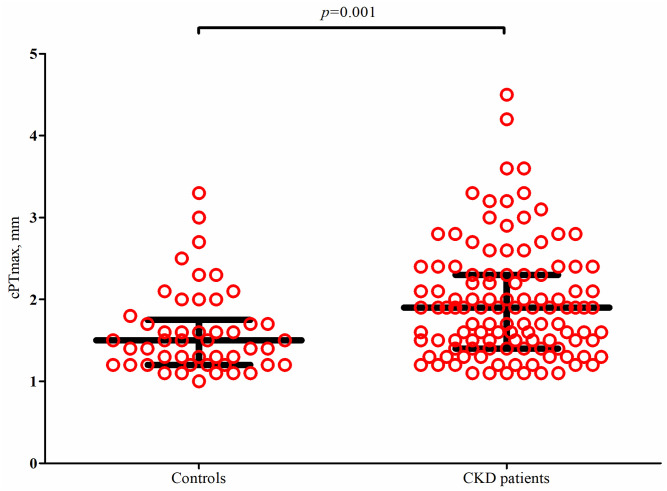
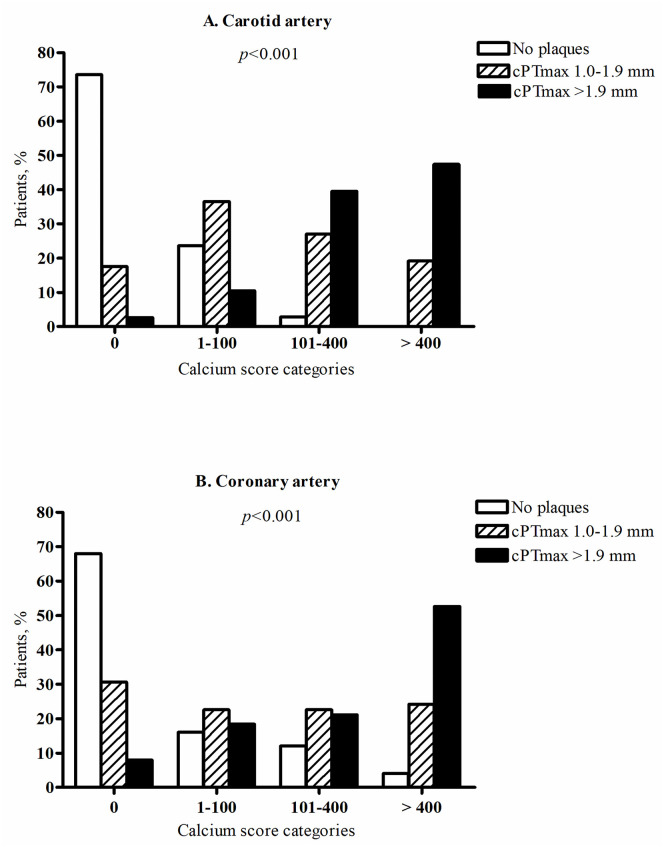
Results: Carotid plaques were present in 58% of patients (n = 115) compared with 40% of controls (n = 48), p = 0.002. Among participants with plaques, cPTmax (median, interquartile range) was significantly higher in patients compared with controls (1.9 (1.4-2.3) versus 1.5 (1.2-1.8) mm), p = 0.001. Cardiovascular disease was present in 9% of patients without plaques (n = 85), 23% of patients with cPTmax 1.0-1.9 mm (n = 69) and 35% of patients with cPTmax >1.9 mm (n = 46), p = 0.001. Carotid and coronary calcium scores >400 were present in 0% and 4%, respectively, of patients with no carotid plaques, in 19% and 24% of patients with cPTmax 1.0-1.9 mm, and in 48% and 53% of patients with cPTmax >1.9 mm, p<0.001.

Conclusions: This is the first study showing that cPTmax is increased in patients with chronic kidney disease stage 3 compared to controls and closely associated with prevalent cardiovascular disease and severity of calcification in both the carotid and coronary arteries.


Conflict of interest statement

I have read the journal´s policy and the authors of this manuscript have the following competing interests: BFR reports research grants from The NovoNordisk Foundation (Steno Collaborative Grant), HS reports research grants from Philips Ultrasound and Bayer and honoraria from Bayer, Novo Nordisk, Bracco and Philips Ultrasound, TBS reports research grants from Sanofi Pasteur and GE Healthcare, the Lundbeck Foundation and the Novo Nordisk Foundation during the conduct of the study. All other authors: no competing interests.

Figures
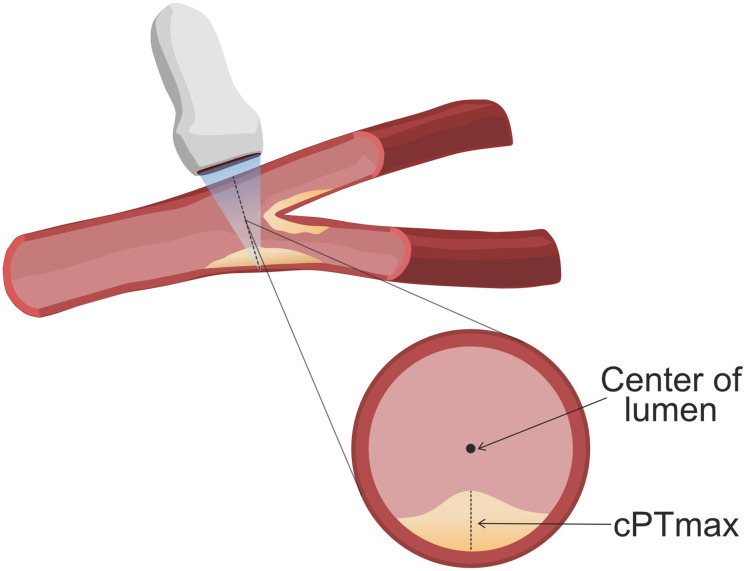
Fig 1
Fig 1. Measurement of maximal carotid plaque thickness (cPTmax).
Image showing a segment of the carotid artery with a plaque, which is scanned with a transducer. The transverse section of the carotid artery shows how cPTmax is measured.
Fig 2
Fig 2. Distribution of maximal carotid plaque thickness (cPTmax) in patients with CKD stage 3 and controls.
Includes only participants with plaques (115/200 patients and 48/121 controls). Dot plot with median (long black horizonal line) and interquartiles (short black horizontal lines). The p-value is from a Mann-Whitney U-test.
Fig 3
Fig 3. Association between maximal carotid plaque thickness (cPTmax) and carotid artery calcium score (A) and coronary artery calcium score (B).
According to carotid ultrasound findings, patients were divided into 3 groups: No carotid plaques, cPTmax 1.0–1.9 mm, cPTmax >1.9 mm. Based on the distribution of calcium scores from noncontrast CT scanning of the carotid and coronary arteries, patients were divided into calcium score categories of 0, 1–100, 101–400 and >400. The p-values are from cross tabulation and chi-square analysis (rows: Calcium score categories, columns: cPTmax categories).
Fig 4
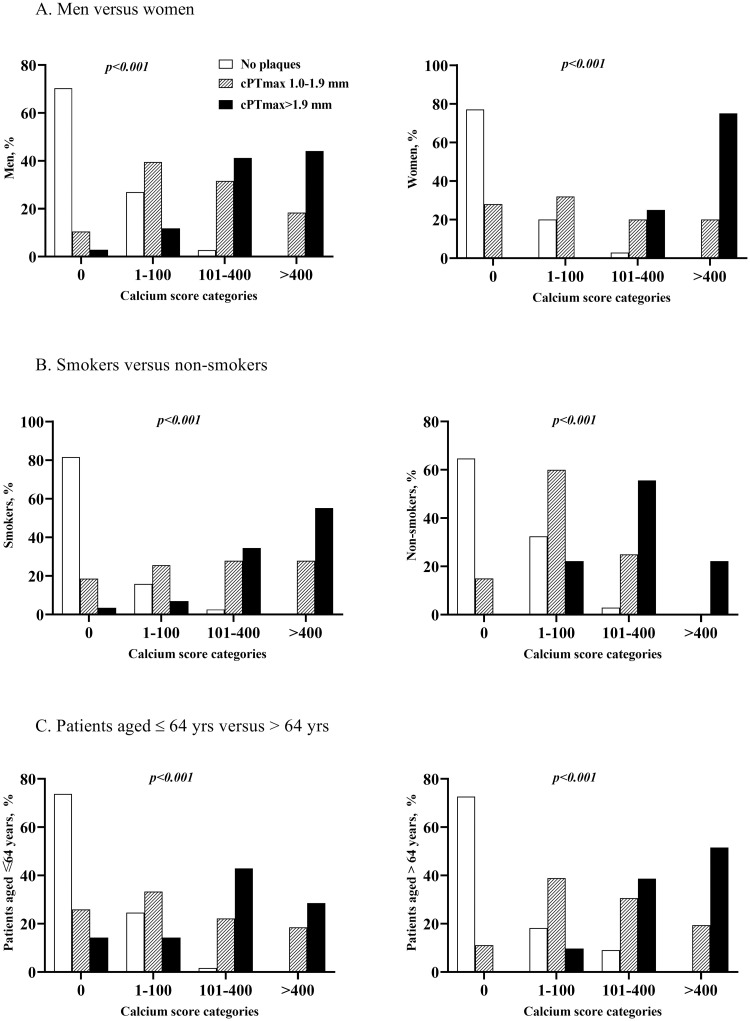
Fig 4. Association between maximal carotid plaque thickness (cPTmax) and carotid artery calcium score in patients with CKD stage 3.
(A) In men versus women, (B) in smokers versus non-smokers, and (C) in patients aged ≤ 64 yrs. versus > 64 yrs. According to carotid ultrasound findings, patients were divided into 3 groups: No carotid plaques, cPTmax 1.0–1.9 mm, cPTmax >1.9 mm. Based on the distribution of calcium scores from CT scanning of the carotid arteries, patients were divided into calcium score categories of 0, 1–100, 101–400 and >400. Non-smokers are defined as patients with 0 smocking pack yrs. and smokers as patients with smoking pack yrs. > 0. Age 64 yrs. is the median age of the CKD patients. The p-values are from cross tabulation and chi-square analysis (rows: Calcium score categories, columns: cPTmax categories).
Fig 5
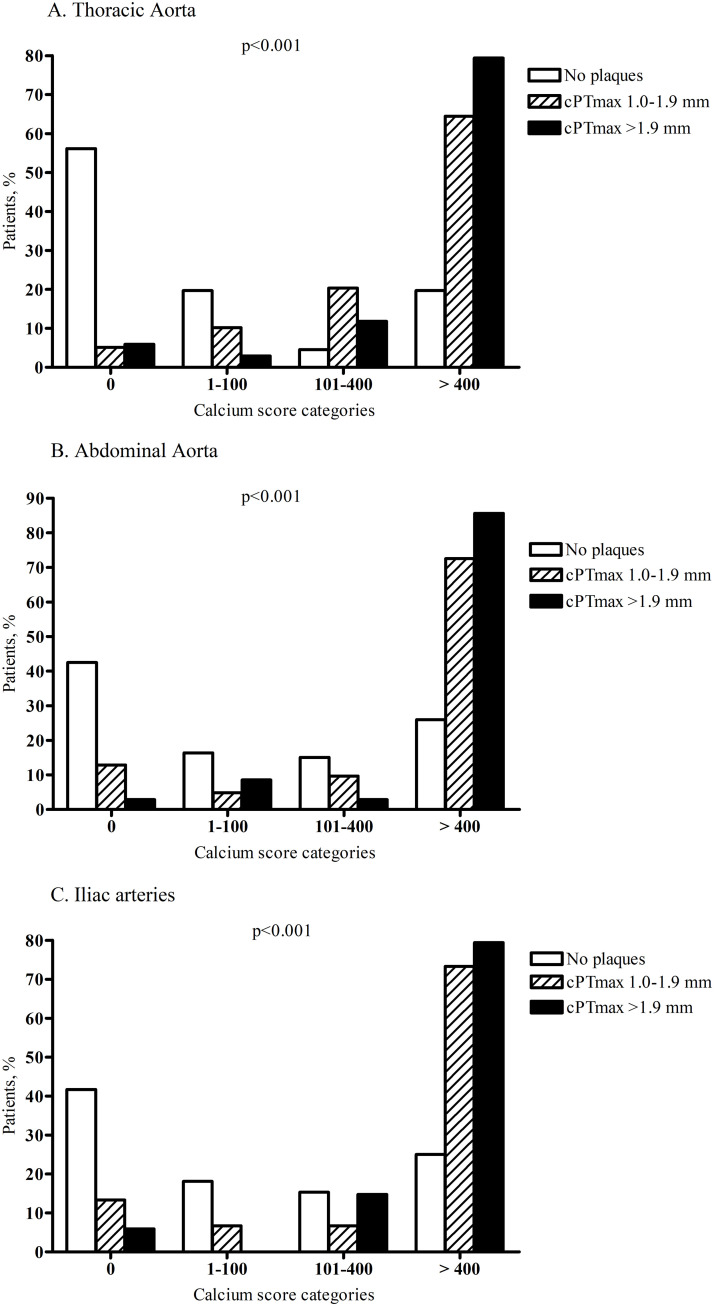
Fig 5. Association between maximal carotid plaque thickness (cPTmax) and thoracic aortic calcium score (A), abdominal aortic calcium score (B) and iliac artery calcium score (C).
According to carotid ultrasound findings, patients were divided into 3 groups: No carotid plaques, cPTmax 1.0–1.9 mm, cPTmax >1.9 mm. Based on the distribution of calcium scores from noncontrast CT scanning of the thoracic aorta, abdominal aorta and iliac arteries, patients were divided into calcium score categories of 0, 1–100, 101–400 and >400. The p-values are from cross tabulation and chi-square analysis (rows: Calcium score categories, columns: cPTmax categories).

References

    1. Gansevoort RT, Correa-Rotter R, Hemmelgarn BR, Jafar TH, Heerspink HJ, Mann JF, et al. Chronic kidney disease and cardiovascular risk: epidemiology, mechanisms, and prevention. Lancet. 2013;382(9889):339–52. doi: 10.1016/S0140-6736(13)60595-4 - DOI - PubMed
    1. Astor BC, Coresh J, Heiss G, Pettitt D, Sarnak MJ. Kidney function and anemia as risk factors for coronary heart disease and mortality: the Atherosclerosis Risk in Communities (ARIC) Study. Am Heart J. 2006;151(2):492–500. doi: 10.1016/j.ahj.2005.03.055 - DOI - PubMed
    1. Abramson JL, Jurkovitz CT, Vaccarino V, Weintraub WS, McClellan W. Chronic kidney disease, anemia, and incident stroke in a middle-aged, community-based population: the ARIC Study. Kidney Int. 2003;64(2):610–5. doi: 10.1046/j.1523-1755.2003.00109.x - DOI - PubMed
    1. Wattanakit K, Folsom AR, Selvin E, Coresh J, Hirsch AT, Weatherley BD. Kidney function and risk of peripheral arterial disease: results from the Atherosclerosis Risk in Communities (ARIC) Study. J Am Soc Nephrol. 2007;18(2):629–36. doi: 10.1681/ASN.2005111204 - DOI - PubMed
    1. Kottgen A, Russell SD, Loehr LR, Crainiceanu CM, Rosamond WD, Chang PP, et al. Reduced kidney function as a risk factor for incident heart failure: the atherosclerosis risk in communities (ARIC) study. J Am Soc Nephrol. 2007;18(4):1307–15. doi: 10.1681/ASN.2006101159 - DOI - PubMed

Publication types

MeSH terms