


Implementation of a multi-level community-clinical linkage intervention to improve glycemic control among south Asian patients with uncontrolled diabetes: study protocol of the DREAM initiative
- PMID: 34814899
- PMCID: PMC8609264
- DOI: 10.1186/s12902-021-00885-5
Implementation of a multi-level community-clinical linkage intervention to improve glycemic control among south Asian patients with uncontrolled diabetes: study protocol of the DREAM initiative
Abstract
Background: A number of studies have identified patient-, provider-, and community-level barriers to effective diabetes management among South Asian Americans, who have a high prevalence of type 2 diabetes. However, no multi-level, integrated community health worker (CHW) models leveraging health information technology (HIT) have been developed to mitigate disease among this population. This paper describes the protocol for a multi-level, community-clinical linkage intervention to improve glycemic control among South Asians with uncontrolled diabetes.
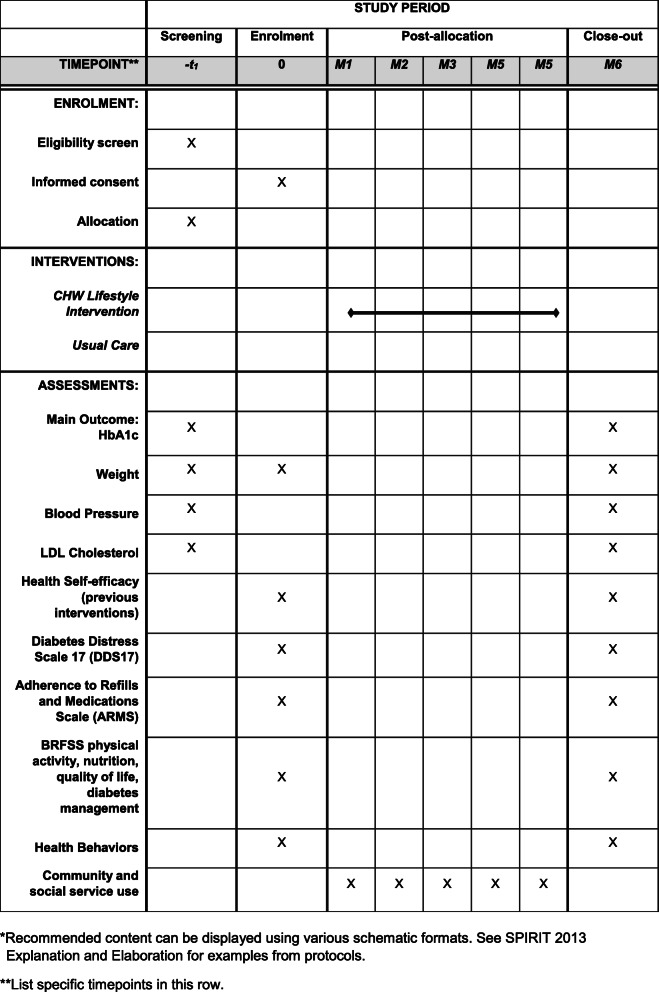
Methods: The study includes three components: 1) building the capacity of primary care practices (PCPs) to utilize electronic health record (EHR) registries to identify patients with uncontrolled diabetes; 2) delivery of a culturally- and linguistically-adapted CHW intervention to improve diabetes self-management; and 3) HIT-enabled linkage to culturally-relevant community resources. The CHW intervention component includes a randomized controlled trial consisting of group education sessions on diabetes management, physical activity, and diet/nutrition. South Asian individuals with type 2 diabetes are recruited from 20 PCPs throughout NYC and randomized at the individual level within each PCP site. A total of 886 individuals will be randomized into treatment or control groups; EHR data collection occurs at screening, 6-, 12-, and 18-month. We hypothesize that individuals receiving the multi-level diabetes management intervention will be 15% more likely than the control group to achieve ≥0.5% point reduction in hemoglobin A1c (HbA1c) at 6-months. Secondary outcomes include change in weight, body mass index, and LDL cholesterol; the increased use of community and social services; and increased health self-efficacy. Additionally, a cost-effectiveness analysis will focus on implementation and healthcare utilization costs to determine the incremental cost per person achieving an HbA1c change of ≥0.5%.
Discussion: Final outcomes will provide evidence regarding the effectiveness of a multi-level, integrated EHR-CHW intervention, implemented in small PCP settings to promote diabetes control among an underserved South Asian population. The study leverages multisectoral partnerships, including the local health department, a healthcare payer, and EHR vendors. Study findings will have important implications for the translation of integrated evidence-based strategies to other minority communities and in under-resourced primary care settings.
Trial registration: This study was registered with clinicaltrials.gov: NCT03333044 on November 6, 2017.
Keywords: Community health workers; Community-based participatory research; Diabetes management; Electronic health records; Health disparities; South Asian; Structural determinants of health.
© 2021. The Author(s).
Conflict of interest statement
The authors declare that they have no competing interests. The funders have no role in the design or conduct of the study or the manuscripts.
STL is founder and co-owner of NowPow, LLC. Under the terms of grant number 1C1CMS330997–01-00 (STL, PI), from the Department of Health and Human Services, Centers for Medicare & Medicaid Services, awardees were expected to develop a sustainable business model to continue to support the model that was tested after award funding ended. Neither the University of Chicago nor the University of Chicago Medicine is endorsing or promoting NowPow or its business, products or services.
Figures
References
-
- A Demographic Snapshot of South Asians in the United States [http://saalt.org/wp-content/uploads/2012/09/Demographic-Snapshot-Asian-A...]. Accessed 30 Sept 2021.
-
- Profile of New York City’s Bangladeshi Americans: 2013 Edition [http://www.aafny.org/cic/briefs/bangladeshi2013.pdf]. Accessed 30 Sept 2021.
-
- Profile New York City's Indian Americans: 2013 Edition [http://www.aafny.org/cic/briefs/indian2013.pdf]. Accessed 30 Sept 2021.
-
- Profile of New York City's Pakistani Americans: 2013 Edition [http://www.aafny.org/cic/briefs/pakistani2013.pdf]. Accessed 30 Sept 2021.
Publication types
MeSH terms
Substances
Associated data
Grants and funding
- U48 DP001904/DP/NCCDPHP CDC HHS/United States
- UL1 TR001445/TR/NCATS NIH HHS/United States
- R18DK110740/DK/NIDDK NIH HHS/United States
- U48DP001904/CC/CDC HHS/United States
- U54 MD000538/MD/NIMHD NIH HHS/United States
- 1UG3HL151310/HL/NHLBI NIH HHS/United States
- R01DK11048/DK/NIDDK NIH HHS/United States
- R18 DK110740/DK/NIDDK NIH HHS/United States
- P30 DK092949/DK/NIDDK NIH HHS/United States
- UL1TR001445/TR/NCATS NIH HHS/United States
- UG3 HL151310/HL/NHLBI NIH HHS/United States
- K07 AG068186/AG/NIA NIH HHS/United States
- R01 DK110048/DK/NIDDK NIH HHS/United States
- U54MD000538/MD/NIMHD NIH HHS/United States
LinkOut - more resources
Full Text Sources
Medical
