. 2021 Oct 31;33(5):563-573.
doi: 10.21147/j.issn.1000-9604.2021.05.03.

Integrating pathomics with radiomics and genomics for cancer prognosis: A brief review

Affiliations

Integrating pathomics with radiomics and genomics for cancer prognosis: A brief review

Cheng Lu et al. Chin J Cancer Res. .

Abstract

In the last decade, the focus of computational pathology research community has shifted from replicating the pathological examination for diagnosis done by pathologists to unlocking and discovering "sub-visual" prognostic image cues from the histopathological image. While we are getting more knowledge and experience in digital pathology, the emerging goal is to integrate other-omics or modalities that will contribute for building a better prognostic assay. In this paper, we provide a brief review of representative works that focus on integrating pathomics with radiomics and genomics for cancer prognosis. It includes: correlation of pathomics and genomics; fusion of pathomics and genomics; fusion of pathomics and radiomics. We also present challenges, potential opportunities, and avenues for future work.

Keywords: Radiomics; digital pathology; genomics; pathomics; prognosis.


Conflict of interest statement

Conflicts of Interest: The authors have no conflicts of interest to declare.

Figures
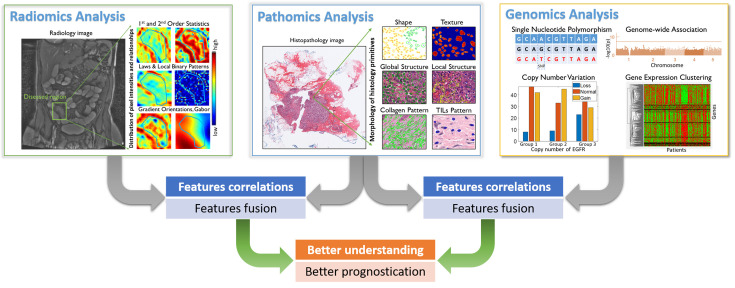
Figure 1
Figure 1
An overview for the fusion of pathomics, radiomics and genomics analyses. In radiomics analysis, quantitative image features were derived from radiology images, which may include traditional hand-crafted features, e.g., 1st and 2nd order statistics, Laws & Local Binary Patterns, Gradient orientations and Gabor and features that learnt by deep learning model. In pathomics analysis, quantitative image features were derived from histopathological images, which may include hand-crafted features like nuclear shape, texture, global structure, local structure, stroma collagen pattern and TIL patterns and features that learnt by deep learning model. In genomics analysis, single nucleotide polymorphism (SNP), copy number variation (CNV), genome structure data and gene expression data [e.g., ribonucleic acid (RNA)-seq data] were analyzed. In the context of prognosis, features/signatures that associated with patient outcomes from different modalities can be associated and fused, in order to better understand the relationship of disease genotypes and genotypes and to create better prognostic tools.

References

    1. Bera K, Schalper KA, Rimm DL, et al Artificial intelligence in digital pathology — new tools for diagnosis and precision oncology. Nat Rev Clin Oncol. 2019;16:703–15. doi: 10.1038/s41571-019-0252-y. - DOI - PMC - PubMed
    1. Doherty GJ, Petruzzelli M, Beddowes E, et al Cancer treatment in the genomic era. Annu Rev Biochem. 2019;88:247–80. doi: 10.1146/annurev-biochem-062917-011840. - DOI - PubMed
    1. Fournier L, Costaridou L, Bidaut L, et al Incorporating radiomics into clinical trials: expert consensus endorsed by the European Society of Radiology on considerations for data-driven compared to biologically driven quantitative biomarkers. Eur Radiol. 2021;31:6001–12. doi: 10.1007/s00330-020-07598-8. - DOI - PMC - PubMed
    1. Bhargava R, Madabhushi A Emerging themes in image informatics and molecular analysis for digital pathology. Annu Rev Biomed Eng. 2016;18:387–412. doi: 10.1146/annurev-bioeng-112415-114722. - DOI - PMC - PubMed
    1. AbdulJabbar K, Raza SEA, Rosenthal R, et al Geospatial immune variability illuminates differential evolution of lung adenocarcinoma. Nat Med. 2020;26:1054–62. doi: 10.1038/s41591-020-0900-x. - DOI - PMC - PubMed

LinkOut - more resources