


Contemporary trends on expenditure of hospital care on total cancer and its subtypes in China during 2008 - 2017
- PMID: 34815636
- PMCID: PMC8580796
- DOI: 10.21147/j.issn.1000-9604.2021.05.09
Contemporary trends on expenditure of hospital care on total cancer and its subtypes in China during 2008 - 2017
Abstract
Objective: To describe the contemporary trends in total, inpatient, and outpatient expenditure on major subtypes of cancer in different classifications of hospitals in mainland China.
Methods: Home page of Inpatient Medical Records (HIMRs) and Hospital Annual Reports (HARs) were used to estimate hospital care expenditure on cancer. Inpatient payments and their share of cancer were calculated with the top-down method. Kriging spatial interpolation methods were used at the county level and summed at the province level. Outpatient expenditure was estimated with inpatient expenditure and the ratios of outpatient to inpatient payments in specialized cancer hospitals, stratified by province. Total expenditure on cancer was the sum of both payments. Log-linear regression was applied to estimate annual percentage change (APC) of expenditure.
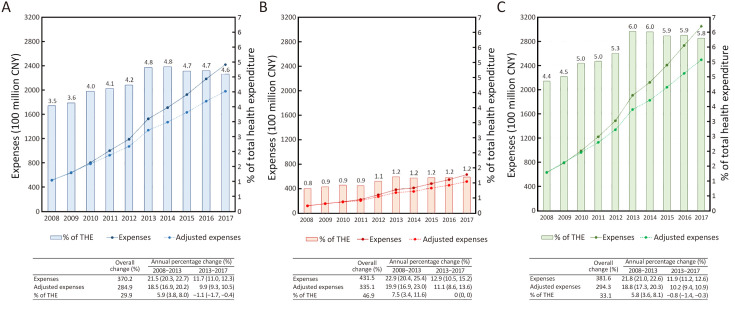
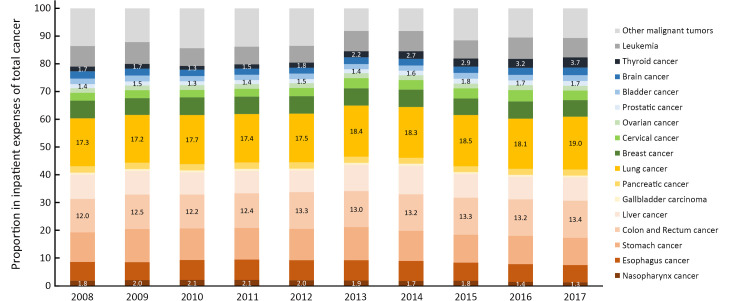
Results: Total expenses for cancer of Chinese residents reached up to 304.84 billion Chinese Yuan (CNY) in 2017, accounting for 5.8% of the total health expenses (THE). After adjusting for consumer price index (CPI), medical expenses for cancer have increased from 63.30 billion CNY in 2008 to 249.56 billion CNY in 2017 [APC: 15.2%, 95% confidence interval (95% CI): 13.4%-17.0%]. The APC was slightly higher than THE around 2013, while was lower after 2013. During 2008-2017, the ratio of inpatient to outpatient costs for cancer decreased from 4.3:1 to 3.8:1. The inpatient payments for cancer mainly happened in grade 3 general hospitals, East China, and among lung, colorectal, and stomach cancer; while the fastest increase was found in West China, and among thyroid, prostate, and colorectal cancer.
Conclusions: During 2008-2017, the rapid growth trend of medical expenses for cancer has been effectively controlled with the continuous deepening of medical reform and improvements of residents' health care. More attention should be paid to potential increases of medical costs caused by technological progress and demand release. Socialized and multi-channel insurance financing modes should be explored in the future.
Keywords: Cancer; economic burden; expenditure; payments.
Copyright ©2021Chinese Journal of Cancer Research. All rights reserved.
Conflict of interest statement
Conflicts of Interest: The authors have no conflicts of interest to declare.
Figures
References
-
-
Global Burden of Disease Collaborative Network. Global Burden of Disease Study 2019 (GBD 2019) Results. 2020. Available online: http://www.healthdata.org/gbd/2019
-
-
-
National Health Commission of the People’s Republic of China. China Health Statistical Yearbook, 2020. Beijing: Peking Union Medical College Press, 2021.
-
-
- Carey K, Burgess JF Hospital costing: experience from the VHA. Financial Accountability & Management. 2000;16:289–308. doi: 10.1111/1468-0408.00109. - DOI
LinkOut - more resources
Full Text Sources