. 2021 Nov 16;5(11):e361.
doi: 10.1002/pld3.361. eCollection 2021 Nov.

Electrophysiological study of Arabidopsis ABCB4 and PIN2 auxin transporters: Evidence of auxin activation and interaction enhancing auxin selectivity

Affiliations

Electrophysiological study of Arabidopsis ABCB4 and PIN2 auxin transporters: Evidence of auxin activation and interaction enhancing auxin selectivity

Stephen D Deslauriers et al. Plant Direct. .

Abstract

Polar auxin transport through plant tissue strictly requires polarly localized PIN proteins and uniformly distributed ABCB proteins. A functional synergy between the two types of membrane protein where their localizations overlap may create the degree of asymmetric auxin efflux required to produce polar auxin transport. We investigated this possibility by expressing ABCB4 and PIN2 in human embryonic kidney cells and measuring whole-cell ionic currents with the patch-clamp technique and CsCl-based electrolytes. ABCB4 activity was 1.81-fold more selective for Cl- over Cs+ and for PIN2 the value was 2.95. We imposed auxin gradients and determined that ABCB4 and PIN2 were 12-fold more permeable to the auxin anion (IAA-) than Cl-. This measure of the intrinsic selectivity of the transport pathway was 21-fold when ABCB4 and PIN2 were co-expressed. If this increase occurs in plants, it could explain why asymmetric PIN localization is not sufficient to create polar auxin flow. Some form of co-action or synergy between ABCB4 and PIN2 that increases IAA- selectivity at the cell face where both occur may be important. We also found that auxin stimulated ABCB4 activity, which may contribute to a self-reinforcement of auxin transport known as canalization.


Conflict of interest statement

The Authors did not report any conflict of interest.

Figures
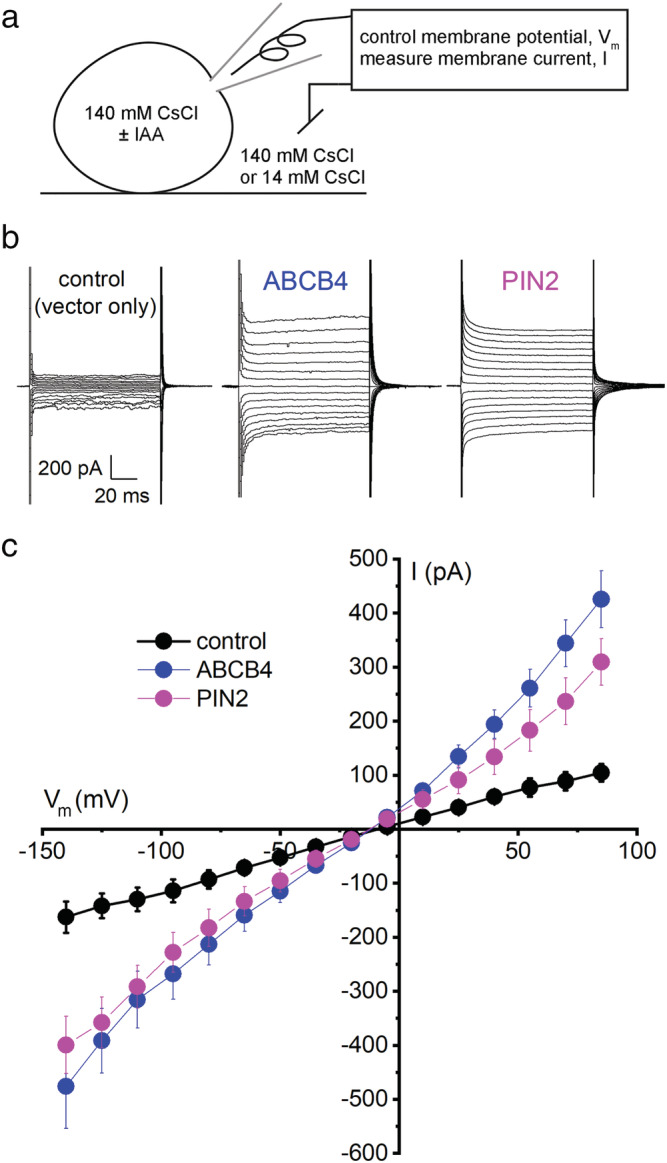
FIGURE 1
FIGURE 1
Electrogenic activities of ABCB4 and PIN2 proteins expressed in HEK cells. (a) Diagram of the whole‐cell patch clamp technique employing Cs+ and Cl as principal charge carriers. The amplifier controlled (clamped) the membrane potential (V m ) while the transmembrane electric currents (I) were measured. The cells were transfected with a vector carrying only EGFP or DsRED cDNA (control), ABCB4 and EGFP cDNA in separate reading frames, or PIN2 and DsRED cDNA in separate reading frames. (b) Example recordings of transmembrane currents elicited by step‐wise changes in V m recorded from control cells and cells transfected with ABCB4 or PIN2. (c) I–V curves represent mean current ± SE at each membrane potential measured in control cells (n = 5), ABCB4‐expressing cells (n = 6), and PIN2‐expressing cells (n = 6). The pipette and bath solutions contained 140 mM CsCl
FIGURE 2
FIGURE 2
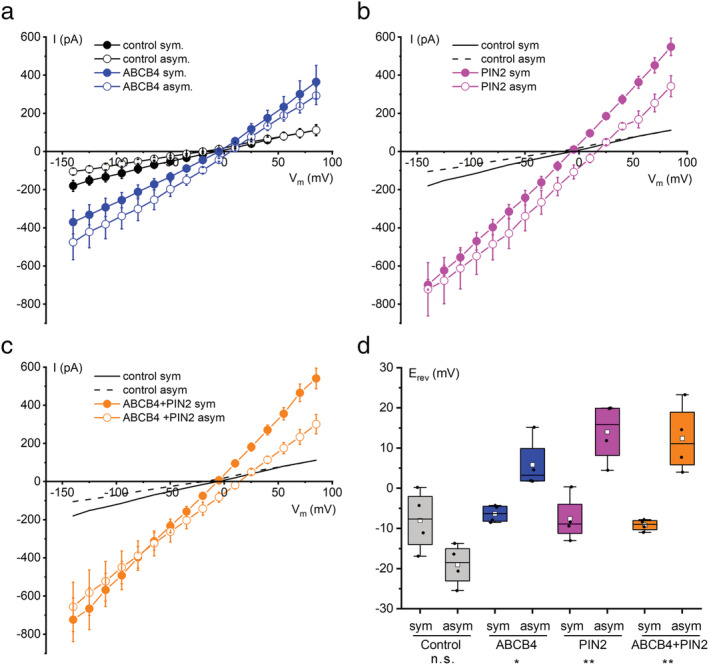
Current–voltage analysis of ABCB4, PIN2, and co‐expressed ABCB4 + PIN2 in symmetrical and asymmetrical conditions demonstrates anion preference. (a) ABCB4 and control cell I–V relationships recorded with 140 mM CsCl in the bath and pipette (symmetrical) and after switching the bath to 14 mM CsCl (asymmetrical). Plotted are the mean currents ± SE at each voltage obtained from four separate cells for each condition. (b) Same as (a) but for cells expressing PIN2. The control cell curves are re‐plotted from (a). (c) Same as (b) but for cells co‐expressing ABCB4 and PIN2. (d) The reversal potential (E rev ) values determined by linear regression performed on a limited portion of the I–V curve and displayed in a box plot. The positive shift in mean E rev (white square symbol within box) between symmetric and asymmetric conditions was used to calculate Cl to Cs+ permeability ratios (PCl:PCs) with Equation 1 for ABCB4 (1.91), PIN2 (2.95), and ABCB4 + PIN2 (2.95). Notations on the bottom of the graph indicate whether the differences in E rev between the symmetrical and asymmetrical CsCl were not statistically significant (n.s.) or significant with *p <  0.05 or **p <  0.01
FIGURE 3
FIGURE 3
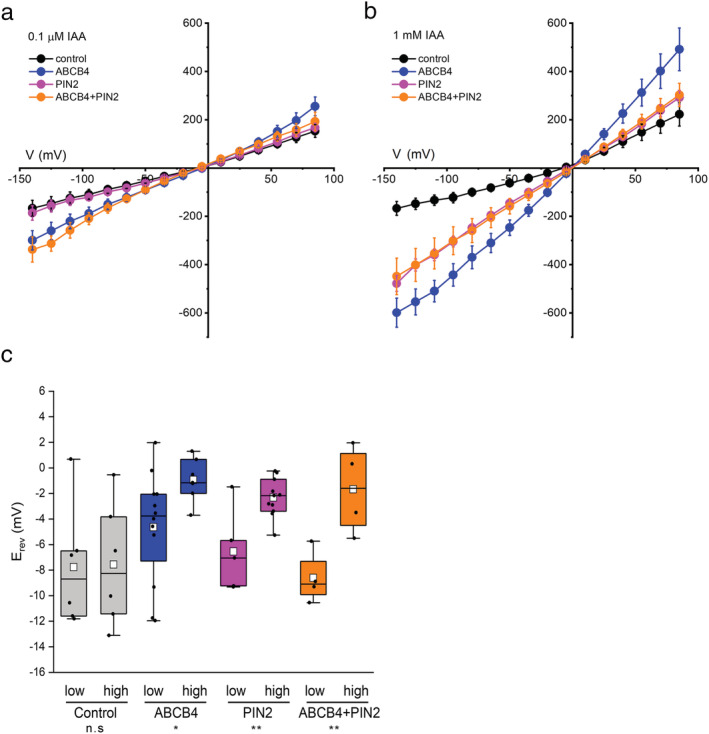
IAA permeability demonstrated by current–voltage analysis. (a) I–V curves obtained in symmetrical 50 mM CsCl conditions with 0.1 μM IAA in the pipette, that is, on the cytoplasmic side. (b) I–V curves obtained as in (a) but with 1 mM IAA in the pipette. The number of independent cells measured per condition was between 4 and 14. (c) Reversal potentials (E rev ) of I–V curves obtained with either 0.1 μM IAA (low) or 1 mM IAA (high) in the pipette displayed in box plots with the means denoted by white square symbols. The E rev value for each trial (independent cell) was determined by linear regression performed on a limited portion of the I–V curve. Notations on the bottom of the graph indicate whether the differences in E rev between the low and high auxin concentrations were not statistically significant (n.s.), or significant with *p <  0.05 or **p <  0.01
FIGURE 4
FIGURE 4
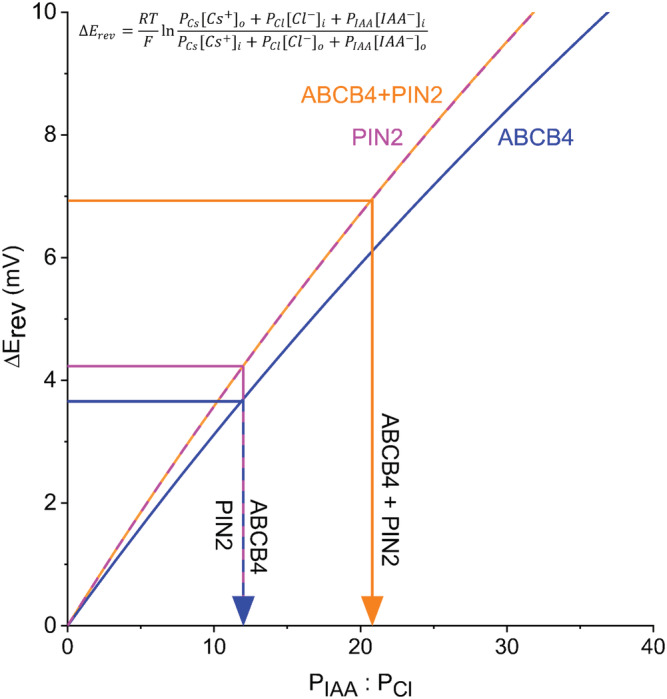
ABCB4 and PIN2 are highly selective for IAA over Cl, and the selectivity approximately doubles when the two are co‐expressed. The Goldman‐Hodgkin‐Katz model of membrane transport was parameterized with values of Cl permeability (PCl) relative to Cs+ permeability (PCs) calculated from the results in Figure 2D to determine the permeability of IAA relative to Cl (PIAA: PCl) based on the ΔErev values presented in Figure 3D
FIGURE 5
FIGURE 5
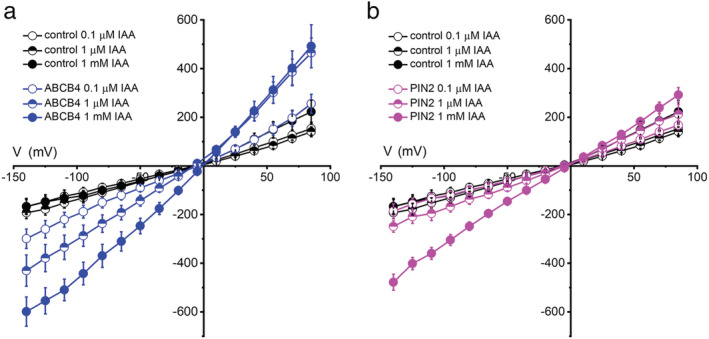
Auxin stimulates ABCB4 activity. (a) I–V relationships for ABCB4 obtained with different concentrations of IAA in the pipette. (b) I–V curves for PIN2 obtained with different concentrations of IAA in the pipette. The pipette and bath solutions contained 50 mM CsCl. The same control data are plotted in (a) and (b); the 0.1 μM IAA and 1 mM IAA data are replotted from Figure 3. The 1 μM IAA data are mean currents ± SE obtained from six control cells, four ABCB4 cells, and five PIN2 cells. The increase in negative currents in ABCB4‐expressing cells is evidence of auxin‐stimulated IAA transport. PIN2 did not display this regulatory behavior
FIGURE 6
FIGURE 6
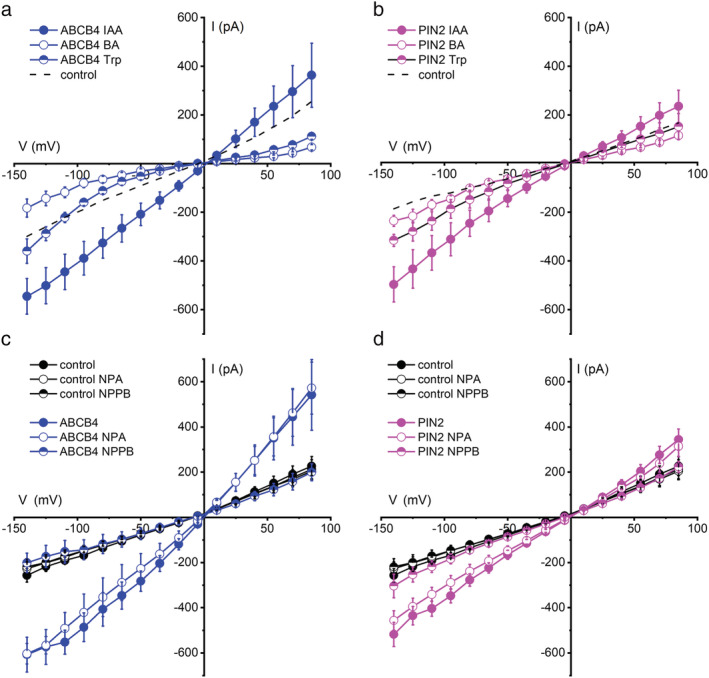
Activation specificity and pharmacology of ABCB4 and PIN2 activity. (a) Neither the indole‐based amino acid Trp nor the aromatic benzoic acid (BA) activates ABCB4 similarly to IAA. The dashed line shows the 0.1 μM IAA ABCB4 baseline copied from Figure 5a. (b) Same as (a) but for PIN2. The dashed line shows the 0.1 μM IAA PIN2 baseline copied from Figure 5B. (c) ABCB4 activity in auxin‐stimulated conditions is blocked by 20 μM NPPB but not 10 μM NPA applied by switching the bath solution. Neither treatment significantly affected the control cell currents. (d) Same as (c) but for PIN2. Plotted is mean current ± SE at each voltage for n = 4 or 6 independent cells for each treatment. The pipette and bath contained 50 mM CsCl. Untreated control cell data are replotted from Figure 5a
FIGURE 7
FIGURE 7
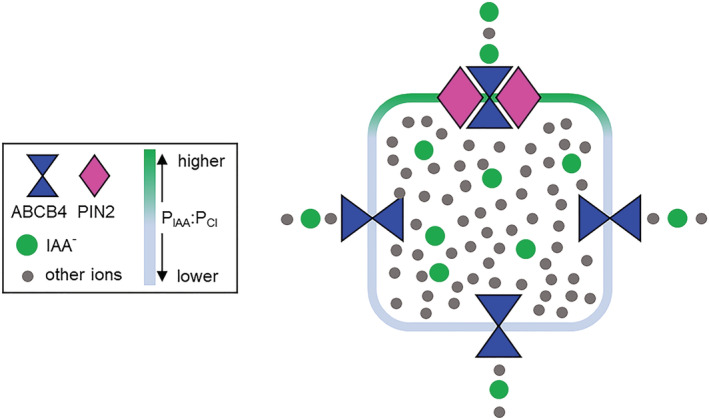
Diagram summarizing how the intrinsic and synergistic properties of ABCB4 and PIN2 measured by patch clamping may produce the twofold asymmetry in P IAA across a cell that results in polar auxin transport through tissues. The diagram shows that ion flux across the end of a cell containing ABCB4 and PIN2 is twofold enriched for IAA compared to faces of the cell that do not have both components. A synergy or co‐action between ABCB4 and PIN2 that enhances selectivity for IAA could explain why the phenomenon of polar auxin transport requires ABCB4 in addition to polarly localized PIN proteins

References

    1. Abas, L. , Benjamins, R. , Malenica, N. , Paciorek, T. , Wiśniewska, J. , Moulinier‐Anzola, J. C. , Sieberer, T. , Friml, J. , & Luschnig, C. (2006). Intracellular trafficking and proteolysis of the Arabidopsis auxin‐efflux facilitator PIN2 are involved in root gravitropism. Nature Cell Biology, 8, 249–256. 10.1038/ncb1369 - DOI - PubMed
    1. Abas, L. , Kolb, M. , Stadlmann, J. , Janacek, D. P. , Lukic, K. , Schwechheimer, C. , Sazanov, L. A. , Mach, L. , Friml, J. , & Hammes, U. Z. (2021). Naphthylphthalamic acid associates with and inhibits PIN auxin transporters. Proceedings of the National Academy of Sciences of the United States of America, 118(1), e2020857118. - PMC - PubMed
    1. Band, L. R. , Wells, D. M. , Fozard, J. A. , Ghetiu, T. , French, A. P. , Pound, M. P. , Wilson, M. H. , Yu, L. , Li, W. , Hijazi, H. I. , Oh, J. , Pearce, S. P. , Perez‐Amador, M. A. , Yun, J. , Kramer, E. , Alonso, J. M. , Godin, C. , Vernoux, T. , Hodgman, T. C. , … Bennett, M. J. (2014). Systems analysis of auxin transport in the Arabidopsis root apex. Plant Cell, 26, 862–875. 10.1105/tpc.113.119495 - DOI - PMC - PubMed
    1. Bayer, E. M. , Smith, R. S. , Mandel, T. , Nakayama, N. , Sauer, M. , Prusinkiewicz, P. , & Kuhlemeier, C. (2009). Integration of transport‐based models for phyllotaxis and midvein formation. Genes & Development, 23, 373–384. 10.1101/gad.497009 - DOI - PMC - PubMed
    1. Bennett, T. , Hines, G. , & Leyser, O. (2014). Canalization: What the flux? Trends in Genetics, 30, 41–48. 10.1016/j.tig.2013.11.001 - DOI - PubMed

LinkOut - more resources