


C-reactive Protein as a Prognostic Marker of 1-Year Mortality after Transcatheter Aortic Valve Implantation in Aortic Stenosis
- PMID: 34817012
- PMCID: PMC8682084
- DOI: 10.36660/abc.20190715
C-reactive Protein as a Prognostic Marker of 1-Year Mortality after Transcatheter Aortic Valve Implantation in Aortic Stenosis
Abstract
Background: C-reactive protein (CRP) is an inflammation biomarker that can be a predictor of adverse events in cardiovascular procedures. Its use in the assessment of long-term prognosis of transcatheter aortic valve implantation (TAVI) is still incipient.
Objective: To evaluate CRP as a prognostic marker in the first year after TAVI in aortic stenosis (AoS).
Methods: CRP was assessed on the first postoperative week in a retrospective cohort of patients with AoS. Pre- and post- CRP levels were correlated with mortality, and predictors of 1-year mortality were investigated. Multivariate Cox regression was performed to identify independent factors of 1-year mortality.
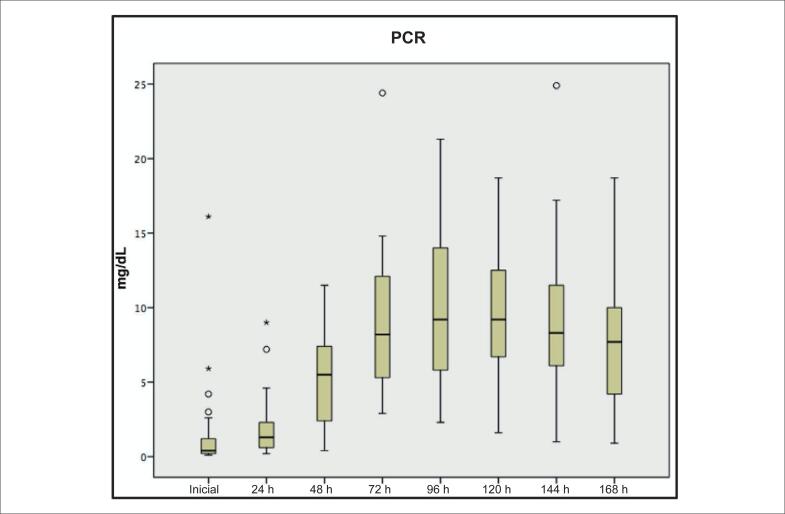
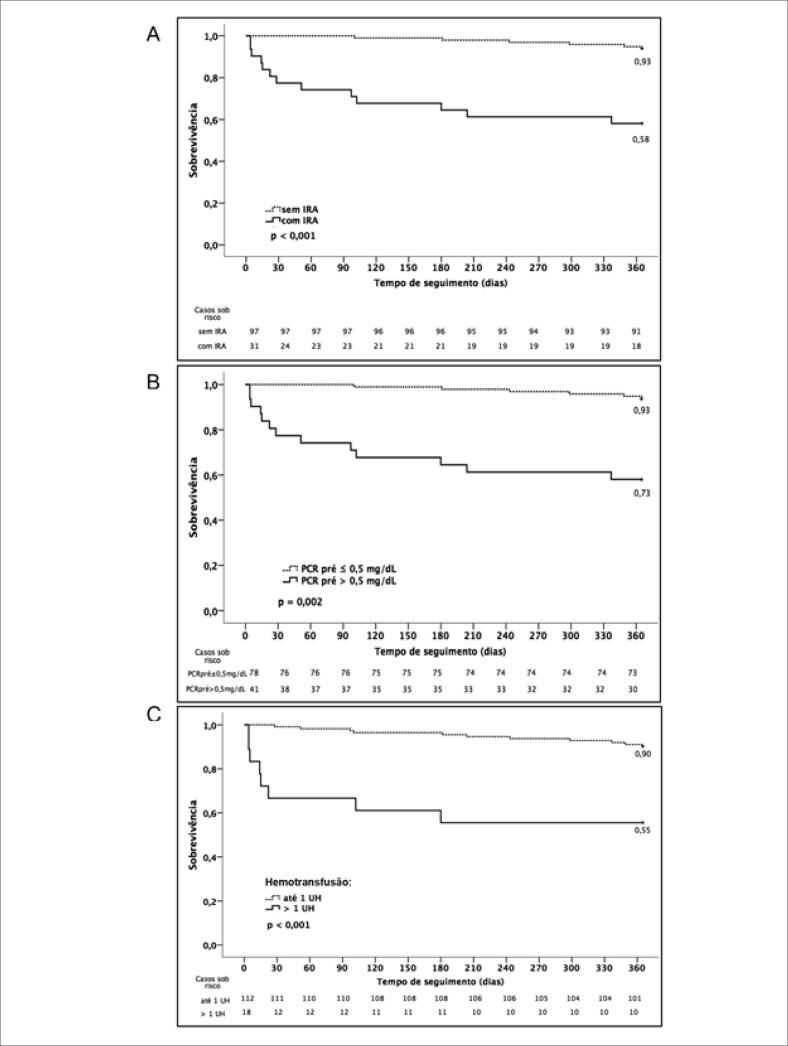
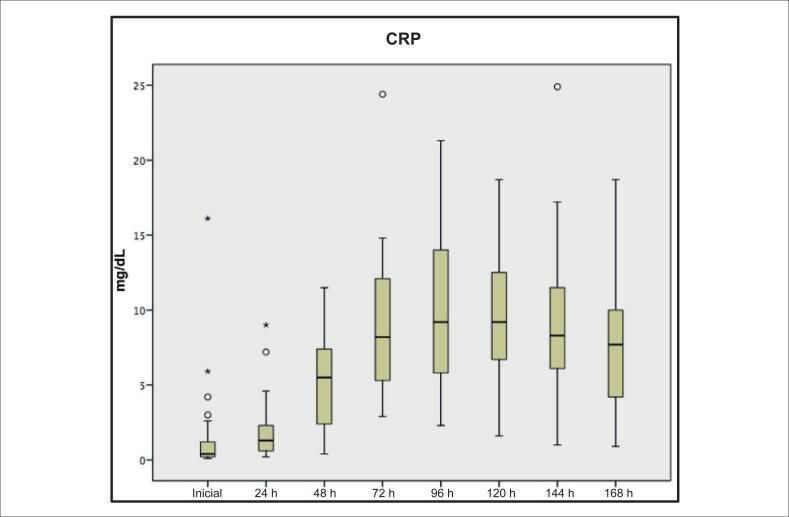
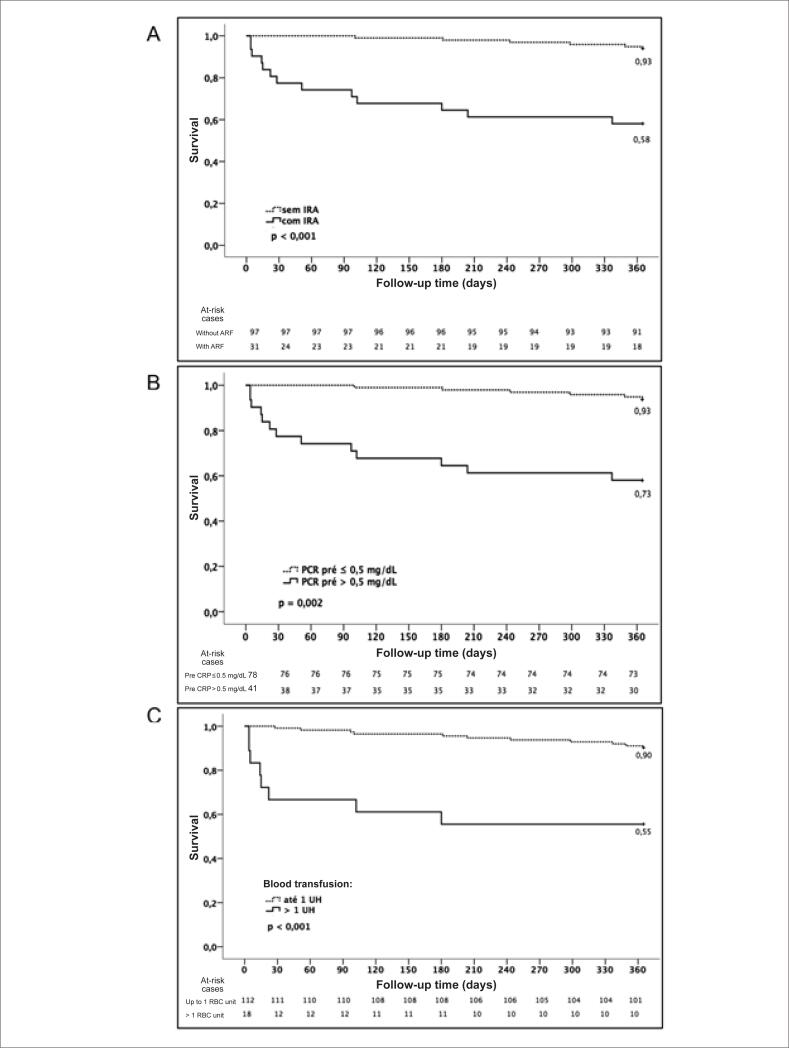
Results: This study evaluated 130 patients who underwent TAVI, with median age of 83 years, and 49% of women. High pre-TAVI CRP (> 0.5 mg/dL) was observed in 34.5% of the cases. Peak CRP was 7.0 (5.3-12.1) mg/dL no quarto dia. The rate of 1-year mortality was 14.5% (n = 19), being greater in the groups with high pre-TAVI CRP (68.8% vs 29.1%; p = 0,004) and with peak CRP ≥ 10.0 mg/dL (64.7% vs 30.8%; p = 0,009). Independent predictors of mortality were acute renal failure (ARF) (hazard ratio [HR] = 7.43; 95% confidence interval [95%CI], 2.1-24.7; p = 0,001), high pre-TAVI CRP (HR 4.15; 95%CI, 1.3-12.9; p = 0.01), and large blood transfusion [HR 4,68; 1,3-16,7; p = 0.02].
Conclusions: High pre-TAVI CRP showed to be an independent predictor of 1-year mortality, as well as the presence of ARF and large blood transfusions.
Fundamento: A proteína C-reativa (PCR) é um biomarcador de inflamação preditor de eventos adversos em procedimentos cardiovasculares. Na avaliação do implante da válvula aórtica transcateter (transcatheter aortic valve implantation, TAVI) em relação ao prognóstico de longo prazo ainda é incipiente.
Objetivo: Avaliar a PCR como marcador prognóstico no primeiro ano pós-TAVI na estenose aórtica (EAo).
Métodos: A PCR foi avaliada na primeira semana do peroperatório numa coorte de casos retrospectiva com EAo. Correlacionou-se a PCR pré- e pós-TAVI com a mortalidade e foram pesquisados fatores preditores de mortalidade em 1 ano. Realizada regressão de Cox multivariada para identificar os preditores independentes de óbito em 1 ano.
Resultados: Estudados 130 pacientes submetidos a TAVI, com mediana de idade de 83 anos, sendo 49% deles do sexo feminino. A PCR pré-TAVI elevada (> 0,5 mg/dL) ocorreu em 34,5% dos casos. O pico de PCR foi 7,0 (5,3-12,1) mg/dL no quarto dia. A mortalidade em 1 ano foi 14,5% (n = 19), sendo maior nos grupos com PCR pré-TAVI elevada (68,8% vs 29,1%; p = 0,004) e pico de PCR ≥ 10,0 mg/dL (64,7% vs 30,8%; p = 0,009). Os fatores preditores independentes de mortalidade foram insuficiência renal aguda (IRA) [razão de risco (RR) = 7,43; intervalo de confiança de 95% (IC95%), 2,1-24,7; p = 0,001], PCR pré-TAVI elevada [RR = 4,15; IC95%, 1,3-12,9; p=0,01] e hemotransfusão volumosa [HR = 4,68; 1,3-16,7; p = 0,02].
Conclusões: A PCR pré-TAVI elevada mostrou-se fator preditor independente de mortalidade no primeiro ano, assim como a ocorrência de IRA e hemotransfusões volumosas.
Conflict of interest statement
Não há conflito com o presente artigo
Figures
Comment in
-
The Role of Inflammation in Post-TAVI Outcomes.Arq Bras Cardiol. 2021 Nov;117(5):1028-1029. doi: 10.36660/abc.20210809. Arq Bras Cardiol. 2021. PMID: 34817013 Free PMC article. English, Portuguese. No abstract available.
References
-
- Brasil. Presidência da República. Secretaria de Direitos Humanos. Secretaria Nacional de Promoção Defesa dos Direitos Humanos. [Internet]. Dados sobre o envelhecimento no Brasil. [acesso em 2016 set. 21]. Disponível em:<http://www.sdh.gov.br/assuntos/pessoa-idosa/dados-estatisticos/Dadossobr...
-
- Franceschi C, Campisi J. Chronic inflammation (inflammaging) and its potential contribution to age-associated diseases. J Gerontol A Biol Sci Med Sci. 2014;69(Suppl 1):S4-9. - PubMed
-
- Otto CM, Kuusisto J, Reichenbach D, Gown A, O’Brien KD. Characterization of the early lesion of ‘degenerative’ valvular aortic stenosis. Histological and immunohistochemical studies. Circulation. 1994;90(2):844-53. - PubMed
-
- Mazzone A, Epistolato MC, De Caterina R, Storti S, Vittorini S, Sbrana S, et al. Neoangiogenesis, T-lymphocyte infiltration, and heat shock protein-60 are biological hallmarks of an immunomediated inflammatory process in end-stagecalcified aortic valve stenosis. J Am Coll Cardiol. 2004;43(9):1670-6. - PubMed
MeSH terms
Substances
LinkOut - more resources
Full Text Sources
Research Materials
Miscellaneous
