Safety Outcomes of Brolucizumab in Neovascular Age-Related Macular Degeneration: Results From the IRIS Registry and Komodo Healthcare Map
- PMID: 34817566
- PMCID: PMC8613703
- DOI: 10.1001/jamaophthalmol.2021.4585
Safety Outcomes of Brolucizumab in Neovascular Age-Related Macular Degeneration: Results From the IRIS Registry and Komodo Healthcare Map
Abstract
Importance: Limited data exist on the real-world safety outcomes of patients with neovascular age-related macular degeneration treated with brolucizumab (Beovu).
Objective: To determine the real-world incidence of intraocular inflammation (IOI), including retinal vasculitis (RV) and/or retinal vascular occlusion (RO), for patients with neovascular age-related macular degeneration who underwent brolucizumab treatment. Additionally, potential risk factors associated with these adverse events were evaluated.
Design, setting, and participants: This cohort study included patients with neovascular age-related macular degeneration in the Intelligent Research in Sight (IRIS) Registry and Komodo Healthcare Map. Patients initiating and receiving 1 or more brolucizumab injections from October 8, 2019, to June 5, 2020, with up to 6 months of follow-up were included.
Intervention: Brolucizumab injections.
Main outcome and measures: Incidence of IOI (including RV) and/or RO and RV and/or RO and risk stratification for the identified risk factors.
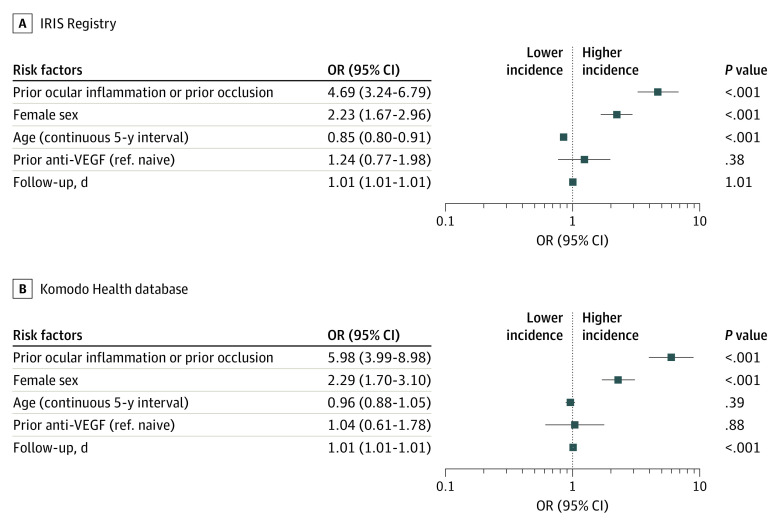
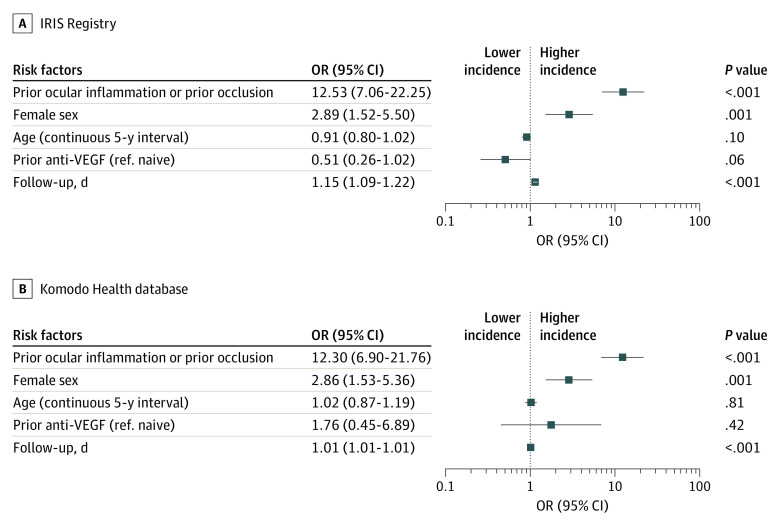
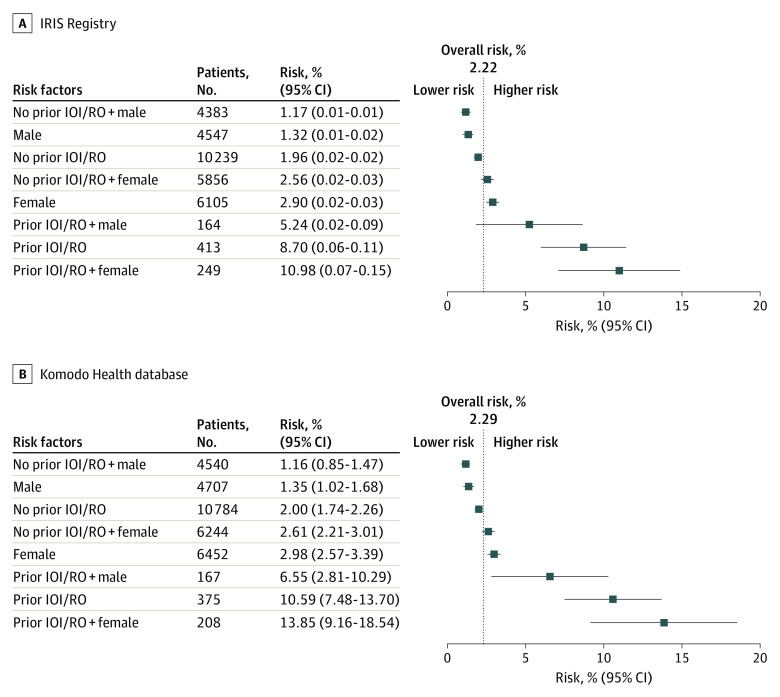
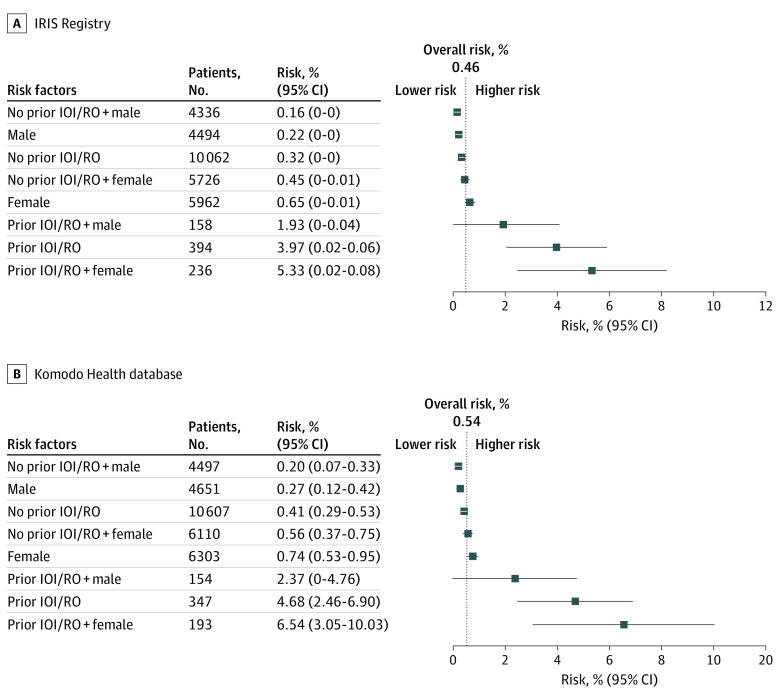
Results: Of 10 654 and 11 161 included eyes (from the IRIS Registry and Komodo Health database, respectively), the median follow-up times were 97 and 95 days. Most eyes switched from another anti-vascular endothelial growth factor agent (9686 of 10 654 [90.9%] and 10 487 of 11 161 [94.0%], respectively), most commonly aflibercept (7160 of 9686 [73.9%] and 7156 of 10 487 [68.2%]), and most were from women (6105 of 10 654 [57.3%] and 6452 of 11 161 [57.8%]). The overall incidence of IOI and/or RO was 2.4% (255 of 10 654 eyes) and 2.4% (268 of 11 161 eyes) for the IRIS and Komodo groups, respectively, and RV and/or RO, 0.6% (59 of 10 654 eyes and 63 of 11 161 eyes), respectively. Patients with a history of IOI and/or RO in the 12 months before brolucizumab initiation had an increased observed risk rate (8.7% [95% CI, 6.0%-11.4%] and 10.6% [95% CI, 7.5%-13.7%]) for an IOI and/or RO event in the 6 months following the first brolucizumab treatment compared with patients without prior IOI and/or RO (2.0% in both data sets). There was an increased estimated incidence rate in women (2.9% [95% CI, 2.5%-3.3%] and 3.0% [95% CI, 2.6%-3.4%]) compared with men (1.3% [95% CI, 1.0%-1.7%] and 1.4% [95% CI, 1.0%-1.7%]), but this risk was not as large as that of a prior IOI and/or RO. Similar findings were observed for patients with RV and/or RO events.
Conclusions and relevance: The incidence rate of IOI and/or RO was approximately 2.4%. Patient eyes with IOI and/or RO in the 12 months prior to first brolucizumab injection had the highest observed risk rate for IOI and/or RO in the early months after the first brolucizumab treatment. However, given study limitations, the identified risk factors cannot be used as predictors of IOI and/or RO events, and causality with brolucizumab cannot be assessed.
Conflict of interest statement
Figures
Comment on
-
Risk Factors for Intraocular Inflammation After Brolucizumab Treatment.JAMA Ophthalmol. 2022 Jan 1;140(1):28-29. doi: 10.1001/jamaophthalmol.2021.4586. JAMA Ophthalmol. 2022. PMID: 34817570 No abstract available.
References
-
- Centers for Disease Control and Prevention . Common eye disorders. Updated June 3, 2020. Accessed October 15, 2020. https://www.cdc.gov/visionhealth/basics/ced/index.html
-
- Novartis Pharmaceuticals Corporation . Beovu package insert. Published 2020.
Publication types
MeSH terms
Substances
LinkOut - more resources
Full Text Sources
Other Literature Sources
Medical
Research Materials