The patient's medication access journey: a conceptual framework focused beyond adherence
- PMID: 34818095
- PMCID: PMC10391227
- DOI: 10.18553/jmcp.2021.27.12.1627
The patient's medication access journey: a conceptual framework focused beyond adherence
Abstract
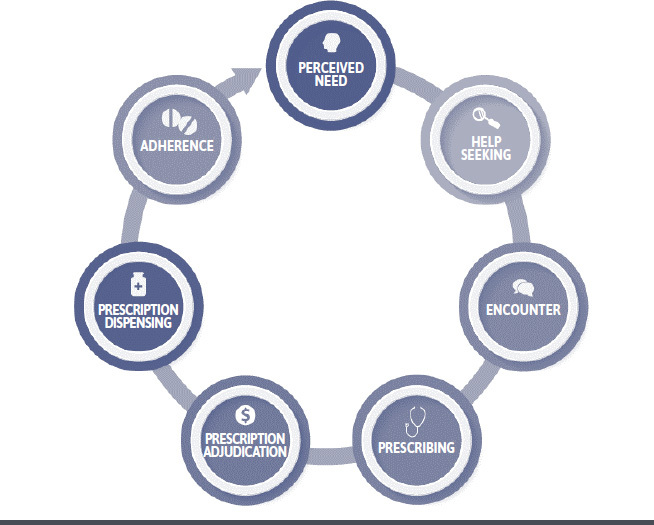
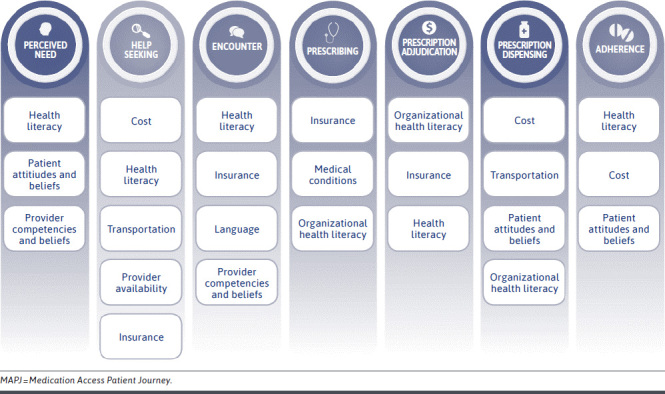
BACKGROUND: It is well known that medication accessibility reduces morbidity and mortality and increases health-related quality of life; however, despite efforts to improve health care access, many Americans still face challenges in accessing medications. Several health care access and utilization conceptual frameworks have been created and used for decades to illustrate key relationships and interdependencies between elements of the system. However, none of these frameworks have focused exclusively on medication access and associated factors. Medication access is a complex, multidimensional issue that must consider not only patient-specific challenges, but also health system limitations, among others. A better understanding of medication access, beyond the proxy marker of adherence, is needed to identify opportunities to improve accessibility. OBJECTIVE: To develop a conceptual framework that defines a patient's medication access journey and characterizes barriers frequently encountered while seeking medication access. METHODS: A multistakeholder roundtable composed of 15 experts from across the health care continuum was convened in 2018 by the Pharmacy Quality Alliance to develop a conceptual framework for medication access. The roundtable participants were convened through in-person and telephonic meetings. To inform their work, 2 literature reviews and an environmental scan were conducted to identify medication access barriers, interventions affecting medication access, and medication access quality measures. RESULTS: The resulting framework included 7 nodes that represent the major access points encountered by patients when attempting to access medications: perceived need, help seeking, encounter, prescribing, prescription adjudication, prescription dispensing, and adherence. Also, 18 barriers were identified. Patient health literacy, cost, insurance, and organizational health literacy were predominant barriers across multiple nodes. CONCLUSIONS: The framework that was developed provides a patient-focused, holistic view of medication access, incorporating access nodes and corresponding barriers. It also provides a structure to consider key opportunities for interventions and measurement to address medication access challenges. DISCLOSURES: This study was conducted with grant support from the National Pharmaceutical Council, which served as a collaborator in the study. Westrich is employed by the National Pharmaceutical Council. Nelson is employed by the Pharmacy Quality Alliance, which was contracted to conduct this study. Pickering, Campbell, and Holland were employed by the Pharmacy Quality Alliance at the time of this study. This research was presented as a professional poster at the American Public Health Association Annual Meeting in October 2019, Philadelphia, PA.
Conflict of interest statement
This study was conducted with grant support from the National Pharmaceutical Council, which served as a collaborator in the study. Westrich is employed by the National Pharmaceutical Council. Nelson is employed by the Pharmacy Quality Alliance, which was contracted to conduct this study. Pickering, Campbell, and Holland were employed by the Pharmacy Quality Alliance at the time of this study.
This research was presented as a professional poster at the American Public Health Association Annual Meeting in October 2019, Philadelphia, PA.
Figures
References
-
- Patient Protection and Affordable Care Act. HR 3590, 111th Cong (2009-2010). Accessed February 14, 2020. https://www.congress.gov/bill/111th-congress/house-bill/3590
-
- Agency for Healthcare Research and Quality. About the National Quality Strategy. Last reviewed March 2017. Accessed December 4, 2019. https://www.ahrq.gov/workingforquality/about/index.html
-
- Kirzinger A, Lopes L, Wu B, Brodie M. KFF Health Tracking Poll – February 2019: Prescription Drugs. Kaiser Family Foundation. March 1, 2019. Accessed October 25, 2019. https://www.kff.org/health-costs/poll-finding/kff-health-tracking-poll-f...
-
- Shulman NB, Levinson RM, Dever A, Porter RS, Owen SL, Hall WD. Impact of cost problems on morbidity in a hypertensive population. Am J Prev Med. 1991;7(6):374-78. - PubMed
-
- Spiker EC, Giannamore MR, Nahata MC. Medication use patterns and health outcomes among patients using a subsidized prescription drug program. J Am Pharm Assoc (2003). 2005;45(6):714-19. - PubMed
MeSH terms
LinkOut - more resources
Full Text Sources