


Enterovirus D68-Associated Acute Respiratory Illness ─ New Vaccine Surveillance Network, United States, July-November 2018-2020
- PMID: 34818320
- PMCID: PMC8612514
- DOI: 10.15585/mmwr.mm7047a1
Enterovirus D68-Associated Acute Respiratory Illness ─ New Vaccine Surveillance Network, United States, July-November 2018-2020
Abstract
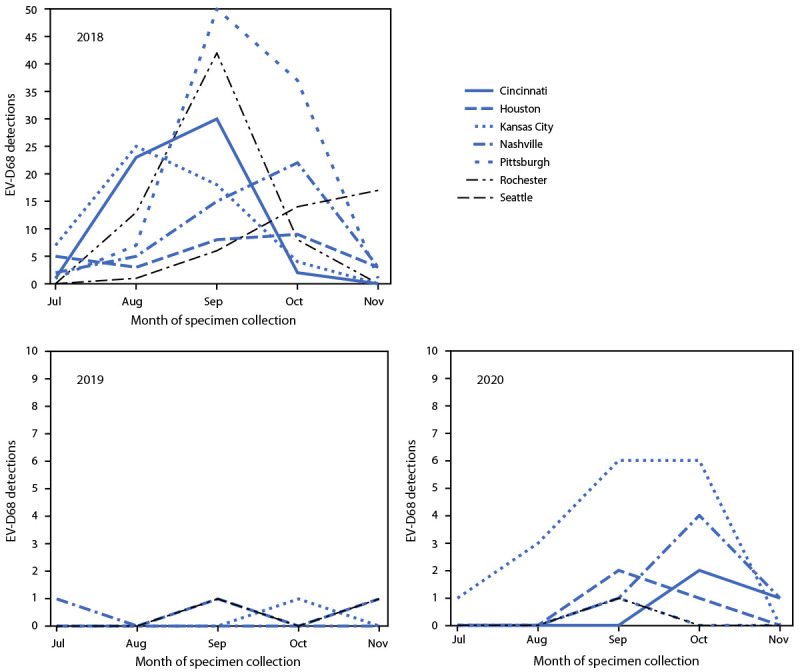
Enterovirus D68 (EV-D68) is associated with a broad spectrum of illnesses, including mild to severe acute respiratory illness (ARI) and acute flaccid myelitis (AFM). Enteroviruses, including EV-D68, are typically detected in the United States during late summer through fall, with year-to-year fluctuations. Before 2014, EV-D68 was infrequently reported to CDC (1). However, numbers of EV-D68 detection have increased in recent years, with a biennial pattern observed during 2014-2018 in the United States, after the expansion of surveillance and wider availability of molecular testing. In 2014, a national outbreak of EV-D68 was detected (2). EV-D68 was also reported in 2016 via local (3) and passive national (4) surveillance. EV-D68 detections were limited in 2017, but substantial circulation was observed in 2018 (5). To assess recent levels of circulation, EV-D68 detections in respiratory specimens collected from patients aged <18 years* with ARI evaluated in emergency departments (EDs) or admitted to one of seven U.S. medical centers† within the New Vaccine Surveillance Network (NVSN) were summarized. This report provides a provisional description of EV-D68 detections during July-November in 2018, 2019 and 2020, and describes the demographic and clinical characteristics of these patients. In 2018, a total of 382 EV-D68 detections in respiratory specimens obtained from patients aged <18 years with ARI were reported by NVSN; the number decreased to six detections in 2019 and 30 in 2020. Among patients aged <18 years with EV-D68 in 2020, 22 (73%) were non-Hispanic Black (Black) persons. EV-D68 detections in 2020 were lower than anticipated based on the biennial circulation pattern observed since 2014. The circulation of EV-D68 in 2020 might have been limited by widespread COVID-19 mitigation measures; how these changes in behavior might influence the timing and levels of circulation in future years is unknown. Ongoing monitoring of EV-D68 detections is warranted for preparedness for EV-D68-associated ARI and AFM.
Conflict of interest statement
All authors have completed and submitted the International Committee of Medical Journal Editors form for disclosure of potential conflicts of interest. Janet A. Englund reports institutional research support from AstraZeneca, Merck & Co., Pfizer Inc., and GlaxoSmithKline plc; consulting fees from Sanofi Pasteur, Meissa Vaccines Incorporated, AstraZeneca, and Teva Pharmaceutical Industries Ltd.; and unpaid membership on the publication committees for the Infectious Diseases Society of America and the Pediatric Infectious Diseases Society. Christopher J. Harrison reports institutional grant support from GlaxoSmithKline plc and Pfizer Inc., for vaccine studies and from Merck & Co. for a study of antibiotic resistance, and royalties from UpToDate for editing chapter on rotavirus. Natasha B. Halasa reports institutional support from Sanofi Pasteur and Quidel Corporation. Geoffrey A. Weinberg reports honoraria as a consultant to ReViral Ltd, and as an author of textbook chapters in the Merck Manual. No other potential conflicts of interest were disclosed.
Figures
References
-
- Khetsuriani N, Lamonte-Fowlkes A, Oberst S, Pallansch MA; CDC. Enterovirus surveillance—United States, 1970–2005. MMWR Surveill Summ 2006;55:1–20. - PubMed
MeSH terms
Grants and funding
LinkOut - more resources
Full Text Sources
Miscellaneous
